What this guide covers
Timber farming in India is sold, for the most part, by the people selling the saplings. The pitch runs to a species name, a maturity year and a price per tree, with nothing said about thinning, felling permission, or who actually turns up to buy the wood. This guide compares the four species Indian growers ask about most, using measured yields and Karnataka’s own rules rather than nursery arithmetic.
INSTANT ANSWER
For most Indian growers the realistic shortlist is melia dubia on a 6 to 12 year horizon, teak on 15 to 20 years or longer, and silver oak as a boundary and support tree rather than a timber crop in its own right. Mahogany is marketed hard but has no Indian research yield data behind it. Which species fits you depends on your horizon, your rainfall and soil, and whether your land sits in a notified Karnataka taluka where felling still needs permission.
Fast growing timber trees in India compared – rotation, permission and buyer
| Species | Typical rotation | Wood use and who buys | Felling permission in Karnataka (Act of 1976) | Transit pass in Karnataka (7 Dec 2016 notification) | Best role on a farm | The claim to be careful of |
|---|---|---|---|---|---|---|
| Melia dubia (also called Malabar neem) | 6 to 12 years for a good economic yield | Plywood, pulpwood and timber industries. Plywood mills rate it the most preferred species | On the exempt-species list. No felling permission needed | Named as Melia among the 42 exempt species, private land only | Block plantation, roughly 300 to 400 trees per acre | Per-year income and per-acre biomass figures quoted by sellers. We do not repeat them |
| Teak, Tectona grandis (sagwan) | 15 to 20 years for farm timber. Prime quality takes at least 50 to 60 years | Furniture and construction. Sawmills, government depots and agents. India imports 60 per cent of its teak logs | Not on the exempt list. Permission applies in notified areas | Not among the named exempt species. A transit pass applies | Long-horizon block plantation, only with a thinning plan | Rs 50,000 to 1,00,000 a tree in 20 years, and 1 cubic metre a tree in 8 to 12 years. Measured plots gave 0.15 to 0.36 cubic metres (2024) |
| Silver oak, Grevillea robusta | 10 to 15 years in woodlots at 800 to 1,200 trees per hectare | Medium-strength timber for furniture, packing cases, flooring, panelling and plywood | On the exempt-species list. No felling permission needed | Named in the exempt list for private land | Single-row boundary and support tree | Being sold as a main timber crop. The same factsheet calls it not a high priority plantation timber species, and it does poorly above 23 degrees Celsius mean annual temperature |
| Mahogany, Swietenia macrophylla | 12 to 15 years claimed, and 15 to 20 years claimed in the same article. Little Indian research data | Furniture and veneer. We found no Indian farm-gate buyer data | No named exemption found. Assume permission applies and check | Not among the named exempt species | Unproven in Indian conditions. Treat as experimental | Retirement-fund framing. Neotropical populations are also controlled under CITES Appendix II from 15 November 2003 |
What is timber tree farming in India, and who buys the wood
Timber tree farming in India is the growing of trees on private farmland for their wood, and it is also known as farm forestry or agroforestry. The buyers are plywood mills, pulp and paper mills, sawmills, government timber depots and the agents who feed them.
Almost all of the country’s commercial wood now comes from outside the forests. TERI’s policy brief of 11 February 2021 puts more than 80 per cent of India’s timber demand as met from the agroforestry sector. A farm forestry analysis published on 20 November 2012 estimated that private lands supply 85 to 90 per cent of India’s industrial wood.
That shift was policy rather than accident. The Forest Conservation Act, 1980 and the National Forest Policy, 1988 ended green felling in government forests, which pushed timber demand on to private land. India then adopted a National Agroforestry Policy in 2014, and the Sub-Mission on Agroforestry that followed in 2016 to 2017 runs only in states that have liberalised their timber transit rules.
Knowing the buyer matters more than most sellers admit, because each one wants a different tree. A plywood mill wants volume at a girth it can peel, within trucking distance. A pulp mill wants short-rotation wood on a repeatable cycle: one paper-mill programme in Andhra Pradesh ran casuarina on a four-year rotation. A sawmill or depot wants large, straight, clean logs, which is the teak case and the slowest of the three. If none of those sits within reach of your land, the specific question is academic.
Timber is one option among several for farmland, and it behaves very differently from fruit and plantation crops: see how timber compares with fruit and plantation crops.
Which timber trees are worth planting in India
Melia dubia is worth planting on a 6 to 12 year horizon, teak on 15 to 20 years or longer, and silver oak along boundaries rather than in blocks. Mahogany is not yet backed by Indian yield research, so treat it as experimental.
Sort by horizon first, because the horizon is the one input you cannot change after planting.
- Six to twelve years: melia dubia. The only one of the four that finishes inside a decade on current Indian research, with the clearest buyer and no felling permission needed in Karnataka.
- Fifteen to twenty years and beyond: teak. The recognised name and the slower bet, and the only one of the four that carries both a felling permission and a transit requirement in Karnataka.
- A supporting role rather than a rotation: silver oak. A boundary, windbreak and support tree, with timber as a secondary benefit at 10 to 15 years.
- Unproven: mahogany. The claims are confident and the Indian evidence is thin.
Eucalyptus, poplar and casuarina are also grown as farm timber in India and are named in the central felling and transit guidelines, but they sit outside this guide. The species most growers start with, and the one with the shortest wait, is melia dubia.
Is melia dubia really as fast as nurseries say
Close to it, with a condition attached. ICAR-CAFRI puts the cultivation period at 6 to 12 years for a good economic yield, the fastest of the four species here, but that figure assumes the trees are tended rather than planted and left.
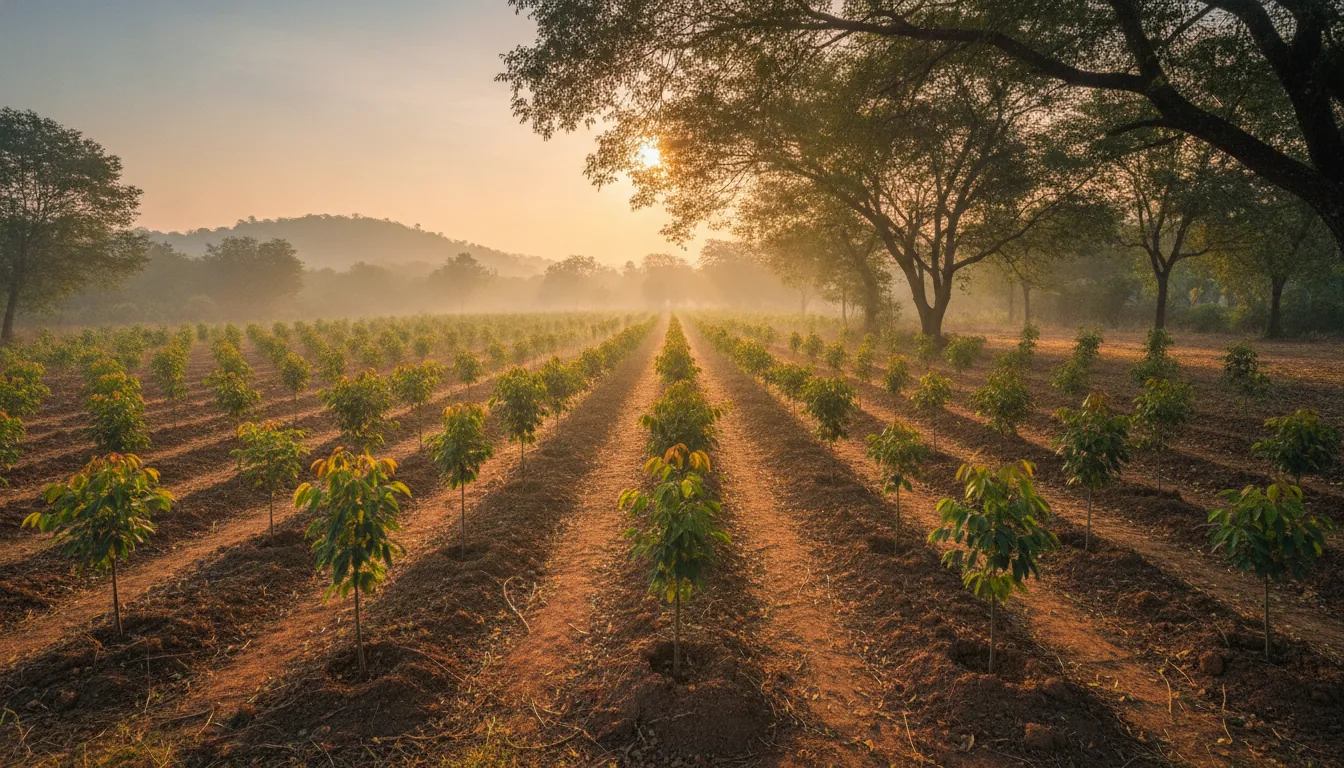
Melia dubia, also called Malabar neem, is planted in blocks of roughly 300 to 400 trees per acre, and demand comes from the pulpwood, plywood and timber industries. TNAU’s forestry reference calls it the most preferred species for the plywood industry and places it on sandy loam, red and lateritic soils with 800 mm or more of annual rainfall.
The rainfall picture needs care, because the two sources pull in different directions. ICAR notes that it grows in low rainfall. TNAU gives 800 mm as the working figure. The honest reading is that melia dubia survives in low rainfall but establishes best with water and attention, and the first 6 to 8 years are when that attention decides the outcome.
We have deliberately left out the per-year income and per-acre biomass numbers that appear in some of the source material. They are projections rather than measured farm results, and this is not a page that puts a figure on what your land will earn.
For spacing, irrigation and the harvest window in detail, read our melia dubia growth and yield guide .
Teak is the species where that gap between the projection and the measured result has been documented most clearly.
What does a teak tree actually yield after 20 years
Far less than the nursery promised. Measured Indian plantations gave 0.15 to 0.36 cubic metres of timber per tree after 25 to 30 years, against a nursery claim of 1 cubic metre per tree in 8 to 12 years.
This is the clearest oversell in Indian farm forestry, and it is on the record. Down To Earth reported on 7 February 2024 that nurseries sold teak seedlings at Rs 400 to 2,500 a plant on the promise of Rs 50,000 to 1,00,000 per tree after 20 years, with tissue-culture material said to be harvestable in 8 to 12 years at 1 cubic metre per tree.
CLAIM VERSUS MEASURED – TEAK
| The nursery claim | The measured result |
|---|---|
| Harvestable in 8 to 12 years | The measured plots ran 25 to 30 years |
| 1 cubic metre of timber per tree | 0.26 to 0.36 cubic metres per tree at 25 to 30 years |
| 1 cubic metre of timber per tree | 0.15 to 0.30 cubic metres per tree at 25 years |
| Rs 50,000 to 1,00,000 per tree at 20 years | One Maharashtra sawmill paid Rs 5 to 10 per kg of dried wood, roughly Rs 500 to 1,500 a tree |
| Low maintenance | A thinned, well-managed agroforestry plot reached 0.96 cubic metres per tree at 25 years in a 2021 study |
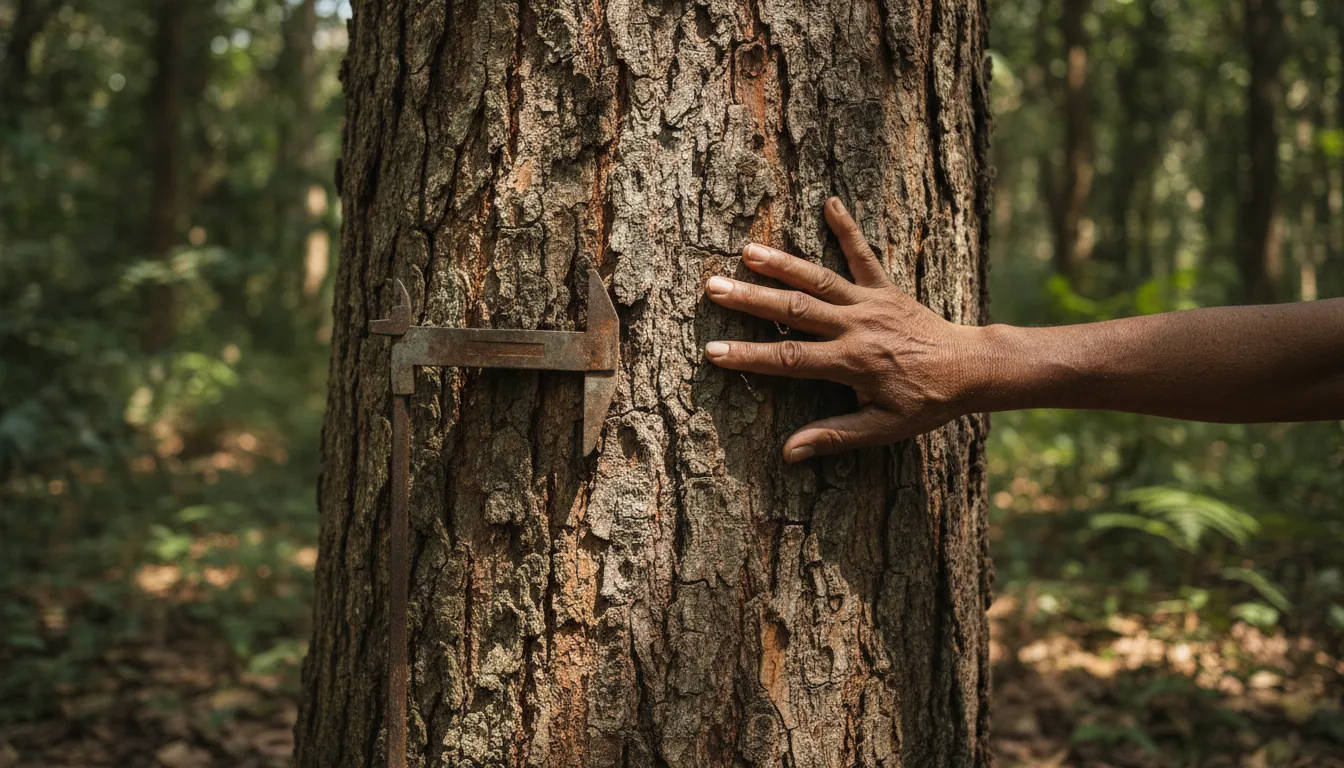
The gap is management, and specifically thinning. The same report names closer spacing without prescribed thinning practices as the main cause of failure, and records unthinned stands at 15 years with girths of only 10 to 15 cm. A stem that thin has no sawlog in it at any age. The author’s working figure for a properly managed plot is about 0.25 to 0.30 cubic metres per tree at 25 years, and the well-thinned 2021 plot shows the ceiling when the work is actually done. For scale, Indian forest teak averages 2 to 5 cubic metres per hectare against a potential of around 10.
So when the search results ask what a 20-year-old sagwan tree sells for, the volume question has to come first. A price per cubic metre means nothing until you know how many cubic metres are standing in the tree.
For the full picture on rotation, thinning and grade, read what teak really returns over 20 years.
Is silver oak a timber crop or a boundary tree
A boundary tree first. A farm-forestry factsheet describes Grevillea robusta as not a high priority plantation timber species, and notes that it is most commonly planted as a single-row boundary tree.
The timber itself is useful rather than high-grade: medium strength, used for furniture, packing cases, flooring, panelling and plywood. Where it is grown as a woodlot, the same factsheet gives rotations of 10 to 15 years at 800 to 1,200 trees per hectare. Two cautions on that source: it is nearly three decades old and it is not India-specific, so use it for the role the tree plays rather than for a yield figure.
One hard constraint is temperature. Silver oak performs poorly where the mean annual temperature runs above 23 degrees Celsius, which rules out a good deal of the plains and makes it a tree for cooler, higher ground.
Its practical advantage in Karnataka is paperwork. Silver oak sits on the exempt-species list under the Karnataka Preservation of Trees Act, 1976, so felling permission is not required, and it is named in the transit notification of 7 December 2016 for private land. For a grower who wants trees on a boundary without opening a permission file, that counts for a lot.
See silver oak growth rate and farm value for the planting detail.
Is mahogany worth planting in India
On current evidence, not yet. The yield claims circulating for Indian mahogany are inconsistent, and we found no Indian research data to test them against.
The claim is that Swietenia macrophylla reaches full maturity in 12 to 15 years. The same article that makes that claim later gives 15 to 20 years for timber yield. An article that cannot hold one figure for the length of its own argument is not a basis for a 15-year commitment of your land.
We looked for Indian research yield data on mahogany and found none. That is the finding, and we are not going to cover it over with a number borrowed from somewhere else.
Two further points a grower should know. Mahogany has no named exemption under the Karnataka Preservation of Trees Act, 1976 and is not among the species named in the transit notification of 7 December 2016, so assume both felling permission and a transit pass apply until your local forest office says otherwise. Separately, from 15 November 2003 logs, sawn wood, veneer sheets and plywood from neotropical populations of the species have been controlled under CITES Appendix II. That guidance says nothing about plantation timber grown outside the native range, so the export position for Indian-grown mahogany is worth checking before you plant for that market.
The verdict is unproven rather than unsuitable, and the case either way is set out in whether mahogany is worth planting in India.
Where does sandalwood fit
Sandalwood is a separate decision, not a fifth option in this comparison. It has its own legal regime, its own host-tree requirement and its own market, and none of the permission positions set out on this page transfer to it.
If sandalwood is what you are actually weighing up, start with the complete sandalwood farming guide and read sandalwood ownership and permission rules before anything else, because the rules there are nothing like the ones for teak or melia dubia.
Do you need permission to cut and transport timber in Karnataka
In many places yes, and it depends on the species and on where your land sits. Under the Karnataka Preservation of Trees Act, 1976, felling needs Karnataka Forest Department permission in notified rural areas covering 9 districts, 47 talukas and 65 municipal areas.
- Felling: The Act works through a Tree Officer and applies in notified areas rather than across the whole state. Within those areas there is a family-use exemption: in a calendar year a grower may take up to 2.8 cubic metres of timber, 100 poles, 100 bamboo and 5 tons of firewood without permission. That covers household use, not a harvest.
- The exempt-species list is where the four species separate: Silver oak and Melia dubia are on it, so they need no felling permission. Teak is not on it. Mahogany is not named either.
- Transport: Chapter XVI of the Karnataka Forest Rules, 1969 requires a Transit Pass to move timber and other forest produce into, out of or within the state. A notification dated 7 December 2016 under Rule 144(1) excluded 42 species from that requirement, up from 26 on the earlier list, and the relaxation applies only to private lands. The named species include Eucalyptus, Silver Oak, Casuarina, Acacia hybrid, Acacia mangium and Melia. Teak and mahogany are not among the species named in the reporting of that notification.
- The two permissions are separate: This is where growers come unstuck. The 2016 transit relaxation does not remove the felling requirement. Where the Act applies, you still need the Tree Officer’s permission to cut, even for a species you can then transport freely.
- The central guidelines are not state law: The Ministry of Environment, Forest and Climate Change issued guidelines on 18 November 2014 asking states to exempt farm-grown species from felling and transit permits, naming Teak, Silver Oak, Melia dubia, Eucalyptus, Casuarina and Poplar, with teak exempt only where it does not occur in natural forests. Mahogany is not mentioned. Treat that document as a recommendation to states: the Vidhi review of August 2021 found no confirmation that Karnataka had adopted the teak exemption.
- What to do about it: The list of notified districts and talukas is not published in the sources we worked from, so do not assume your land falls outside it. Before you buy saplings, take your survey number to the Range Forest Office that covers your land and get the position for your species in writing. Doing that costs a morning. Finding out at harvest costs the harvest.
KARNATAKA PERMISSION SUMMARY, BY SPECIES
| Species | Position in Karnataka, as at the sources dated here |
|---|---|
| Melia dubia | No felling permission under the Act of 1976. Named as Melia in the transit notification of 7 December 2016, private land only |
| Silver oak | No felling permission under the Act of 1976. Named in the transit notification of 7 December 2016, private land only |
| Teak | Not on the exempt list, so felling permission applies in notified areas. Not among the named transit-exempt species, so a transit pass applies |
| Mahogany | No named exemption found in either list. Assume both apply and confirm with the Range Forest Office |
This also settles two questions the search results keep raising. Growing teak in India is legal. What is regulated is cutting it and moving it, and that regulation is what people are describing when they call teak illegal.
Once the permission position is clear, the next question is the one about money, and specifically about the wait.
How long until timber pays, and how do you get through the wait
Timber pays once, at the end of the rotation: about 6 to 12 years for melia dubia and 15 to 20 years or more for teak. Nothing arrives in between unless you plant something else alongside the trees.
That single payment at the end is the whole financial shape of timber, and it is the opposite of a quick return. Anyone selling it as a fast financial product is selling something other than timber.
We are not going to put a figure on what your trees will earn. The outcome turns on four things: the rotation you can genuinely wait out, the quality that thinning and protection deliver, your felling and transit position, and whether a buyer sits within reach at harvest. Change any one of those and the arithmetic changes with it.
Intercropping is how growers bridge the gap. ICAR’s work on melia dubia notes that its deep roots and thin crown leave room for crops underneath, which is why it appears in intercropping systems rather than as a monoculture. The early years suit short crops and the window narrows as the trees close in, so planning the intercrop at planting rather than afterwards is the difference between income during the wait and a decade of nothing.
The wait is also where most timber plans come apart, and the reasons are well documented.
Why do so many timber plantations fail
Management, not species choice. The recorded causes are close spacing without the prescribed thinning, pruning that injures the trunk, mislabelled planting stock, and a distress sale at the end to whoever happens to be buying.
- Thinning is the big one: Down To Earth’s review of 7 February 2024 names closer spacing without prescribed thinning as the main cause of poor teak plantations, and records unthinned stands at 15 years with girths of only 10 to 15 cm. Thinning feels like destroying your own crop, which is exactly why it does not get done.
- Bad pruning does its own damage: Stripping leaves from the bole causes injuries, galls and knots, and knots are what take a log out of the sawlog grade.
- Planting stock is the quiet failure: Material sold under labels such as Burma teak is often not what it claims, and the grower finds out 15 years later. The same review recommends certified nursery stock and a complete package covering cultivation, thinning and pruning rather than saplings on their own.
- There is no guaranteed floor price: India has no national minimum support price that guarantees a floor for farm timber. TERI’s brief of 11 February 2021 lists an unregulated pricing regime, transit and felling regulations among the sector’s problems, and proposes a method for setting minimum support prices for trees grown outside forests. Haryana introduced an MSP for short-rotation timber, but it remains equal to or below the market rate.
- Growers who need cash sell badly: Private sawmills and middlemen are often the only bidder, and farmers who need money end up selling to agents at a distress price. One Maharashtra sawmill paid Rs 5 to 10 per kg of dried wood, about Rs 500 to 1,500 a tree. This has happened at scale once already: the timber market crashed in the early 1990s and a large number of plantations failed on poor management and weak market links.
- Two practical risks round it off: High-value standing timber is a theft target, which makes fencing and watching part of the plan rather than an afterthought. And melia dubia needs water through its establishment years, so borewell and irrigation reliability belongs in the plan from the start.
Every item on that list is something a person has to do, on the ground, repeatedly, for the whole rotation. Which is why the species choice matters less than it looks, and the choice about care matters more.
How do you choose the right timber tree for your land
Work six checks in order: your horizon, your rainfall and soil, the temperature ceiling for silver oak, whether your area is notified under the Act of 1976, whether a mill or depot is within reach, and who will thin and protect the trees.
- Your horizon: Decide the longest wait you can genuinely sit through, and shortlist on that alone. Six to twelve years points to melia dubia. Fifteen to twenty years or more points to teak.
- Rainfall and soil: Melia dubia wants sandy loam, red or lateritic soil and 800 mm or more of rainfall to establish well, even though it survives on less.
- Temperature, for silver oak only: Above a 23 degrees Celsius mean annual temperature it performs poorly, so check your district before planting it as anything more than a boundary tree.
- Your permission position: Find out whether your taluka is notified under the Karnataka Preservation of Trees Act, 1976, then check your species against the exempt list and the transit list of 7 December 2016. Silver oak and Melia dubia are clear on both. Teak is on neither.
- A buyer within reach: Name the plywood mill, pulp mill, sawmill or depot you expect to sell to, and the trucking distance to it. If you cannot name one, treat the species choice as unresolved.
- Who does the work: Thinning, pruning, protection and watching, every year, for the whole rotation. If the answer is that you will drive down at weekends, be honest about what year 11 looks like.
Who will look after the trees for the next 20 years
Timber is a 6 to 20 year decision depending on the species, and it is not really a decision about the species. Every number on this page turns on something being done on the ground: the thinning in year 5 and again in year 10, the pruning done properly, the fence and the watching, the irrigation through establishment, the harvest sold to a named buyer rather than to whoever turns up. Land that sits unattended for a decade does not produce timber. It produces thin stems and a disappointing sale.
That is the problem managed farmland is built to solve. Every Hasiru project is built around a distinct lived theme, not generic plots with a clubhouse: we sell a place with an identity, managed for life after the sale. Ongoing management is a contracted service, not a one-time sale. A Maintenance Agreement is executed between Hasiru and the buyer, under which Hasiru undertakes the management and maintenance of the farmland, and our in-house Hasiru Care team works on the ground at our projects. Every buyer receives individual ownership of their farmland through a registered Sale Deed executed in their own name, and the agricultural character of the land is retained. We have been operating since 2021, with 300+ acres delivered and 250+ families.
We do not lead with speculative returns, and nothing on this page is a projection of what your trees will earn. What we will say is that the care problem is real, it runs for the whole rotation, and it is the thing most timber plans leave blank.
If that is the part you want solved, start with managed farmland with Hasiru Farms, read how Hasiru Care looks after your trees year-round , and see farmland along the Kanakapura corridor or the Parva project.
Frequently asked questions
What is timber farming also known as?
Timber farming is also known as farm forestry, and it sits within agroforestry when trees are grown alongside crops. All three terms describe growing trees for wood on private land rather than in state forests.
Which timber tree grows fastest in India?
Of the four species compared here, melia dubia is the fastest. ICAR-CAFRI puts its cultivation period at 6 to 12 years for a good economic yield, against 15 to 20 years or more for teak.
Is it legal to grow teak in India?
Yes. Growing teak on private land is legal. What is regulated is felling and transport. In Karnataka teak is not on the exempt-species list under the Act of 1976, so felling permission applies in notified areas, and a transit pass is needed to move the timber.
Do I need permission to cut silver oak in Karnataka?
Silver oak is on the exempt-species list under the Karnataka Preservation of Trees Act, 1976, so felling permission is not required, and it is named in the transit notification of 7 December 2016 for private land. Confirm your own position with the Range Forest Office before you fell, because notified areas and species lists change.
Is timber farming profitable in India?
It depends on four things and nobody can promise it: the rotation you can wait out, the quality that thinning and protection deliver, your felling and transit position, and whether a buyer is within reach at harvest. The measured yield data on this page is a sounder starting point than any per-tree income figure.
Which wood is very costly in India?
Teak is the costliest of the farm-grown timbers compared here. Government depots sold teak at Rs 30,000 to 60,000 per cubic metre, and market rates ran Rs 700 to 4,000 per cubic foot depending on grade. Both are 2024 figures from Down To Earth. Sandalwood is costlier still and is a separate subject with its own legal regime.
Who looks after timber trees if I do not live near my land?
On a Hasiru farmland plot, Hasiru Care does. A Maintenance Agreement is executed between Hasiru and the buyer, under which Hasiru undertakes the management and maintenance of the farmland, and Hasiru Care has on-ground presence at our projects. Ongoing management is a contracted service, not a one-time sale.