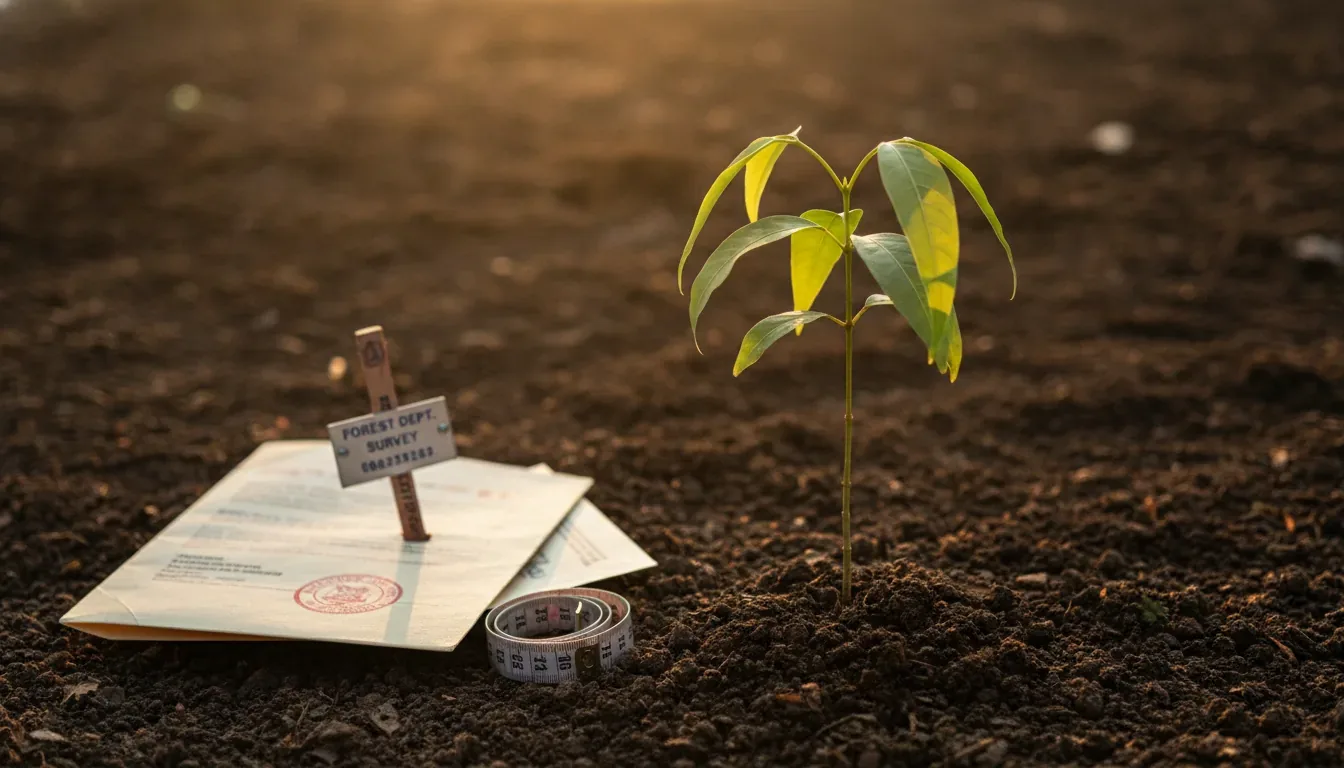
Many people believe sandalwood is banned in India and that the forest department will seize any tree you grow. That belief is out of date. This page gives you the straight legal position: what you can do, what is regulated, and who actually pays you when the wood is sold.
The short answer
Yes. Growing sandalwood is legal in India, and a tree grown on your own land belongs to you. What is regulated is the cutting, transporting and selling of the wood, which need forest-department permission and, in most states, a government-routed sale. The fear comes from the old law, not the current one.
TL;DR: Sandalwood was under a state monopoly for over 200 years, then legalised for private growers in 2001-02. You can plant and own the tree on your own land. Cutting, moving and selling it are controlled, and the sale runs through a government auction that pays the grower after a deduction.
Table of Contents
Was sandalwood farming ever banned in India
Not banned outright, but held under a tight state monopoly for a very long time. For over two centuries the state controlled sandalwood, and even trees on private land were treated as government property. That history is why the fear of growing it has stayed alive.
The control goes back to the kingdom of Mysore, which declared sandalwood the Royal Tree in 1792 and reserved it for the state. Private cultivation was effectively closed off, so a farmer who grew sandalwood could not simply treat it as their own. This is the origin of the common belief that “sandalwood is illegal to grow.” The belief describes the old regime, not the current one.
Is it legal to grow sandalwood on private land now
Yes. Under the Karnataka Forest (Amendment) Act, 2001 (Section 108), a sandalwood tree grown on private land is the property of the landowner. The change was operationalised by a notification dated 11 July 2008, and Tamil Nadu followed with its own reform in 2002. Together these are the 2001-02 legalisation.
The practical effect is simple to state. A sandalwood tree grown on your land is yours, the same way any other tree on your land is yours. The 2001 amendment recognised individual growers as the absolute owners of the sandalwood they cultivate, which ended the position where the tree defaulted to the state. Anybody can now grow sandalwood on private land without the old apprehension that the tree does not belong to them.
For the full picture of how sandalwood is grown, spaced and managed, see our complete guide to sandalwood farming in India. This page stays on the legal question.
Do I need a licence or registration to plant sandalwood
No licence is needed to plant. You can grow sandalwood on your own agricultural land freely. What you should do is register each planted tree with the district or state forest department, and a small fee applies. The licensing controls sit on cutting and selling, not on planting.
This is where the advisory blogs contradict each other. Some say no permission is needed at all, and some say a licence is required simply to grow. The accurate position is in between: planting is free, but the tree is recorded with the forest department so that its eventual felling and sale can be tracked and authorised. Registration protects you as much as the department, because it establishes on paper that the tree is yours and was grown legitimately.
Can I cut and harvest my own sandalwood tree
Not freely, even though you own the tree. Felling a sandalwood tree needs a permit, and the harvest must take place in the presence of a forest range officer. To move the logs afterwards you need a transit permit. Owning the tree does not, by itself, give you the right to cut it whenever you choose.
This is the part that surprises new growers, and it is worth stating plainly rather than glossing over. Ownership of the tree and the right to harvest it are two separate things. The felling is supervised so that the wood entering the market can be traced to a lawful source, which is how the system controls smuggling. In practice you apply for permission, the department inspects and authorises the felling, and only then is the tree cut and the logs marked for movement.
Can I sell sandalwood, and who buys it
You can sell, but through a regulated channel rather than the open market. Harvested logs are auctioned by the government on the grower’s behalf, and the grower is paid after a deduction. On reported figures the grower receives about 80% of the sale value, with roughly 20% retained by the government.
In Karnataka the sale has historically been routed through designated buyers rather than any private trader. These have included the Karnataka Forest Department, Karnataka Soaps and Detergents Limited, the Karnataka State Handicrafts Development Corporation and the Forest Industries Corporation. A Range Forest Officer issues the selling permit and transit pass, with clearance from the Deputy Conservator of Forests. In Tamil Nadu, sandalwood from private land reaches public auction at government depots, and the state retains 20% of the sale amount from private cultivators’ trees.
There is a reported change to be aware of. Karnataka rules were reported in 2022 to allow farmers to sell sandalwood more widely, not only to government agencies. Treat this as a reported liberalisation rather than settled nationwide law, and confirm the current position for your own land with your District Forest Officer before you plan a sale.
Do the rules change from state to state
Yes. Sandalwood sits under the Indian Forest Act as the overarching frame, and each state adds its own forest rules on top, so the exact permits and limits differ. Tamil Nadu and Karnataka show the range clearly, and other states set their own conditions. Always confirm the specifics with your District Forest Officer.
Tamil Nadu
Tamil Nadu works to named instruments. Under the Tamil Nadu Sandalwood Possession Rules, 1970, no person may possess sandalwood in excess of five kilograms without a licence from the District Forest Officer, applied for in Form I. Movement is governed by the Tamil Nadu Sandalwood Transit Rules, 1967, which require a Form I or II permit or a Form III way permit, and the wood must carry the mark of Government Origin. For a tree on private land, the owner applies to the DFO in Form IV; after inspection the officer affixes a departmental hammer mark and issues written permission to extract.
Karnataka
Karnataka runs the designated-buyer route described above, with the Range Forest Officer and Deputy Conservator of Forests in the approval chain, and offers subsidised saplings through schemes reported as Sirichandana Vana. For the state-specific detail, see sandalwood farming in Karnataka.
Is red sandalwood farming legal too?
Red sandalwood is a different species under a stricter regime, and it is not the subject of this page. White or Indian sandalwood (Santalum album) is what the 2001-02 legalisation covers. Red sandalwood (Pterocarpus santalinus) is a restricted species, largely endemic to Andhra Pradesh, with tighter and CITES-linked controls.
Because the two are governed differently, do not assume the rules above apply to red sandalwood. If red sandalwood is what you are researching, start with red vs white sandalwood farming in India and red sandalwood farming in Andhra Pradesh.
Who handles all these permits if I own managed farmland?
With managed farmland you hold the title in your own name while a professional team looks after the land. At Hasiru Farms, every buyer receives individual ownership of their farmland through a registered Sale Deed executed in their own name, which conveys exclusive title to the specific parcel purchased.
The land is agricultural land, and every project goes through comprehensive legal due diligence before it is offered: parent title traced up to 60 years or more, Encumbrance Certificates, RTC and mutation entries, survey records, PTCL verification, a pending-litigation check, a nil-tenancy check and zoning. Each plot is individually surveyed and demarcated before the sale, the 11E sketch is approved in the buyer’s name, and the khata is mutated to the buyer. Because the buyer holds individual registered title, the land remains theirs regardless of what happens to the company.
A formal Maintenance Agreement between Hasiru and the owner covers the ongoing management of the land after the sale, so the owner is not left navigating the ground-level work alone. Hasiru has operated since 2021, with 100+ acres delivered and 250+ families as owners, under the registered entity Hasiru Farms Enterprises Pvt Ltd, Bengaluru. To see the exact document set and title you receive, read exactly what you own when you buy Hasiru farmland. The sandalwood-linked project in this model is Parva, our managed sandalwood farmland project.
What you can and cannot do, at a glance
| Action | Allowed? | Permission needed |
|---|---|---|
| Plant on your own land | Yes | No licence to plant |
| Own the growing tree | Yes | Tree belongs to the landowner (2001 amendment) |
| Register the tree | Required | Registered with the district or state forest department; fee applies |
| Cut / fell the tree | Controlled | Felling permit; harvest in the presence of a forest range officer |
| Transport the logs | Controlled | Transit permit / transit pass required |
| Sell the wood | Controlled | Government-routed sale / auction; grower paid after a deduction |
Karnataka and Tamil Nadu compared
| Point | Karnataka | Tamil Nadu |
|---|---|---|
| Legalised for private growers | 2001 (notified 11 July 2008) | 2002 |
| Possession limit | State forest rules apply | Over 5 kg needs a licence (Possession Rules 1970) |
| Harvest / extraction | Permit via Range Forest Officer | Apply in Form IV; departmental hammer mark affixed |
| Sale route | Designated buyers (KFD, KSDL, Handicrafts Corp, FIC); 2022 wider-sale change reported | Public auction at government depots (Tiruppattur, Salem, Sathyamangalam) |
| Government deduction | Grower paid after deduction (~20%) | State retains 20% of the sale amount |
Rules change and are applied locally. Confirm the current position for your land with your District Forest Officer before you plant, harvest or sell.
Frequently asked questions
Is sandalwood farming legal in Tamil Nadu?
Yes. Sandalwood can be grown on private land in Tamil Nadu since the 2002 reform. Possession of more than five kilograms needs a licence from the District Forest Officer under the Tamil Nadu Sandalwood Possession Rules, 1970, and harvest and movement follow the state’s permit process.
Is chandan tree farming legal or illegal in India?
Chandan is the common name for sandalwood, and growing it is legal. You may plant and own chandan trees on your own land. Cutting, transporting and selling the wood are regulated and need forest-department permission, so the tree is legal to grow but controlled to harvest and sell.
Do I own the sandalwood tree growing on my land?
Yes, on private land. Since the Karnataka Forest (Amendment) Act, 2001, a sandalwood tree grown on private land is the property of the landowner. Ownership of the tree is settled; what remains regulated is the felling and sale of the wood.
How many sandalwood trees can be planted in one acre?
That depends on spacing and host-tree planning, which is a cultivation question rather than a legal one. It is covered in our complete guide to sandalwood farming in India.
What is sandalwood worth per kilogram or per tree?
Price and per-tree value are commercial questions and sit outside this legality page. For current figures, see sandalwood farming profit per acre in Karnataka and whether sandalwood farming is profitable in India.
If I buy Hasiru farmland, is it in my own name, and what if the company shuts down?
Yes, it is registered in your own name. Every buyer receives individual ownership through a registered Sale Deed executed in their name, with the RTC, Encumbrance Certificate and khata in the buyer’s name. Because you hold individual registered title, the land remains yours regardless of what happens to the company.