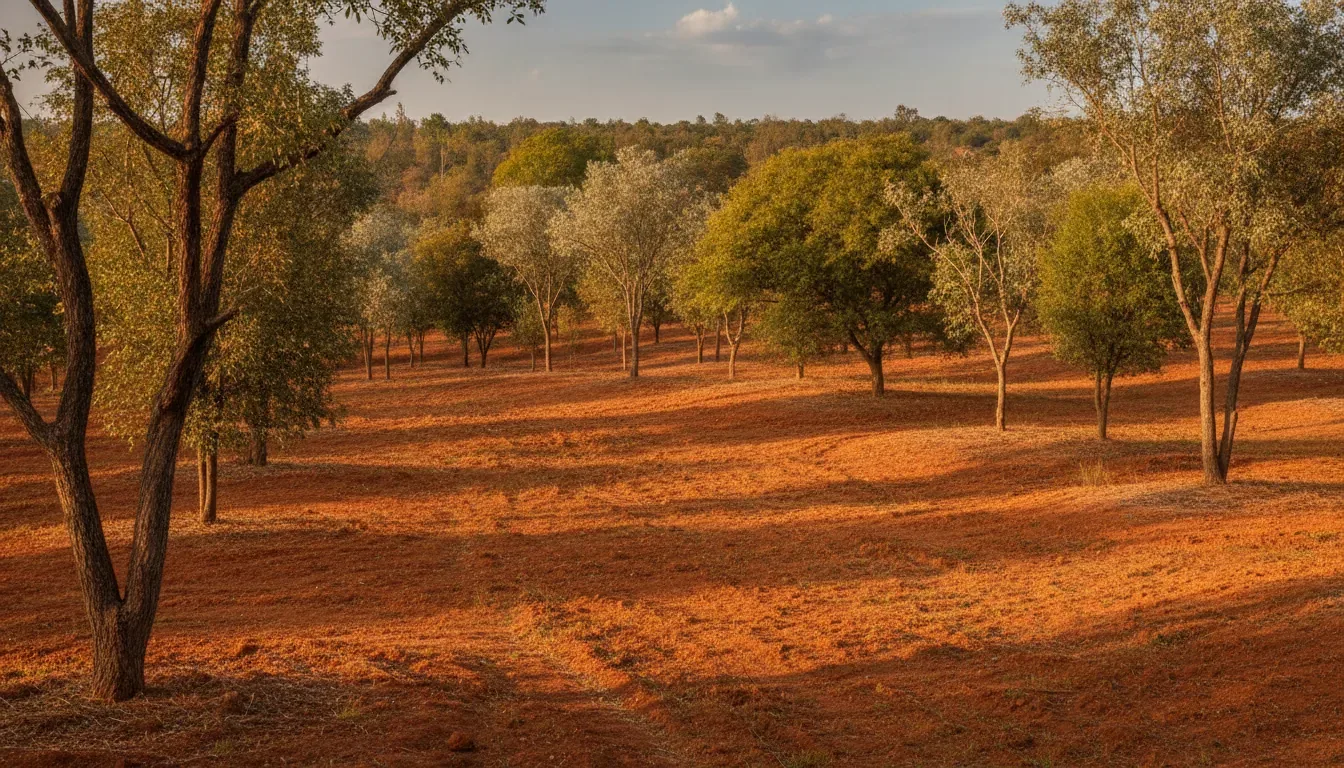
A good farm-plot fence does three jobs at once: it marks possession clearly, it reduces everyday friction (animals, trespass, boundary arguments), and it fits your usage model (weekend visits vs full-time farming). The right choice is rarely “strongest fence wins.” It is usually a tradeoff between time to effectiveness, maintenance burden, permissions, and how often you can show up.
If you are still validating your boundaries on paper, do not build anything permanent yet. Start here first (and then come back to fencing): Karnataka legal checklist for farm plot buyers.
Table of Contents
TLDR
- Bio-fencing (live fencing) is great when you want a greener edge, windbreak, long-term boundary stability, and you can wait for growth. It often needs a temporary fence while it matures. Some published studies show bio-fences can be economical, but costs depend on species, spacing, and year.
- Compound walls give instant, high-visibility separation and privacy, but they are typically the highest upfront cost and need correct boundary alignment, drainage planning, and local permissions.
- Permissions are local. In Gram Panchayat areas, “building” definitions can include a wall, compound wall, and fencing, so always check local process before construction.
- Avoid illegal electric fences. Karnataka High Court materials highlight the risk of wildlife electrocution and explicitly call out unauthorised illegal electric fences as something authorities should not permit.
- If you want “security,” remember: security is a system, not a fence. Controlled access, lighting, and operations matter, especially in gated managed projects.
Step 1: Be clear about why you are fencing
Before comparing bio-fencing vs a compound wall, decide which outcome matters most to you:
- Boundary clarity and dispute reduction
A fence should sit on the correct boundary. If you fence the wrong line, you create your own problem. - Crop and orchard protection
Your biggest threat could be stray cattle, wild boar, monkeys, or even goats from nearby villages. - Theft and trespass deterrence
For many weekend owners, the goal is deterrence, not fortress-level security. - Privacy and “finished plot” feel
Walls create privacy fast. Green fences create privacy slowly, but can look more natural. - Windbreak, dust reduction, microclimate
Live fences can act as wind filters and ecological buffers.
Your “why” determines your “how.”
The three fence categories most farm plot buyers end up choosing
A) Temporary or light perimeter (fast, functional)
Examples: barbed wire, chain link, welded mesh, GI wire on RCC posts.
This is often the first layer, especially when you want something working immediately.
B) Bio-fencing (slow start, strong long-term)
A living hedge or multi-row boundary planting that becomes the fence over time.
C) Compound wall (instant barrier, high cost, higher compliance needs)
Masonry wall with foundation, pillars, and gate structures.
Most real-world solutions are hybrids: a light fence now, plus a bio-fence that becomes the permanent edge.

Bio-fencing explained like a buyer, not a botanist
What bio-fencing really is
Bio-fencing is a living boundary using plants that form a dense, thorny, or uninviting edge. It can be a single-row hedge, a double-row thicket, or a mixed boundary with shrubs and trees.
Many farm systems use live fences on bunds and boundaries because they can provide additional benefits like biomass and soil protection, if managed well.
What bio-fencing is good at
- Long-term boundary presence: once established, it is hard to “shift” casually.
- Microclimate benefits: wind filtering, dust reduction, habitat support.
- Lower “hard material” exposure: less concrete and brick, more living edge.
- Aesthetics: it often fits eco-living and nature-first projects.
What bio-fencing is not good at
- Instant security: it needs time to become dense.
- Zero maintenance: the first 6 to 18 months can be work-heavy.
- One-size-fits-all: species choice matters. Some plants thrive in one corridor and fail in another.
Time-to-effectiveness (set expectations)
- First 0 to 3 months: saplings establish, gaps are common.
- 3 to 12 months: hedge begins to thicken if watered and protected.
- 12 to 24 months: many bio-fences become meaningfully deterrent.
- After 24 months: pruning and gap-filling becomes the main job.
If you need strong protection immediately, plan a temporary wire or mesh fence while the bio-fence grows.
Cost reality (how to think about it)
Bio-fencing costs depend on species and spacing. One ICAR publication documented running-meter costs for bio-fencing species with rates based on March 2008 (example figures like Agave sisalana and Euphorbia tirucalli). Use this as a cost-structure reference, not as a current price list.
A peer-reviewed study on bamboo-based bio-fencing estimated an initial cost for a 100 m length, showing how economical a dense bio-fence can be when designed correctly.
Buyer takeaway: bio-fencing can be cost-effective, but only if you budget for establishment care: watering, protection from grazing, and gap replacement.
Maintenance reality (where most people fail)
Bio-fencing fails for predictable reasons:
- no water plan for the first dry season
- cattle or goats eat the young plants
- gaps are ignored until they become permanent holes
- pruning is skipped and hedge becomes leggy or weak
If you want a low-touch ownership model, ask whether maintenance is handled by a team. Hasiru’s Hasiru Care page explicitly lists fencing as part of infrastructure upkeep in managed farmland operations.
Compound wall explained with the boring details that matter
What a compound wall gives you
- Immediate boundary visibility
- Instant privacy
- Clear deterrence for casual trespass
- Cleaner “ready plot” feel, especially for weekend owners
Why compound walls become expensive
The wall itself is not the only cost. Common cost drivers:
- excavation and foundation depth (soil type matters)
- pillars and spacing
- materials transport to rural sites
- plastering, coping, painting
- gates and access work
- drainage planning to avoid water pressure damage
What compound walls do poorly
- They can magnify disputes if the boundary is not settled.
- They can block natural drainage paths if not planned.
- They can crack in certain soils if foundation planning is weak.
- They create a “hard edge” that can annoy neighbors if placed without discussion.
Buyer rule: do not build a compound wall until you are confident your boundary is correct.
Decision framework: Choose bio-fencing vs compound wall using five questions
1) How fast do you need protection?
- Need protection in weeks: choose a temporary fence now; compound wall only if you are sure about boundary and permissions.
- Can wait 12 to 24 months: bio-fencing becomes more attractive.
2) What is your biggest risk?
- Stray cattle and goats: dense hedges plus temporary wire works well.
- Theft and trespass risk: compound wall plus gate discipline helps, but security is still operational.
- Wild boar or wildlife corridor risk: your solution must be safe, legal, and non-lethal.
3) How often will you visit?
- Visiting monthly or less: low-maintenance choices matter more.
- Visiting weekly: you can manage pruning, gap filling, and repairs.
4) Do you want an eco-living boundary or a “villa plot” boundary?
- Eco-living: bio-fencing aligns naturally.
- High privacy, finished look: wall aligns naturally.
5) Are you in a managed community or standalone plot?
Standalone ownership often means you personally manage boundaries and repairs. Hasiru’s managed vs standalone discussion points out how boundary and fencing responsibilities can become stressful when you cannot visit often.

Cost breakdown without fake numbers
Instead of quoting a random “per foot” rate that will be wrong in your location, use this structure when taking quotes.
Bio-fencing cost formula
- Planting material: saplings or cuttings (species matters)
- Spacing: tighter spacing costs more but closes gaps faster
- Planting labor: trenching, pits, soil amendments
- Protection: tree guards or temporary mesh
- Watering: drip line or manual watering plan
- First-year maintenance: weeding, gap replacement, pruning
If any of these is missing from a quote, your “cheap bio-fence” can become a failed bio-fence.
Compound wall cost formula
- Foundation: excavation, rubble soling, footing concrete
- Wall structure: blocks or brick, mortar, pillars
- Finish: plaster, coping, paint
- Gate system: hinges, lock, possible automation
- Drainage detail: weep holes, slope management
- Site logistics: transport and labor availability
Walls cost more in remote corridors because logistics and labour availability change.
Maintenance calendar: what you actually sign up for
Bio-fencing maintenance (first 24 months)
- weekly checks in first 2 to 3 months
- watering plan through summer
- gap replacement after each loss wave
- pruning and training so hedge thickens, not just grows tall
- pest and grazing protection
After establishment, maintenance often becomes seasonal.
Compound wall maintenance (ongoing)
- crack inspection after monsoon
- paint touch-ups or anti-fungal treatment
- cleaning along base so weeds do not hide structural issues
- gate hinge and lock maintenance
- drainage clearance so water does not pool at foundation
Walls are not “build once, forget forever.” They are just a different kind of maintenance.
Permissions and compliance: the practical truth
Start with boundaries, then permissions
Permissions become easier when your boundary is defensible. If boundary is disputed, any permanent construction can worsen the conflict.
If you are still unclear on boundaries and survey paperwork, read this first and then fence: Karnataka Farm plot legal checklist.
In Gram Panchayat areas, fencing can be treated as part of “building”
The Karnataka Panchayat Raj Act defines “building” broadly and explicitly includes “wall, compound wall, fencing” in the definition.
Separately, a government notification on Panchayat processes references that anyone intending to construct a building within Gram Panchayat limits must apply for permission or a license letter through the Panchayat process.
What this means for you: do not assume “it is just a fence, no permission needed.” Rules can vary by local bye-laws and enforcement. Always check the local authority before building a permanent wall.
Electric fencing: extreme caution
If you are considering electric fencing for crop protection near wildlife zones, treat safety and legality as non-negotiable.
Karnataka High Court materials reference deaths due to electrocution and explicitly state that unauthorised illegal electric fences should not be permitted and should be replaced with scientific protective barricades.
Buyer-safe approach: If you truly need an energised fence, consult qualified professionals and local authorities, and avoid any illegal power tapping or unsafe voltage practices. Never improvise.
Security reality: why a fence alone is not “gated”
Many buyers assume “compound wall plus gate” equals security. In reality, security is a design plus operations system:
- controlled access points
- lighting and visibility
- surveillance and incident response
- periodic checks and upkeep
Hasiru’s gated community article explains this benefit in the managed farmland context, where controlled access and surveillance often exist as part of a system, not just a gate.
If you are comparing models, this overview helps you match “gated vs community vs open farmland” with your real goal and responsibility appetite.
Common fencing mistakes that cause regret
- Building first, verifying later
A permanent wall on a wrong boundary is expensive to undo. - Choosing bio-fencing without a water plan
Many live fences fail in the first summer. - Skipping temporary protection
Young plants get eaten, trampled, or stolen. You need a transition plan. - Ignoring drainage
Compound walls can trap water or fail structurally if drainage is ignored. - Over-optimising for looks
Your fence should solve your risk first, then look good.
Buyer checklist: ask these before you commit
Use this checklist before paying for fencing work.
Before taking quotes
- Confirm perimeter length and corners.
- Confirm boundary markers and neighbour alignment.
- Confirm access road reliability. A fence is useless if you cannot reach the plot confidently.
Before choosing a fencing type
- What is the biggest risk: animals, trespass, privacy, or aesthetics?
- How often will you visit for maintenance?
- Will the fence be managed by a team or by you?
If you are buying in a managed project, use this question framework and specifically ask how plot demarcation and boundary maintenance are handled.
If you are in a managed model
Understand what maintenance looks like behind the scenes, including infrastructure upkeep.
FAQs
Is bio-fencing enough to stop trespass?
Eventually it can deter casual trespass, but most buyers need a temporary fence while the hedge matures.
Do I need permission to build a compound wall on agricultural land?
It depends on where your land lies and local governance. In Gram Panchayat areas, the legal definition of “building” can include compound walls and fencing, and permission processes exist for construction. Always verify locally before building.
What is the biggest hidden cost in compound walls?
Foundations and drainage. Soil and monsoon conditions punish shallow foundations and poor water flow planning.
Is electric fencing safe for wildlife?
Unsafe and illegal practices are a major problem. Karnataka High Court materials highlight harm from illegal electric fences and call for preventing such fencing. If you need energised fencing, treat compliance and proper design as mandatory.
What is the most practical approach for weekend owners?
Often a hybrid: temporary wire or mesh for immediate protection, plus bio-fencing for a greener long-term boundary, plus community security measures if in a gated managed project.