Search for an avocado plant price in India and you get a wall of nursery listings, each showing one number and no explanation. Those numbers run from ₹65 to ₹2,500 a plant, yet none of them says whether the plant is grafted, how many you need for an acre, or what you will pay once the plants arrive. This guide answers all three, with every price dated and every per-acre figure worked out in front of you.
TL;DR
Grafts cost more than seedlings because they fruit in about three years, not five to six. An acre at ICAR spacing needs 110 grafts, which cost about ₹33,000 to ₹1,20,000, plus ₹21,693 for drip before subsidy, plus pits and manure. The plants are a one-time bill. Upkeep runs for three years to first fruit and up to eight before commercial yields, per ICAR.
In this guide
How much does one avocado plant cost in India
One avocado plant costs ₹65 to ₹1,090 in India on listings checked in October 2026, and the price depends on whether the plant is grafted, which variety it is and what rootstock it grows on.
Whether a listing calls it an avocado fruit plant, a sapling or a tree, the number on its own tells you very little. We do not sell avocado plants and we do not recommend any nursery, so the listings below are described by type, not by name.
Avocado plant prices in India by plant type
| Plant type | What the listing offers | Price |
|---|---|---|
| Wholesale nursery plant | Ex-nursery, minimum order of 50 plants | ₹65 |
| Farmer-raised Arka Supreme graft | Four-month-old graft raised by a grower in Beed | ₹300 |
| Online nursery grafted plant, “tropical variety” | Single plant, MRP ₹1,350 | ₹675 |
| Online nursery seed-grown plant | Single plant, MRP ₹799 | ₹699 |
| Online nursery grafted Hass | Single plant, 1.5 to 2 ft in one listing | ₹749 to ₹1,090 |
| Graft on imported commercial rootstock | Plant grown on a commercial rootstock from Israel | ₹2,500 |
Two things stand out. A seed-grown plant at ₹699 and a grafted plant at ₹675 appeared in the same search, so a higher avocado tree price does not prove you are buying a graft. And the ₹65 wholesale price applies only to orders of 50 or more, from a listing that does not say whether the plant is grafted.
Plant choice is one decision inside a larger crop plan, which our complete guide to avocado farming in India covers end to end. Here, the next question is grafting, because it sits behind much of the gap between a cheap plant and an expensive one.
Why does a grafted avocado tree cost more than a seedling
A grafted avocado tree costs more than a seedling because it starts fruiting within about three years, while a seedling takes five to six years, according to ICAR.
One online nursery’s own listing for a seed-grown plant puts the wait at 5 to 10 years. Seed also brings uncertainty. Plants grown from random seed vary in quality, The Better India reported in May 2024.
How is a grafted avocado plant made?
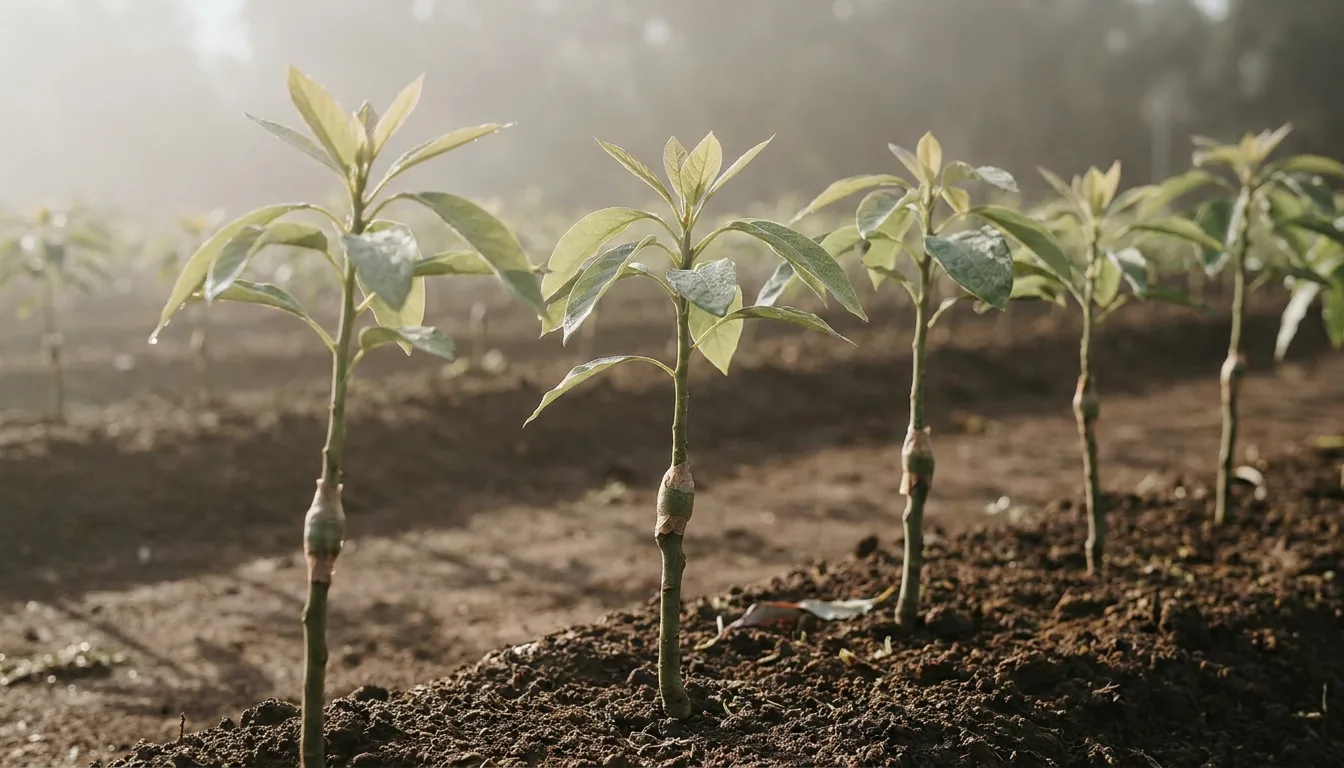
Avocado is commercially propagated through softwood grafting, and ICAR reports a success rate of more than 90% under a subhumid tropical climate. Grafting joins a named variety, such as Hass or Arka Supreme, onto a separate rootstock. That extra work is part of what you pay for.
Costs vary by grower. One farmer in Beed put grafting at about ₹100 per sapling including the rootstock, which was sourced from Tamil Nadu, with four-month-old Arka Supreme grafts at ₹300.
Why do some avocado plants cost ₹2,500?
Avocado plants at around ₹2,500 are grown on commercial rootstocks imported from Israel, according to a grower interviewed by The Better India in May 2024. The rootstock controls yield and canopy size, which keeps harvesting at 10 to 12 feet.
Rootstocks are also chosen for disease resistance. One Kerala grower picked the wild rootstocks Bounty and Doosa for that reason. Few price tags name the rootstock at all, so ask for it before you buy. Grafting also explains a trap worth knowing about, which is a seedling sold under a variety name.
Is a cheap “Hass” avocado plant really grafted Hass
A cheap Hass avocado plant is not necessarily grafted Hass, and a listing that does not say grafted should be treated as a seedling until the seller proves otherwise.
The price gap is the reason to check. In October 2026, grafted Hass from online nurseries was listed at ₹749 to ₹1,090, against ₹675 for a grafted “tropical variety” plant. In the same search, a large online marketplace showed plants titled “Hass” at ₹262 and ₹340, with no grafting stated in the title.
Other reports point the same way. The Better India reported in May 2024 that plants sold in South India for about ₹500 may be grown from random seeds. On one online listing for a seed-grown plant, two buyer reviews said they had received seed-grown plants and wished the listing had said so more clearly.
Hass avocado seedlings, grown from seed, carry the same drawbacks as any seedling, a wait of five to six years for fruit and uneven quality.
What should you check before paying for an avocado plant?
Before paying for an avocado plant, check for a visible graft union, a named variety, a named rootstock and grafted status in writing.
- A visible graft union – Look for the joint on the stem where the variety was grafted onto the rootstock. If you cannot find one, ask the seller to point it out.
- A named variety – The listing should say Hass, Arka Supreme, Fuerte or another named variety, not a general label such as “tropical variety”.
- A named rootstock – Ask which rootstock the plant is grafted on and where it came from.
- Grafted status in writing – Get the word “grafted” on the listing or the invoice before you pay.
None of these checks accuses a seller of anything. They turn a price tag into a product you can compare like for like. Once you know the plant is a real graft, the next question is whether one variety is enough.
Do you need more than one avocado variety
Yes, you need more than one avocado variety, one of flowering Type A and one of Type B, because Type B plants pollinate Type A varieties.
Two ICAR-IIHR varieties from CHES Chettalli in Kodagu show how this works. Arka Supreme is Type A, and Arka Coorg Ravi is Type B, so it can pollinate Type A varieties such as Arka Supreme (Krishi Jagran, April 2025). Hass is also Type A and is grown with a Type B such as Fuerte, which growers report can raise yields by up to 30%.
For your budget, this means the plant order is split across two varieties, so get prices for both before you place an order. If avocado is still one option among several, see how avocado compares with other tree and fruit crops per acre before you commit. With the varieties settled, the plant count sets the size of the bill.
How many avocado plants do you need per acre
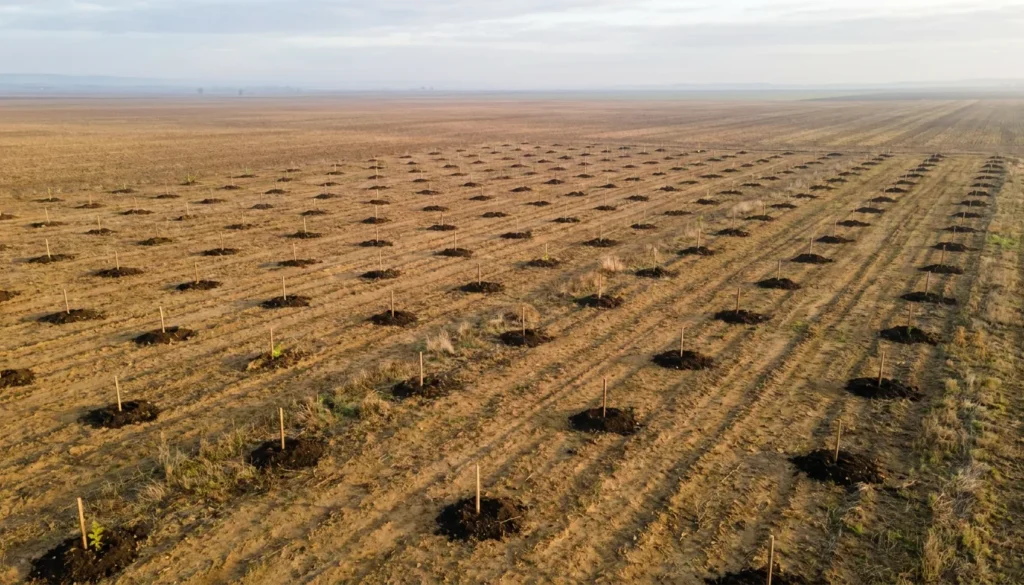
You need 110 grafted avocado plants per acre at ICAR’s typical spacing of 6 m × 6 m, or 40 to 60 seedlings per acre at 8 m × 8 m or 10 m × 10 m, depending on how vigorous the variety is.
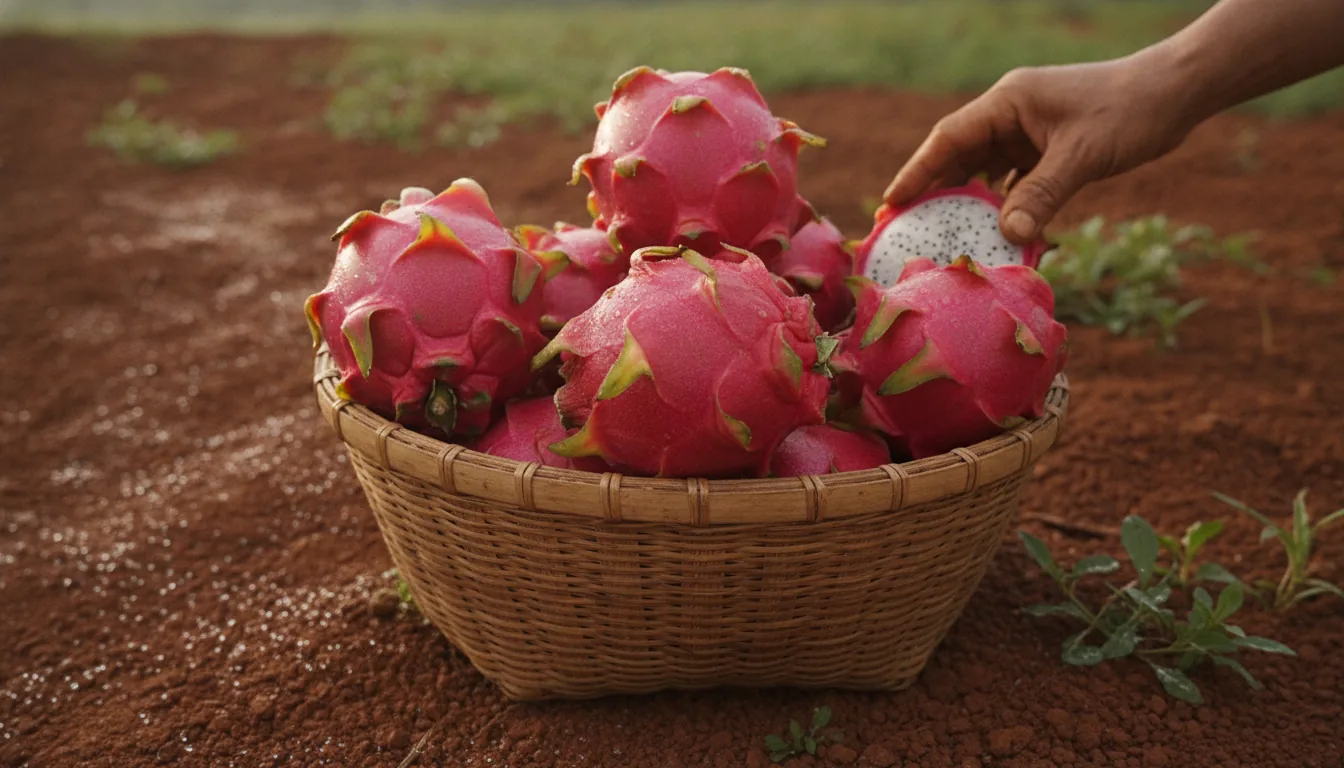
Avocado is a widely spaced tree crop. For a crop planted very differently, see what dragon fruit cuttings and trellis cost by comparison.
Plant bill for one acre of avocado
| Plant option | Spacing (ICAR) | Plants per acre | Price per plant | Plant bill per acre |
|---|---|---|---|---|
| Farmer-raised Arka Supreme graft | 6 m × 6 m | 110 | ₹300 (Nov 2024) | 110 × ₹300 = ₹33,000 |
| Online grafted “tropical variety” | 6 m × 6 m | 110 | ₹675 | 110 × ₹675 = ₹74,250 |
| Online grafted Hass, lower listing | 6 m × 6 m | 110 | ₹749 | 110 × ₹749 = ₹82,390 |
| Online grafted Hass, higher listing | 6 m × 6 m | 110 | ₹1,090 | 110 × ₹1,090 = ₹1,19,900 |
| Graft on imported rootstock | 6 m × 6 m | 110 | ₹2,500 (May 2024) | 110 × ₹2,500 = ₹2,75,000 |
| Online seed-grown plant | 8 m × 8 m | 60 | ₹699 | 60 × ₹699 = ₹41,940 |
| Online seed-grown plant | 10 m × 10 m | 40 | ₹699 | 40 × ₹699 = ₹27,960 |
To use your own quote, multiply the price per plant by 110 for grafts, or by 40 to 60 for seedlings. A seed-grown acre can look cheaper on paper, but it comes with the longer wait of five to six years to first fruit.
The ₹65 wholesale plant is not in the table because its listing does not say whether it is grafted, and without that you cannot tell which spacing applies.
The cost to prepare pits and drainage for avocado depends on local labour and manure rates, so budget by quantity. ICAR specifies pits of 1 cubic metre, which at 110 plants means 110 cubic metres of digging and about 55 cubic metres of manure per acre.
ICAR advises digging the pits in April to May and filling each one with Farm Yard Manure (FYM) and topsoil in equal parts, a 1:1 mix. For one acre of grafts, that works out as follows.
- Digging: 110 pits × 1 cubic metre = 110 cubic metres
- FYM: half of each pit, about 55 cubic metres per acre
- Topsoil: the other half, about 55 cubic metres per acre
Take these quantities to a local labour contractor and an FYM supplier, and price them against your own site.
Drainage matters as much as the pit. Avocado cannot tolerate waterlogging, ICAR notes, and it grows well in a variety of soils except black soil. For drainage, growers in Kerala plant on raised beds about three feet high, which adds earthwork to the bill.
If your land is black soil, settle that before you buy a single plant. Site decides whether the crop works at all, so check which Karnataka districts actually suit avocado before you budget for pits. With the pits ready, the next line on the bill is water.
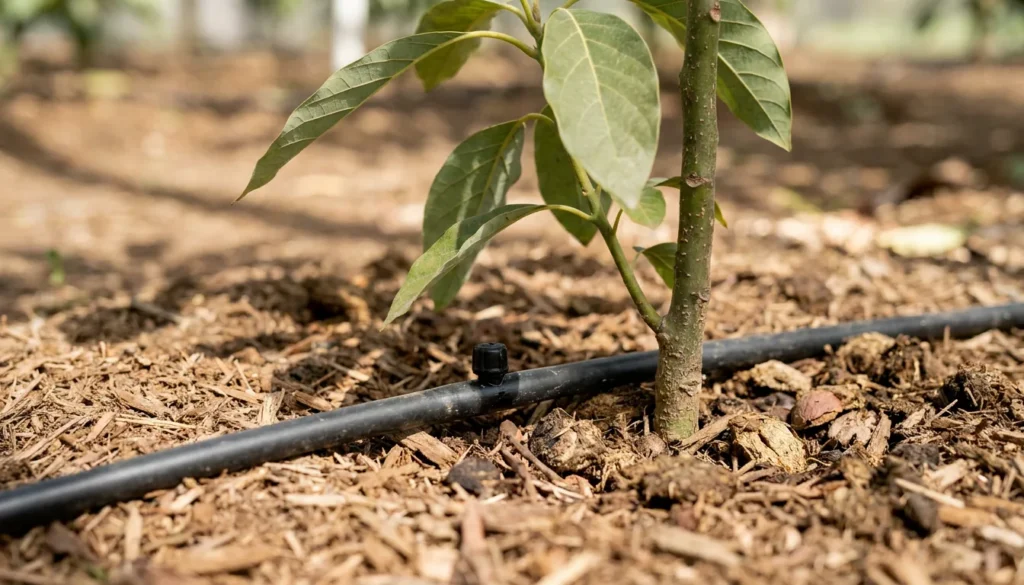
What does drip irrigation cost for an avocado acre
Drip irrigation for an avocado acre costs about ₹21,700 before subsidy at 6 m × 6 m spacing, based on the government’s indicative cost of ₹21,693 for 0.4 hectare in the PDMC Operational Guidelines 2024.
PDMC assistance is 55% for small and marginal farmers and 45% for others. That leaves your share of the 0.4 hectare system at about ₹9,760 (45% of ₹21,693) or about ₹11,930 (55% of ₹21,693).
Indicative drip irrigation cost by avocado spacing
| Spacing | Used for | 0.4 ha (about 1 acre) | 1 ha |
|---|---|---|---|
| 6 m × 6 m | Grafts | ₹21,693 | ₹34,687 |
| 8 m × 8 m | Seedlings | ₹19,711 | ₹28,777 |
| 10 m × 10 m | Seedlings | ₹18,652 | ₹26,181 |
The guidelines set these costs 15% higher in low-penetration states and 25% higher in North Eastern and Himalayan states. The drip cost covers the system itself. It still needs a water source and power to run, so budget for those separately.
Put plants, pits and drip together and you have the full establishment bill.
What is the total cost to establish one acre of avocado
The total cost to establish one acre of avocado is about ₹54,700 to ₹1,41,600 for plants and drip before subsidy, plus the cost of pits and manure, which you price locally.
Establishment cost for one acre of avocado (grafts at 6 m × 6 m)
| Cost line | Basis | Cost per acre |
|---|---|---|
| Planting material | 110 grafts at ₹300 to ₹1,090 | ₹33,000 to ₹1,19,900 |
| Planting material on imported rootstock | 110 grafts at ₹2,500 (May 2024) | ₹2,75,000 |
| Pits and FYM | 110 pits of 1 cubic metre, about 55 cubic metres of FYM | Price locally against these quantities |
| Raised beds, poorly drained sites only | Beds about three feet high | Price locally |
| Drip irrigation | PDMC indicative cost for 0.4 ha | ₹21,693 before subsidy, about ₹9,760 to ₹11,930 after |
| Plants plus drip, before subsidy | ₹33,000 + ₹21,693, up to ₹1,19,900 + ₹21,693 | ₹54,693 to ₹1,41,593, before pits and FYM |
| Government benchmark (MIDH 2025) | Cost norm of ₹1.25 lakh per hectare, without drip | About ₹50,600 |
With imported-rootstock plants, plants plus drip come to ₹2,96,693 (₹2,75,000 + ₹21,693) before pits and FYM.
How does this compare with the government’s cost norm?
The government’s MIDH Operational Guidelines 2025 set a cost norm of ₹1.25 lakh per hectare for avocado, without drip, which is about ₹50,600 per acre (₹1,25,000 ÷ 2.471, since one hectare is 2.471 acres). Avocado sits in the same cost group as rambutan, persimmon and durian, and it is also listed among the additional commercial crops the guidelines support.
Assistance is 40% of the norm in general areas, about ₹20,200 per acre, and 50% in North Eastern, Himalayan and other listed areas. Drip is costed separately under PDMC norms, as in the section above.
Treat the MIDH figure as a costing benchmark for subsidy, not a market quote. At online grafted Hass prices, the plant bill alone (₹82,390 to ₹1,19,900) is already higher than the norm’s per-acre figure.
Establishment is where this page stops, and the orchard then needs years before it bears. For what happens after that, see what an established avocado acre yields and earns.
How long before an avocado plant starts to fruit
A grafted avocado plant starts to fruit within about three years, but ICAR says commercial yields generally begin around eight years after planting. Seedlings take five to six years just to start fruiting.
That gap between first fruit and commercial yields is the avocado plant growth time a buyer actually has to plan for. Farms vary. A Palakkad grower’s trees flowered in their fourth year, with a commercial harvest the following season.
Upkeep is paid in every one of those years. One grower in Beed reported annual maintenance of ₹80,000 for 50 plants. That is one farm’s figure, not a norm. Set it beside the plant bills above and the pattern is plain. The plants are paid for once, the upkeep every year.
What else do first-time avocado growers ask
Is a cheap avocado plant worth buying?
A cheap avocado plant is worth buying only if the seller confirms in writing that it is grafted and names the variety and the rootstock. Plants grown from seed take five to six years to start fruiting, against about three years for grafts, so a low price can cost you years.
Are avocados hard to farm?
Avocados are hard to farm in three specific ways. They cannot tolerate waterlogging, so drainage has to be right before planting. Orchards are planned with a Type A and a Type B variety for pollination. And the plants must be true grafts, or the wait for fruit stretches to five or six years.
How tall can a butter fruit tree grow?
How tall a butter fruit, or avocado, tree grows depends heavily on its rootstock. Plants grafted on commercial rootstocks from Israel keep the canopy small enough to harvest at 10 to 12 feet, according to a grower interviewed by The Better India in May 2024. The rootstock also influences yield, so ask which one a plant is grafted on.
Is there a government subsidy for planting avocado?
Yes, avocado is listed among the crops supported under the MIDH Operational Guidelines 2025, with a cost norm of ₹1.25 lakh per hectare without drip and 40% assistance in general areas, or 50% in North Eastern, Himalayan and other listed areas. Drip irrigation carries separate PDMC assistance of 55% for small and marginal farmers and 45% for others.
Are there hidden costs beyond the avocado plant price?
Yes, there are hidden costs beyond the avocado plant price. They include 110 pits of 1 cubic metre with about 55 cubic metres of manure per acre, drip irrigation at about ₹21,700 per acre before subsidy, raised beds on poorly drained land, and upkeep every year for up to eight years before commercial yields.
Who looks after an avocado orchard if I can’t visit often?
If you cannot visit often, the orchard needs a manager on the ground under a written agreement, because grafts take about three years to fruit and up to eight to reach commercial yields. On Hasiru managed farmland, a Maintenance Agreement executed at handover sets out that Hasiru undertakes the management and maintenance of the farmland.
Is the plant price the real cost of an avocado orchard?
No, the plant price is not the real cost of an avocado orchard. Plants are a one-time bill of about ₹33,000 to ₹1,20,000 for an acre of grafts, while the real cost is the upkeep that runs for three years to first fruit and up to eight before commercial yields, per ICAR.
That carry period is the part most price lists leave out. The doubt buyers raise with us is exactly this, a plot that sits neglected after the plants go in, with ongoing costs nobody mentioned at the start. So before you price a single plant, ask two questions. Who will look after the orchard through those years, and under what agreement?
At Hasiru Farms, every buyer receives individual ownership of their farmland through a registered Sale Deed in their own name. At handover, a Maintenance Agreement is executed under which Hasiru undertakes the management and maintenance of the farmland. We have operated since 2021, with 300+ acres delivered to 250+ families, and we do not lead with speculative returns.