What this page covers
Mahogany grows well in parts of India, but the income claims attached to it do not hold up. There is no published price that Indian growers are reliably paid, harvest timelines quoted online run from 12 to 35 years, and a shoot-boring pest damages young trees. Plant it only if you can confirm a buyer and a price in writing first.
Is mahogany farming actually viable in India
Mahogany grows in India, but there is no reliable public evidence that it pays the way it is marketed. The tree is proven in south Indian conditions. The income model built on top of it rests on a price, a timeline and a buyer that nobody publishes.
| What holds up | What breaks down |
|---|---|
| The tree grows here, and has since 1795. | No published grower price anywhere in India. |
| A domestic sawn-timber trade exists, through yards in Chennai, Bengaluru, Coimbatore, Kerala and Kolkata. | Rotation claims range from about 12 to 35 years, none of them citing research. |
| Rainfall and soil needs are met in parts of south India. | A known pest, the shoot borer Hypsipyla robusta, deforms young trees. |
| Growing it is entirely legal. | No automatic right to fell or move it, and no guaranteed buyer. |
Each line in that right-hand column is dealt with below, with its source named. If you are still choosing between species, the wider view of timber trees worth planting in India is the better starting point. First, settle which tree is being sold to you.
Which mahogany is grown in India, and is it native
The mahogany sold to Indian growers is big-leaf mahogany, Swietenia macrophylla. It is not native to India. It was introduced to the country in 1795 and to Kerala in 1872.
Two centuries is long enough to call the species established here. A Kerala study selected 45 plus trees from 593 candidates across 15 locations in the state, with girth at breast height between 0.75 and 2.00 m, although the ages of those trees were not reported. So the tree grows. That is not the same as knowing what the wood sells for.
One name needs separating out. African mahogany is Khaya senegalensis, a different genus, and nurseries sell both under the single word mahogany. Some yard listings labelled mahogany name an entirely different wood in their own specifications, so even inside the trade the label is loose. If a seller quotes a growth rate or a price, ask which species it refers to. Then ask whether your land suits it.
Where does mahogany grow well in India
Mahogany wants warm, high-rainfall conditions and soil that drains. Grower guides put the range at 1,200 to 2,500 mm of annual rainfall, soil pH no lower than 6.5 and well-drained soil, with waterlogging causing stem rot.
Those figures come from nursery and advisory guides rather than published field trials, so treat them as a starting point. Check them against your own rainfall record and a soil test.
If the honest answer for your land is possibly, with work, it is worth stepping back to compare the crops that suit managed farmland before committing to a tree you cannot harvest for a decade or more. That timeline is the next thing the claims get wrong.
How long does mahogany take to harvest
Mahogany is marketed on a 12 to 15 year rotation. Published claims actually range from about 12 years to 35 years, and none of the pages making them cites research.
| Claimed time to harvest | Where the claim comes from |
|---|---|
| About 12 years | A farmer-advisory site, no source cited |
| Income shown at year 12 | One contract-farming firm’s own income projection |
| Roughly 12 to 15 years | Google’s AI summary for mahogany farming in india |
| 20 to 30 years to harvestable size | A farmland seller’s blog |
| 25 to 35 years to reach 30 to 70 cm diameter | An agriculture blog |
The spread matters more than the midpoint. The longest claim is the only one tied to a size, 30 to 70 cm in diameter. A tree felled at 12 years is a smaller log, and smaller logs sell for less. A projection that pairs a 12-year timeline with a large-log price is describing two different trees at once.
Short rotations are not impossible in Indian timber. Melia dubia, a shorter-rotation timber tree, is grown on that basis. Mahogany’s problem is not the wait. It is that nobody can tell you what the tree is worth at the end of it.
What is a mahogany tree really worth after 10, 15 or 20 years
Nobody publishes a reliable farm-gate price for Indian-grown mahogany, so any per-tree figure online is a projection and not a market rate. We searched for an auction, mandi or forest-depot price series for plantation mahogany in India and found none. Three very different numbers do exist, and they are not measuring the same thing.
| The number | What it actually is |
|---|---|
| ₹250 per cubic foot | The buy-back rate written into one contract-farming firm’s own income projection |
| ₹450 to ₹1,800 per cubic foot | Retail asking prices for planks, logs and cut sizes across 24 listings from timber yards in Chennai, Bengaluru, Kerala and Tamil Nadu |
| ₹2,000 to ₹5,000 per cubic foot | Claims repeated on media and farmer-advisory pages |
The middle row is the one quoted at farmers, and it is the wrong number for them. Those are asking prices for sawn, processed timber sitting in a yard, after felling, transport, milling and a trader’s margin. A standing tree on your land is not that product and does not fetch that price. How much less it fetches is the figure nobody publishes, and that gap is the whole question. Several of those listings also name a different wood in their own specifications, so the species behind the price is not always verified.
The first row is more useful and more sobering. ₹250 per cubic foot is what one seller’s own projection assumes a farmer will be paid. The same projection assumes 20 cubic feet per tree at year 12 and 1,200 trees to the acre, and reports a gross figure with no costs taken out. Its own FAQ says the rate depends on crop, quality, quantity, location and written terms, and tells farmers to confirm every term before planting. That is the seller’s own advice and it is correct.
How to read any projection you are shown
- Gross or net? Most tables deduct nothing for planting, upkeep, felling, transport or permits.
- What survival rate is assumed? Every tree in the table lived 12 years and grew to spec. Ask what the sums look like at 70 out of 100.
- Who guarantees the rate? A number inside a projection is not a contract. Only a signed buy-back is.
- Who pays for felling, transport and transit permission? If it is not written down, you do.
- Do the sums hold? One projection we checked had a cost line that did not multiply correctly.
On price per kilogram: mahogany timber is listed and sold by the cubic foot in India, not by the kilogram, and we will not invent a conversion. A price only matters if somebody is buying.
Who actually buys Indian-grown mahogany
A domestic sawn-timber trade does exist. Mahogany is listed for sale by timber yards in Chennai, Bengaluru, Coimbatore, Kerala and Kolkata. What we could not find is any public data on demand, volumes, or how much of that timber is Indian-grown rather than imported.
That matters because the other route offered to growers is contract buy-back from the nursery that sold the saplings. Buy-back can work. It is only as good as the document behind it, and the sellers themselves say the rate depends on written terms.
Get these five things in writing before you plant
- The buyer’s name and legal identity, not just a brand.
- The rate per cubic foot, and whether it is fixed, indexed, or whatever is prevailing at harvest.
- The minimum girth the buyer will accept, and what happens to trees that fall short.
- When payment is made, and against what proof of delivery.
- Who arranges and pays for felling, transport and transit permission.
If a seller will not put those into a contract, that is your answer on viability. And even with a buyer in place, the trees have to survive long enough to sell.
What goes wrong on a mahogany plantation
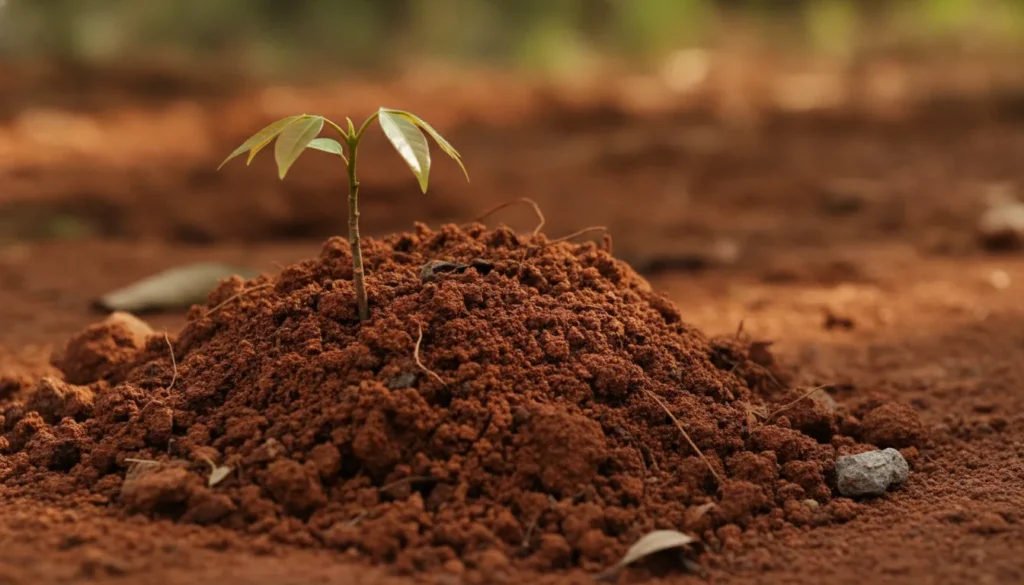
The known problem is the shoot borer. FAO’s review of shoot borers in the Meliaceae reports that Hypsipyla robusta larvae hollow out young shoots of about 60 cm, kill the terminal shoot, and leave what it calls twisted and unthrifty trees that grow more slowly.
FAO also records what the sales pitch leaves out. Swietenia plantations outside the tree’s native range, India included, are attacked about as heavily as those inside it. Planting a tree far from home does not leave its pest behind.
The advice in that review is to avoid overly close spacing and pure stands. Set against the layouts commonly promoted for mahogany in India, pure plantations at roughly 1,000 to 1,200 trees to the acre, and the tension is hard to miss. FAO does not say the pest makes mahogany unplantable, and neither do we. The point is that the recommended defence and the promoted planting plan point in opposite directions, and nobody selling saplings will raise it for you.
Add waterlogging, which grower guides link to stem rot, and the physical risks are on the table. The remaining risk is the one on paper.
Is mahogany illegal in India, and do you need permission to cut it
Growing mahogany in India is legal. The CITES listing people mention covers international trade in timber from the tree’s native range in Central and South America, not cultivation in India.
Swietenia macrophylla was listed in CITES Appendix II at CoP12, by a vote of 68 to 30, with effect from 15 November 2003, covering logs, sawn timber, veneer and plywood. The proposal covered the neotropical populations of the species in southern Mexico, Central America and South America.
That listing is also where the price story begins. Tightly controlled wild mahogany from its native range sets the international hardwood prices quoted in Indian sales pitches, and a grower with a young Indian plantation is not selling into that market. No source we found covers export rules for Indian plantation timber, so we make no claim about them.
Felling and transit permission inside India is the practical question, and the answer is not comfortable.
- The national guidelines of 18 November 2014 list species exempt from felling and transit permits on farm land, and species under limited restriction. Mahogany is on neither list. States are expected to publish their own.
- In Karnataka, the Preservation of Trees Act exempts felling permission for species including silver oak and Hebbevu, which is Melia dubia. Mahogany is not among them, per the Vidhi Centre for Legal Policy report on forestation on private land in Karnataka, 2021.
- A notification of 7 December 2016 removed 42 species from Karnataka’s transit rules. We could not obtain that list, so we cannot say whether mahogany is on it.
- An April 2022 Karnataka notification, a draft and unsigned, proposed exempting 11 species including Swietenia macrophylla from the transit chapter of the Karnataka Forest Rules. We could not confirm that it was finalized, so treat it as a proposal.
So the instructions are simple. Confirm the current felling and transit position for mahogany with your local Range Forest Office before you plant, and get the answer in writing. A 12-year crop you cannot legally fell or move is not a crop. Legal positions can shift in a grower’s favour, as happened with how sandalwood’s legal position changed for private growers, but you cannot plant on the assumption that they will.
Which timber trees make more sense in Karnataka
If the land is in Karnataka and the goal is timber, two species start from a simpler legal position. Silver oak and Hebbevu, which is Melia dubia, are both named in the Karnataka Preservation of Trees Act felling exemption, so felling permission is not the open question it is for mahogany. Start with silver oak, exempt from felling permission in Karnataka, and with how melia dubia fits a shorter timber rotation . Teak and sandalwood each have their own guide. None of them hands you a guaranteed return either, and that is deliberate.
Then there is the part no species choice solves. A timber tree is 12 years or more of watering through dry seasons, pest checks on young shoots, pruning, weeding and protection from grazing. Planting takes a day. The twelve years after it are the actual crop, and a plot that sits neglected is the thing buyers raise with us most often.
That is the problem Hasiru Farms is built around. Hasiru has been operating since 2021, with 300+ Acres delivered and 250+ Families. Every buyer receives individual ownership of their farmland through a registered Sale Deed executed in their own name. A maintenance agreement is executed between Hasiru and the buyer, under which Hasiru undertakes the management and maintenance of the farmland, and because the buyer holds an individual registered title the land remains theirs regardless of what happens to the company. The farmland is theme-based and managed for life after the sale.
New to the category? Start with new to managed farmland? . To see it on the ground there is the Vruksha project near Kanakapura and the Parva project . Or begin with Hasiru Farms managed farmland.
One last word on mahogany. Nothing here says the tree cannot grow on your land. It says the numbers it is sold on are not published, not independently verified, and not yours to rely on. Put a buyer, a rate and a felling plan into a signed document and the picture changes. Until then, the sum in the reel is a sum, not a market.
Frequently asked questions
What is another name for mahogany?
The species grown commercially in India is big-leaf mahogany, botanical name Swietenia macrophylla. African mahogany is a separate tree, Khaya senegalensis. Both are sold in India under the single word mahogany, so always ask which species a quote refers to.
Is the mahogany tree native to India?
No. Mahogany was introduced to India in 1795 and to Kerala in 1872, so the species is well established in the south without being indigenous. Its natural range is southern Mexico, Central America and South America.
What is the price of 1 kg of mahogany wood?
Mahogany timber is listed and sold by the cubic foot in India, not by the kilogram, so there is no reliable per-kg market price to quote. Retail yard listings we checked ran from ₹450 to ₹1,800 per cubic foot for sawn timber. We make no weight conversion from those figures.
Which is costly, teak or mahogany?
We found no like-for-like published price comparison between Indian-grown teak and Indian-grown mahogany, so we will not rank them. The difference that matters is that no published farm-gate price exists for Indian mahogany at all.
What are the disadvantages of mahogany farming?
Four stand out. The shoot borer Hypsipyla robusta damages young shoots and deforms trees. The rotation is uncertain, with published claims between 12 and 35 years. No farm-gate price is published, so income cannot be modelled honestly. And mahogany is not on the national felling and transit exemption lists.
How much time does African mahogany take to grow?
African mahogany is Khaya senegalensis, a different species from the Swietenia macrophylla this page covers, and we found no reliable Indian growth or rotation data for it. Check any timeline quoted for mahogany against the species named on the invoice.
Who looks after a long-rotation tree crop on managed farmland?
At Hasiru Farms a Maintenance Agreement is executed between Hasiru and the buyer, under which Hasiru undertakes the management and maintenance of the farmland. The in-house team does the work on the ground. We make no claim about which crops are planted on any particular plot.