On This Page
Teak farming is usually sold the same way: a price per plant, a harvest in ten years, and a final figure with “crore” in it. The research says something different, and the gap between the two is wide enough to change the decision. This page sets those claims against what farm teak (sagwan) has actually measured, explains how teak is really priced, and gives the Karnataka position on cutting and moving it, with every source named.
Plan on at least 20 years. No Indian forestry research institution recommends a 10 or 15 year rotation, and measured farm trees gave about 0.25 to 0.30 m³ of timber each at 25 years, against the 1 m³ in 8 to 12 years nurseries claim. Teak sells by volume and is graded by girth and log quality, so thinning decides the harvest more than tree count does. In Karnataka you need a forest office transit permit before the timber can move.
Teak farming at a glance
| Item | Figure |
|---|---|
| Botanical and common name | Tectona grandis; sagwan in Hindi |
| Realistic farm timeline | 15 to 30 years; plan on 20 or more for a saleable log |
| Forest rotation | 40 to 80 years; TNAU lists 70 to 80 for planted teak, 100 to 120 in natural forest |
| Measured volume per tree at about 25 years | 0.22 m³ unmanaged to 0.85 m³ intensively managed; 0.25 to 0.30 m³ typical |
| Nursery claim | 1 m³ per tree in 8 to 12 years |
| Plantation productivity | 8 to 10 m³ per hectare per year, about 3.2 to 4 m³ per acre per year |
| Spacing used in India | 1.8 x 1.8 m on dry sites to 4 x 4 m on good sites |
| Thinning | First and second thinning at 5 and 10 years |
| Site needs | 1,200 to 2,500 mm rainfall with a dry season, pH 6.5 to 7.5, deep well-drained soil, below 700 m |
| How it is priced | Per cubic metre, graded by girth class and log quality |
| Karnataka status | Reserved tree under the Karnataka Forest Act, 1963; transit permit needed to move timber |
| Main pests | Hyblaea puera (defoliator), Eutectona machaeralis (skeletoniser) |
How long does teak take to grow in India
A saleable teak log takes at least 20 years on a farm in India. Farm growers typically keep teak for 15 to 30 years, forest plantations run on 40 to 80 year rotations, and no Indian forestry research institution recommends cutting teak at 10 or 15 years.
| Setting | Rotation |
|---|---|
| Forest plantation | 40 to 80 years. TNAU lists 70 to 80 years for planted teak and 100 to 120 in natural forest |
| Farm and agroforestry practice | 15 to 30 years |
| Nursery and scheme claims | 8 to 15 years, not backed by Indian forestry research |
Teak cultivation on a farm is not forest teak. Prime-quality timber takes 50 to 60 years at least, so a farm crop is the best log available inside a human planning horizon. For the same decision across species, see how teak compares with the other timber trees.
Tissue culture stretches the timeline hardest. Plants are sold on a promise of harvest in 8 to 12 years, and the research position is blunt: “No forestry research institution in India recommends a 10- or 15-year rotation period for teak”. There are no comparative studies beyond 25 years, and a 2011 NCL paper found plots from a private company showed poor growth, high variability and high mortality.
India has planted teak commercially since 1842, when the first organised plantation went in at Nilambur. That record is why the rotation question has an answer at all, and what matters next is what the tree has become by then.
How big is a teak tree at 10, 20 and 30 years
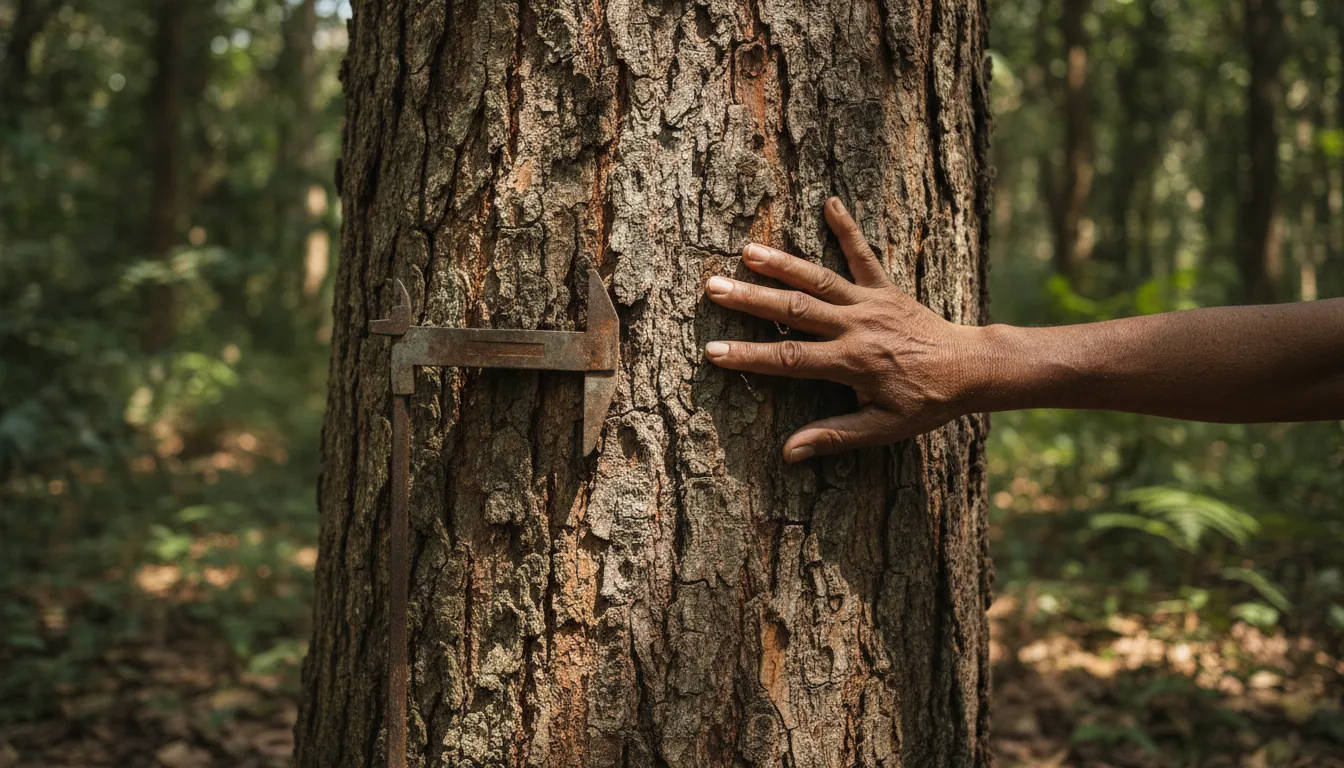
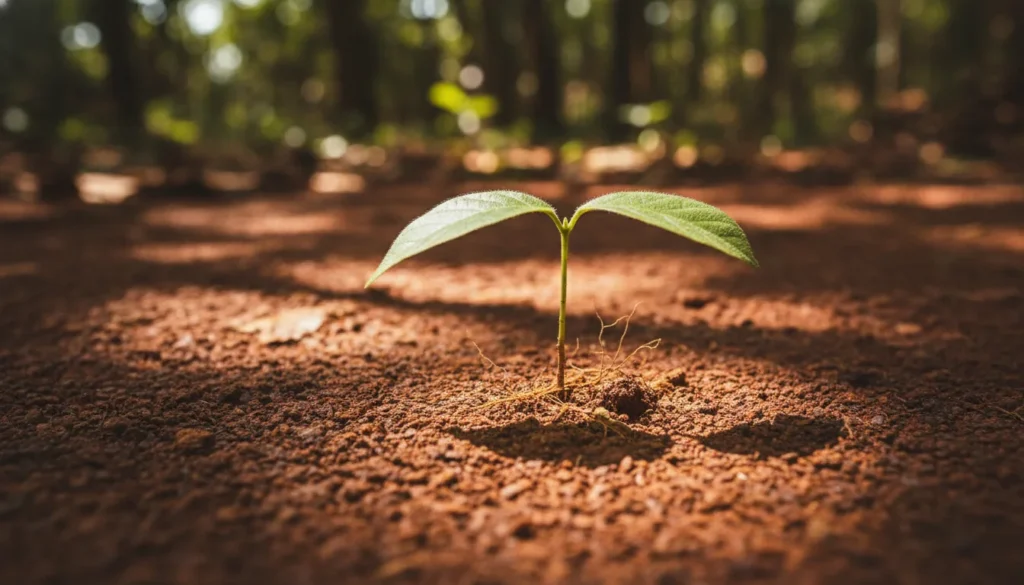
At 20 years an Indian teak tree measures roughly 62 cm in girth on a poor site and about 85 cm on a good one. The diameter figures behind that come from Tewari (1992) for Indian teak plantations, as tabled by FAO.
| Age | Poor site, dbh | Good site, dbh | Poor site, approx. girth | Good site, approx. girth |
|---|---|---|---|---|
| 10 years | 11.7 | 14.7 | about 37 cm | about 46 cm |
| 20 years | 19.8 | 27.2 | about 62 cm | about 85 cm |
| 30 years | 27.4 | 38.4 | about 86 cm | about 121 cm |
Real farms sit on either side of that table. Unthinned stands at 15 years had girths of 10 to 15 cm, while trees near Sangli reached 60 to 70 cm in girth and 8 to 10 m in height in eight years, the upper end on a good, well-managed site. If 20 years is longer than you want to wait, melia dubia, the 6 to 12 year option, is the shorter-cycle timber tree.
A TNAU study of farm teak in Tamil Nadu recorded its highest values in the 15 to 20 year class in the North Eastern Zone, at a mid-diameter of 0.193 m. No Indian source gives a reliable per-tree volume at exactly 15 or 20 years, so the yield figures below come from trees measured at 24 to 25.
How much timber does an acre of teak actually yield
A well-managed teak plantation produces about 8 to 10 m³ of timber per hectare per year, roughly 3.2 to 4 m³ per acre. Measured Indian farm trees gave about 0.25 to 0.30 m³ each at 25 years.
If the comparison is against fruit or plantation crops rather than other timber, how teak compares with fruit and plantation crops sets the cycles side by side. The table below is the teak picture on its own.
| What you are told | What was measured |
|---|---|
| 1 m³ of wood per tree in 8 to 12 years, from tissue-culture sellers | 0.26 to 0.36 m³ per tree, from 32 trees harvested at 25 to 30 years in Raisen Division, Madhya Pradesh, 2019 |
| Returns of ₹50,000 to ₹1,00,000 per tree after 20 years, promised by plantation companies | 0.15 to 0.30 m³ per tree in a farmer’s field at Baramati at 25 years |
| A company projection of 1.06 m³ per tree at 20 years | 16 times more than the volume obtained at 20 years in the most productive plantations in India |
| 10 to 15 cubic feet per tree at 14 years | About 9 to 11 cubic feet per tree, converting 0.25 to 0.30 m³ at 35.3 cu ft per m³, reached at 25 years and not at 14 |
Management, not the species, decides where a plot lands in that range. A 2021 Karnataka study measured usable wood per tree at 24 to 25 years at 0.85 m³ under intensive management at 4 x 4 m, 0.54 m³ under line planting, and 0.22 m³ in unmanaged stands at 2 x 2 m. Well-managed plantations produced nearly four times more usable wood per tree.
A commercial plantation should not fall below 8 m³ per hectare per year, and Indian yields over roughly 20 years came in at 5 to 10 . The working figure stays 0.25 to 0.30 m³ per tree at 25 years, with proper spacing, pruning, thinning and protection.
This is why the per-acre figures online do not hold. They take a nursery’s volume claim, multiply it by a retail timber price, then multiply again by trees planted rather than trees that survive thinning. The number you can influence is volume, and that comes down to spacing and thinning.
How many teak trees should you plant per acre
Between about 250 and 1,250 teak trees per acre, depending on spacing and site quality. The number you plant is not the number you harvest, because thinning removes most of them long before the timber is ready.
| Spacing | Trees per hectare | Trees per acre (approx.) | Where it is used |
|---|---|---|---|
| 1.8 x 1.8 m | about 3,086 | about 1,250 | Close spacing, suitable for dry sites |
| 2 x 2 m | 2,500 | about 1,000 | Common close planting on farms |
| 3 x 3 m | about 1,111 | about 450 | Mid-range farm spacing |
| 3.6 x 3.6 m | about 772 | about 310 | Wider spacing, suitable for good sites |
| 4 x 4 m | 625 | about 250 | Good sites under intensive management |
Thinning turns a crowded block of poles into saleable logs. On good sites with close spacing, FAO puts the first and second thinnings at 5 and 10 years, after which about 25 per cent of the trees are left to grow on. Down To Earth describes the same practice at 2 x 2 m, with 50 per cent harvested after 4 to 5 years and the rest after 8 to 10, leaving about 100 to 150 straight trees per hectare.
The main cause of failure in Indian teak plantations is closer spacing without prescribed thinning. That is where 10 to 15 cm girths at 15 years come from, and waiting does not fix them.
Site sets the ceiling before management starts. FAO gives 1,200 to 2,500 mm of rainfall with a dry season, pH 6.5 to 7.5, deep well-drained alluvial soils, and notes teak cannot grow above 700 metres; TNAU puts 1,000 to 1,500 mm as adequate. Two pests do most of the early damage: the leaf defoliator Hyblaea puera and the leaf skeletoniser Eutectona machaeralis.
What is a 20-year-old teak tree worth
There is no fixed price for a standing teak tree. Teak is sold by the cubic metre and graded by girth class and log quality, and what a grower receives is well below the rates logs fetch at a government depot auction.
Search “teak tree price” and you get per-tree numbers with no girth class and no date. The value sits in the heartwood, whose tectol content gives teak its termite and rot resistance, so a straight log and a crooked pole are not the same product. Government timber depots were reported at ₹30,000 to ₹60,000 per cubic metre, with market rates of ₹700 to ₹4,000 per cubic foot depending on grade and quality
| Girth class (middle girth of log) | Log grade | Average price per m³ |
|---|---|---|
| Girth II, 100 to 149 cm | B | ₹79,044 |
| Girth III, 75 to 99 cm | B | ₹55,978 |
| Girth IV, 60 to 74 cm | B | ₹41,145 |
| Girth IV, 60 to 74 cm | C (defective or crooked) | ₹30,153 |
Individual Kerala sessions in 2013 ran from about ₹10,100 per m³ for Girth IV grade D to about ₹1,60,500 for Girth I grade B. Same species, same state, same year. Record prices mislead further: an export-grade log fetched ₹2.07 lakh per cubic metre at Chaliyam depot in April 2026 (Onmanorama), and a Nilambur tree planted in 1909 and sold at 114 years old fetched ₹39.25 lakh for about 8 m³ at Nedumkayam, having fallen on its own in a preservation plot.
What growers receive is another number. A Maharashtra sawmill paid ₹5 to ₹10 per kg of dried wood, which barely means ₹500 to ₹1,500 per tree , roughly ₹5,000 to ₹10,000 per tonne on our conversion. Farmers who sign power of attorney to timber merchants reportedly receive under one-third of the trees’ market value, and intermediaries often treat farm teak as fit only for poles or fuelwood. India imports 60 per cent of its teak logs, so demand is not the grower’s problem. Grade and access are.
The “teak wood price” quoted on most websites is sawn timber at retail, a furniture price. It is not what a standing tree on your land is worth.
Do you need permission to cut and transport teak in Karnataka
Growing teak is legal anywhere in India. Cutting and moving it is regulated by the state, and in Karnataka teak is a reserved tree, so you need a transit permit from the forest office before the timber can leave your land.
| Point | Position |
|---|---|
| Reserved tree status | Teak, or sagavani (Tectona grandis), is listed first among reserved trees |
| Felling permission | Required in areas notified under the Karnataka Preservation of Trees Act, 1976: the rural areas of 9 districts, plus 47 taluks and 65 municipal areas |
| Exempt species list | Teak is not on the KPTA list of species exempt from felling permission. Silver oak, melia dubia and eucalyptus are on it |
| Outside notified areas | A retired Principal Chief Conservator of Forests writes that farmers outside the Western Ghats can cut species including teak on private land without prior permission. This is his stated position in an opinion column, not a notification or a statute |
| Transit permit | A transport permit is still required. It is issued by the district or divisional forest officer for the area the timber comes from |
| 2016 transit exemption | 42 species were exempted from Karnataka’s transit-pass rules on private land. Teak is not among the species named in reporting on that notification |
| National guidance | Guidelines recommend exempting teak from felling and transit permits where it does not grow in natural forests. This is a recommendation to states, and there is no confirmation that Karnataka adopted it |
| Maharashtra contrast | Maharashtra removed teak from the list of regulated tree species under its Felling of Trees (Regulation) Act, 1964 |
A community guide to the Karnataka teak transit permit lists proof of how the timber was obtained, identity documents and vehicle papers, and says the permit can issue the same day or the next, with the timber to move within a month. Treat it as a community guide, not an official notification.
Delay is the real cost. Pendency of applications on cutting and transport is a standing complaint from farmers, which makes paperwork a planting-stage question. Check with your Range Forest Office, for your survey number, before you plant. Teak is not the strictest case in the state either: see why sandalwood rules are stricter still.
Why is teak sold as a retirement plan
Because from 1991 about 3,600 companies in India sold teak trees on the promise of roughly ₹50,000 a tree after 20 years, and most of them could not pay.
Sanghi Plantations started it in 1991, selling trees at ₹1,000 each with a stated return of ₹50,000 after 20 years. Companies sold trees at a nominal cost on an expectation of spectacular returns after as little as 20 years. When SEBI required credit ratings, 33 of the 34 companies that applied received Grade V, meaning they were likely to default on their pay-out commitments, and one company collected about ₹130 million in 1992 without planting a single sapling. Anubhav Plantations sold teak certificates from ₹1,000 on the same ₹50,000 promise and closed in 1998 when it could no longer pay its depositors.
The companies went, the arithmetic stayed. If a teak pitch hands you a figure per tree, ask the measured volume it assumes, the girth class and grade that volume is priced at, and who will thin and protect the trees for twenty years. The other long-waiting crop has the same problem, covered in what sandalwood actually earns per acre in Karnataka.
Is teak farming worth it for you
Teak is worth planting if you can wait more than 20 years, your land meets the site conditions, and you have a plan for who thins, protects and handles the permits. Miss one and the trees still grow, but the timber is poor.
Five things to settle before you plant:
- Horizon: Twenty years minimum, with no income from the trees in between.
- Site: Rainfall with a dry season, pH 6.5 to 7.5, deep well-drained soil, below 700 metres.
- Thinning plan: Half the stand out at years 4 to 5, most of the rest by year 10, and someone there to do it.
- Protection: Fire, grazing, theft and the two defoliating pests, for two decades.
- Paperwork and buyer: A transit permit before the timber moves, and a buyer you can reach without a middleman taking two-thirds.
If the horizon is the problem rather than the species, melia dubia runs 6 to 12 years and silver oak, better as a boundary tree, is the other short-cycle option. Mahogany is pitched with much the same promise as teak, so it deserves the same three questions.
What does teak need between planting and harvest
Teak needs someone on the land for twenty years. Thinning at years 4 to 5 and again by year 10, pruning for a clean bole, a watch for the defoliator and the skeletoniser, protection from fire, grazing and theft, and the felling and transit paperwork at the end.
That is what the per-tree figures leave out, and it decides whether a plot measures 0.22 m³ a tree or 0.85. It is also hard to run from a city, where most people buying farmland live.
Hasiru Farms has operated since 2021, with 300+ acres delivered and 250+ families. Ongoing management here is a contracted service, not a one-time sale: a Maintenance Agreement is executed between Hasiru and the buyer, under which Hasiru undertakes the management and maintenance of the farmland, run in house through how Hasiru Care looks after land year after year. Every buyer receives individual ownership through a registered Sale Deed in their own name, and because the buyer holds an individual registered title, the land remains theirs regardless of what happens to the company. We do not lead with speculative returns, on teak or anything else.
The long-horizon project is Parva, our timber and sandalwood project, and the corridor most buyers start with is managed farmland on the Kanakapura corridor.
A site visit is the honest way to judge this. Come and see how Hasiru Care looks after land over the long term at a delivered project, and talk to owners already living with the arrangement.
What else do people ask about teak farming
How many teak trees can be planted in 1 acre?
About 250 to 1,250, depending on spacing. Wide spacing at 4 x 4 m gives roughly 250 trees per acre, close spacing at 1.8 x 1.8 m about 1,250, using FAO spacings and our per-acre conversion. Thinning at years 5 and 10 leaves about a quarter of them standing.
What is the price of a 20-year-old teak tree?
There is no fixed price. Teak sells by the cubic metre, graded by girth class and log quality. Kerala depot auctions in 2010 averaged ₹41,145 per m³ for Girth IV grade B and ₹79,044 for Girth II grade B; government depots were reported at ₹30,000 to ₹60,000 per m³ in 2024. Growers selling to sawmills or middlemen receive far less.
Is it legal to grow teak in India?
Yes. Felling and transport are what is regulated, state by state. In Karnataka teak is a reserved tree under the Karnataka Forest Act, 1963, and a transit permit is required to move timber; Maharashtra removed teak from its regulated list in June 2026.
Does tissue culture teak grow faster?
Nurseries claim a harvest in 8 to 12 years and price plants at ₹400 to ₹2,500 each, while seed-origin plants sold under the same label went for ₹100 to ₹250. No Indian research institution recommends a 10 or 15 year rotation, there are no comparative studies beyond 25 years, and a 2011 NCL paper found poor growth and high mortality in tissue-culture plots. “Burma teak” on a label is a marketing term, not a grade.
What are the disadvantages of teak farming?
A wait of 20 years or more with no income from the trees, thinning and pest control through the early years, transit paperwork at the end, and low prices through middlemen, who reportedly pay under one-third of market value. The biggest risk is skipping the thinning: unthinned stands reached girths of only 10 to 15 cm at 15 years.
Who looks after teak trees for 20 years if I don’t live on the land?
On managed farmland that job sits with the managing company under a written agreement. At Hasiru Farms a Maintenance Agreement is executed between Hasiru and the buyer, under which Hasiru undertakes the management and maintenance of the farmland, handled in house.