On this page
Melia dubia, sold across India as Malabar neem and known as malai vembu in Tamil, is a fast-growing deciduous tree that mills buy for plywood core, pulp and matchwood. If you have looked it up, you have almost certainly met the pitch that travels with it: one acre, six years, Rs 25 lakh. This page works through the published figures behind that number, so you can test it against your own land before you plant.
Melia dubia is a real commercial timber tree and south Indian mills do buy it. The TNAU forestry portal puts billets of 50 to 120 cm girth at about Rs 7,300 a tonne, which works out at roughly Rs 2,300 for a well-grown 15 cubic foot tree. The lakh-per-acre figures in circulation need far larger trees, per-cubic-foot log rates and steady irrigation for six years or more.
What is melia dubia, and is it the same as neem
Melia dubia is a different species from the common neem tree, though both sit in the Meliaceae family. It is a deciduous timber tree grown for plywood core and face veneer, pulp and paper, matchwood and packing cases.
It trades under a different name in every market: Malabar neem across India, malai vembu in Tamil, hebbevu in Kannada, munnattikaraka in Telugu, and Maha neem, Gora neem or Barma dhek elsewhere. Some suppliers list it as Melia composita.
ICAR’s April 2025 Indian Farming article puts mature height at up to 25 m, the farming guide FarmAtma at 65 to 100 ft. It flowers from January to March, carries 3 to 4 seeds per drupe, and FarmAtma calls the wood termite resistant. ICAR’s specific gravity of 0.33 works out at about 21 kg per cubic foot, the density that converts a tonne price into a cubic-foot price further down.
Demand is real: ICAR reports 2.76 million tonnes of pulp and paper raw material produced against 5.04 million demanded, a 45 per cent shortfall, and Ply Reporter noted in 2020 that southern plywood makers use melia dubia for core and face veneer.
How fast does melia dubia really grow
Melia dubia grows fast when it is irrigated and managed, and slowly when it is not. ICAR’s April 2025 article puts growth at 20 to 25 cm a year under intensive management against 6 to 8 cm unmanaged, and IFGTB Coimbatore gives 12 to 15 cubic feet of wood per tree at five years under intensive management, around 15 cubic feet by 15 years.
The sharpest evidence is a University of Agricultural Sciences Bangalore study of four-year-old trees at 4 x 5 m spacing on two sites.
| Measured at 4 years | Rainfed (GKVK, Bengaluru) | Irrigated (Periyapatna) |
|---|---|---|
| Height | 3.27 m | 7.82 m |
| Girth | 0.45 m | 0.60 m |
| Biomass per tree | 6.90 kg | 20.00 kg |
| Trees above 60 cm girth | 1 tree out of 301 | 61% |
The last row is the one to sit with: one rainfed tree in 301 had passed 60 cm girth at four years, against 61 per cent of the irrigated trees. Growth varies plant to plant as well. A Hyderabad grower posting between 2012 and 2014 described heights differing widely across one plot, with losses to waterlogging, weeds, wind and shade. That is an account rather than data, but it matches what the research says about site sensitivity.
Before committing land to one species, see which timber trees are worth planting in India.
Does melia dubia grow well around Bengaluru
Melia dubia grows around Bengaluru, but regional rainfall sits at or below what the research prefers, so plan for irrigation rather than for rain. The UAS sites recorded about 895 to 907 mm.
TNAU puts the requirement at 800 mm and above; ICAR and FarmAtma work to about 1,000 mm with supplementary irrigation in drier areas. FarmAtma says rainfed growth is almost half, TNAU that it is much slower. None of them treats this as a low-water crop.
It wants sandy loam and red or lateritic soils, pH 5.5 to 8 per FarmAtma, with ICAR giving a temperature tolerance of 0 to 37.5 degrees Celsius. Waterlogging and shallow gravelly soil rule a parcel out. Water is the first thing to settle, not the last: our guide on checking water before you buy a farm plot covers borewell feasibility in the region.
How many melia dubia trees per acre, and what spacing
Research sources put about 160 to 450 melia dubia trees per acre at the spacings they recommend. Densities above 1,000 trees an acre come from close pulpwood planting, not from the spacing forestry institutes describe as optimal.
| Spacing | Trees per acre |
|---|---|
| 2 x 2 m | about 1,000 |
| 3 x 3 m | 444 |
| 3.5 x 3.5 m | about 330 |
| 4 x 5 m | about 200 |
| 5 x 5 m | about 162 |
| 8 x 8 m | about 63 |
| Boundary or border planting | 50 to 60 |
Counts marked derived are arithmetic worked from the published spacing, not figures the source printed.
The trade-off is simple: more trees means thinner stems, and thinner stems sell by the tonne rather than by the cubic foot, at well under half the rate. You will see 1,000 to 1,200 trees an acre quoted as a default. That is a pulpwood density, and it is the choice that makes each tree worth less at harvest.
How do you plant and look after melia dubia in the first three years
Melia dubia needs pits dug ahead of the monsoon, feeding every three months for three years, watering every 10 to 15 days through the dry season, pruning twice a year and weeding twice a month until year three. Light work per visit, constant across the calendar.
Planting stock comes three ways. IFGTB reports seed germination below 25 per cent as standard, with up to 60 per cent recorded without pretreatment. Rooted cuttings treated with IBA at 1,000 to 2,000 ppm reach about 75 per cent success, and ICAR describes a mini-clonal method from Mettupalayam. Sowing runs March to April with a six-month nursery stage, so stock is booked well ahead of planting.
| Operation | Timing |
|---|---|
| Pit digging and planting | Before and into the monsoon; pits of 45 x 45 x 45 cm, or 2 x 2 x 2 ft |
| Fertiliser, NPK 25 to 50 g per tree | Every 3 months for the first 3 years |
| Irrigation | Every 10 to 15 days through the dry season |
| Weeding | Twice a month up to year 3 |
| Pruning | Every 6 months; trees branch at 8 to 10 m |
| Thinning | As the canopy closes |
That is around 24 weeding rounds a year for three years and an irrigation cycle every fortnight through every dry season, which an owner visiting once a quarter cannot do. Read how a managed care model handles the first three years before you plan the planting.
Can you grow other crops between melia dubia trees
Yes, for roughly the first two to three years, while the canopy is open and light still reaches the ground.
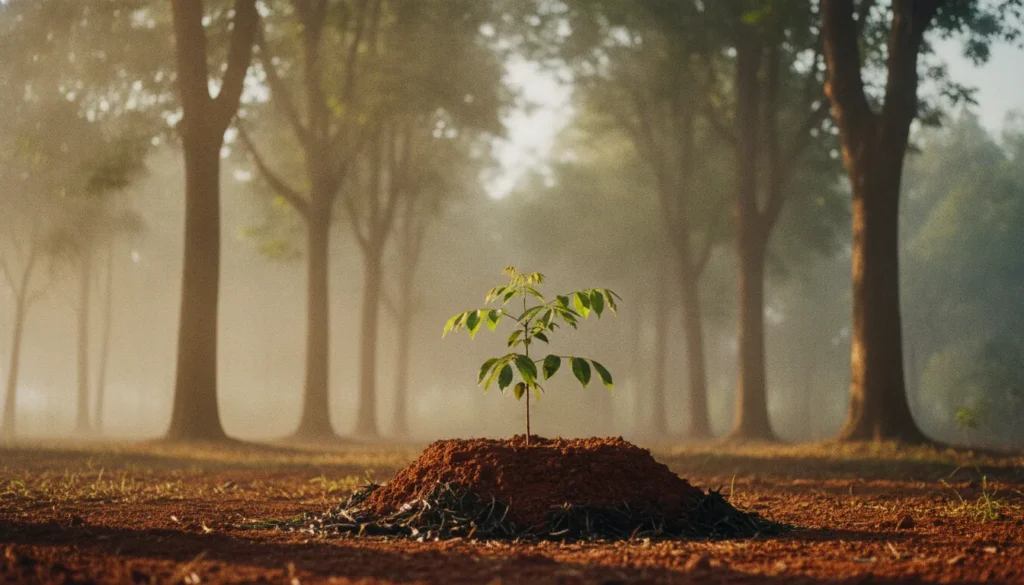
TNAU and ICAR list groundnut, chilli, turmeric, black gram, papaya, banana, melon and sugarcane as intercrops grown with melia dubia, and wider spacing holds the window open longer: 5 x 5 m or 8 x 8 m leaves more light than 3 x 3 m. Once the canopy closes the intercrop ends, and the land carries a single long crop with nothing sold until harvest.
When is melia dubia harvested, and what girth do buyers want
Melia dubia is harvested anywhere from 4 to 14 years, depending on the end use and the girth that buyer needs. The 6 to 8 year figure quoted most often sits inside that range rather than defining it.
| Harvest age | Condition |
|---|---|
| Within 4 years | Trees planted on bunds reaching harvestable size |
| 5 to 7 years | General guide figure |
| 8 to 12 years | Agroforestry rotation |
| 8 to 12 years | IPIRTI figure |
| 12 to 14 years | To reach an economic girth of 90 cm minimum |
Girth sets the date. Ply Reporter reported in 2020 that the match industry needs a minimum girth of 16 inches, and TNAU splits the market at 50 to 120 cm girth for billets against above 120 cm for logs, two classes sold on different units at very different rates.
Not every tree arrives together. The UAS data found 61 per cent of irrigated trees above 60 cm girth at four years against one rainfed tree in 301, and a FarmNest forum member estimated 30 to 40 per cent of trees at 10 x 10 ft reach 2 ft girth by 15 years: one person’s estimate, and the only girth-class distribution published on this crop. ICAR’s 21 kg per cubic foot makes a 15 cubic foot tree about 315 kg, which turns the question into a price question.
What is the current price of melia dubia per tonne
Published melia dubia prices run from about Rs 4,000 to Rs 12,000 a tonne, depending on girth class, buyer, and whether the price is at the farm gate or the factory gate. No official current mill-gate rate for 2026 is published.
| Price | Unit and condition |
|---|---|
| Rs 4,000 to 5,000 | Per tonne |
| Rs 4,500 to 5,500 | Per tonne, trees up to 5 years |
| Rs 5,000 | Per tonne, stated as a 2023 figure |
| Rs 5,000 to 7,000 | Per tonne, farm gate |
| Rs 9,000 to 11,000 | Per tonne, factory gate |
| Up to Rs 12,000 | Per tonne, 25 inch girth |
| Rs 7,300 | Per tonne, billets of 50 to 120 cm girth |
| Above Rs 370 | Per cubic foot, trees above 120 cm girth |
| Rs 350 | Per cubic foot, from the 5th year onwards |
ICAR’s 21 kg per cubic foot makes a tonne about 47.6 cubic feet, so Rs 7,300 a tonne is about Rs 153 a cubic foot, against the large-log rate above Rs 370. On one 15 cubic foot tree weighing about 315 kg that is roughly Rs 2,300 at the tonne rate against about Rs 5,250 at Rs 350 a cubic foot. Same tree, same wood, two prices, and the difference is which class the buyer puts it in.
That gap is where most per-acre claims are built: a projection that applies the log rate to every tree roughly doubles its own answer before it starts. Saplings move on a separate scale, Rs 18 a seedling in one published cost model against Rs 200 for a rooted plant on a contract-farming project page.
How much does it cost to grow an acre of melia dubia
Published cost models for an acre of melia dubia run from about Rs 1.8 lakh over eight years to about Rs 2.6 lakh over six. Both exclude the land, and one excludes harvesting and transport.
| Model | Planting stock | Period | Total, land excluded | What it leaves out |
|---|---|---|---|---|
| FarmAtma cost table | 302 plants at Rs 18 each | 6 years | About Rs 2.6 lakh, including Rs 45,000 of drip in year 1 | Land; harvesting and transport, which the model assumes the buyer bears |
| Contract-farming project page | 400 rooted plants at Rs 200 each | 8 years | About Rs 1.8 lakh | Land; no buyback terms published |
The cheaper model runs longer and uses dearer planting stock, which shows how much of the variation sits in choices rather than in the crop. Handing harvesting and transport to the buyer is doing real work too: on a crop where a tonne is about 47.6 cubic feet of bulky timber, felling and haulage are not rounding errors, and nothing published commits a buyer to paying them. Neither model prices the land, usually the largest number in the exercise, so see what managed farmland actually costs to own .
Is melia dubia farming actually profitable per acre
Melia dubia can pay, but the lakh-per-acre figures in circulation rest on several assumptions holding at once, and the published research does not support all of them.
Rs 25 lakh across 400 trees is Rs 6,250 a tree. At the Rs 7,300 a tonne billet rate that needs about 0.86 tonnes per tree, roughly 41 cubic feet. IFGTB and ICAR give 12 to 15 cubic feet a tree at five years under intensive management, around 15 cubic feet by 15 years. So the claim needs trees about three times the size the research reports, or every tree selling at log rates rather than billet rates, or both.
What has to hold for a high per-acre figure:
- Irrigation through every dry season of the rotation. The UAS figures show what happens without it.
- Most trees reach log girth at about the same time. The only published distribution, one grower’s estimate, puts that at 30 to 40 per cent by 15 years.
- A mill within reach. National demand and a buyer near your land are different facts.
- Harvesting and transport counted as costs, not assumed onto the buyer.
- The price holding six to twelve years out; the published range already spans Rs 4,000 to Rs 12,000 a tonne.
Look at who publishes the high numbers: sapling nursery blogs, contract-farming project pages and video channels selling planting material or planting services. A yield figure published by the party selling the saplings is a sales input rather than research, and none of those pages discloses the interest.
Hasiru Farms does not put yield promises on crops. We would rather hand you the arithmetic and the sources than a number you cannot check.
For melia dubia set against the alternatives, see how melia dubia compares with other farm crops per acre . For a slower, tightly regulated timber crop with a different price structure, see sandalwood profit per acre in Karnataka . One cost appears in none of the published models: the paperwork at the end.
Do you need permission to cut and sell melia dubia in Karnataka
No felling permission is required for melia dubia in Karnataka. The species sits on the exempt list under the Karnataka Preservation of Trees Act 1976, under its Kannada name, per a Vidhi Centre for Legal Policy analysis published in August 2021.
Transport is the part to verify yourself. A notification dated 7 December 2016, under Rule 144 of the Karnataka Forest Rules, exempted 42 species from transit rules, and we could not confirm whether melia dubia is one of them. Check with your Range Forest Office before you move timber, not after it is felled.
There is also a planting incentive. Krushi Aranya Protsaha Yojane, run by the Karnataka Forest Department since 2011-12, pays Rs 35, Rs 40 and Rs 50 per surviving seedling after years one, two and three, Rs 125 in all. It needs the RTC, also called the Pahani, with registration closing end of May, and melia dubia is not on the excluded-species list. Departmental seedlings are priced Re 1 to Rs 5 by poly-bag size. These details are as published on a government-scheme listing rather than the department’s own page, so confirm current rates at the Range Forest Office.
So is melia dubia worth planting on your land
Melia dubia is not a difficult tree. It is a demanding one: water every fortnight through the dry months, feeding every quarter for three years, weeding twice a month to year three, pruning twice a year, thinning as the canopy closes, and all of it for six to twelve years before anything is sold. Most of the distance between the published claims and real harvests is not the tree failing. It is care that did not happen, on land nobody was standing on.
That is the gap Hasiru Care closes. Hasiru Farms has been operating since 2021, with 300+ Acres delivered and 250+ Families. Hasiru Care is the in-house team that manages the farmland, backed by an in-house agronomy function, and it is on the ground at the Kanakapura Road corridor sites. It runs as ongoing management under a contracted service rather than a one-time sale: a Maintenance Agreement is executed between Hasiru and the buyer, under which Hasiru undertakes the management and maintenance of the farmland. Every buyer receives individual ownership of their farmland through a registered Sale Deed executed in their own name, and the agricultural character of the land is retained.
We do not lead with speculative returns, on melia dubia or on anything else. What we will do is tell you what a crop needs, who does the work, and what it takes to keep it going.
Frequently asked questions
Who buys melia dubia wood?
Plywood makers, pulp and paper mills, matchwood units and packing-case manufacturers. Ply Reporter reported in 2020 that southern plywood makers use melia dubia for core and face veneer, and ICAR’s April 2025 figures put pulp and paper raw material demand at 5.04 million tonnes against 2.76 million produced. A buyer within the transport range of your plot is a separate question.
What is the price of 1 kg of malabar neem wood?
At the Rs 7,300 a tonne billet rate given by the TNAU forestry portal, malabar neem works out at about Rs 7.30 a kg. Logs above 120 cm girth sell by the cubic foot instead, above Rs 370 per TNAU, so a per-kg figure understates a large tree.
What does a melia dubia sapling cost?
Published prices range from Rs 18 a seedling in one cost model to Rs 200 for a rooted plant on a contract-farming project page. Under Krushi Aranya Protsaha Yojane, Karnataka Forest Department seedlings are listed from Re 1 to Rs 5 by poly-bag size.
Is melia dubia wood termite resistant?
The farming guide FarmAtma describes melia dubia wood as termite resistant. We have not found that tested in the forestry research used for this page, so treat it as a supplier-side description until a buyer confirms it for your grade.
Do I get paid by the Karnataka government for planting melia dubia?
As published, Krushi Aranya Protsaha Yojane pays Rs 35, Rs 40 and Rs 50 per surviving seedling after years one, two and three, Rs 125 in all. You need the RTC, also called the Pahani, and registration closes by the end of May. Melia dubia is not on the excluded list. Confirm current rates with your Range Forest Office.
Who looks after a melia dubia plantation if I do not live near the farm?
Somebody has to, and it is a fortnightly job for six to twelve years: watering through every dry season, feeding every quarter for three years, weeding twice a month to year three, pruning twice a year, thinning as the canopy closes. Owners who visit occasionally either hire and supervise local labour themselves, or contract the management to a team already on the ground.