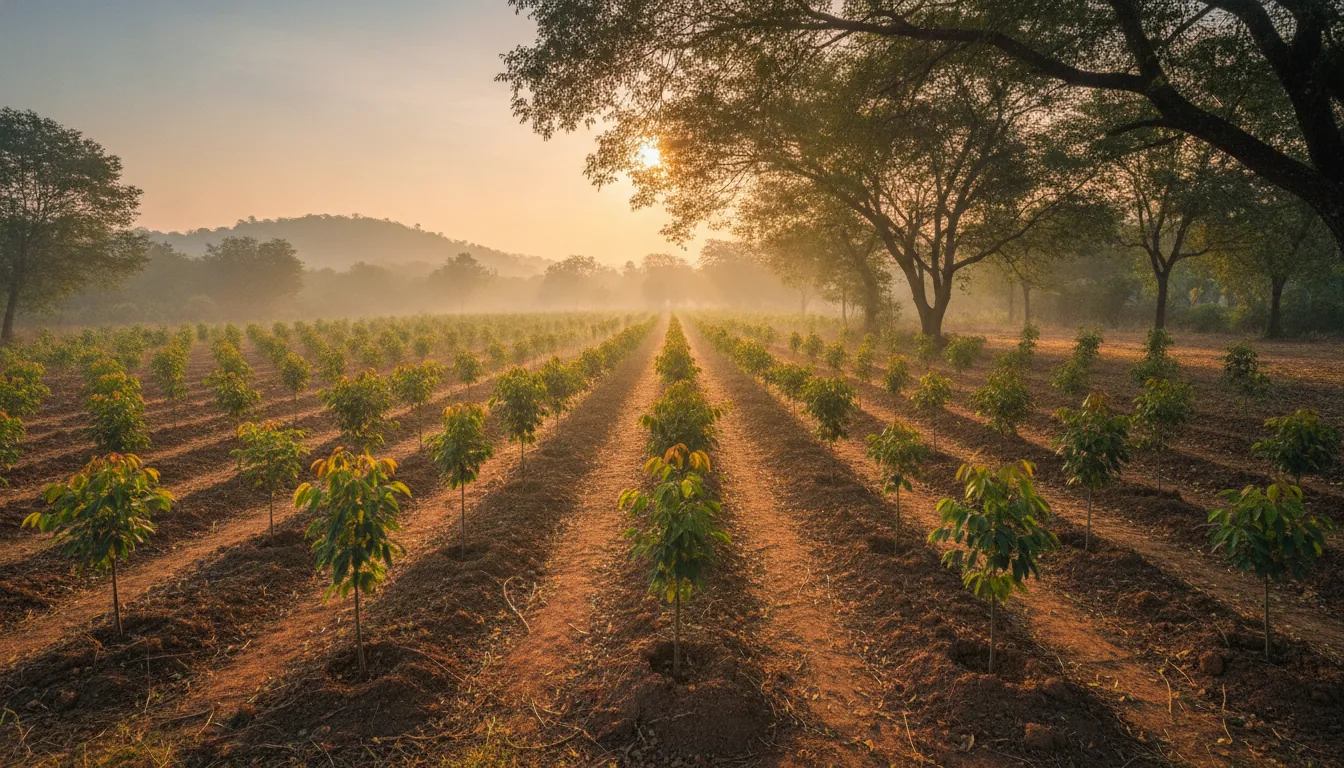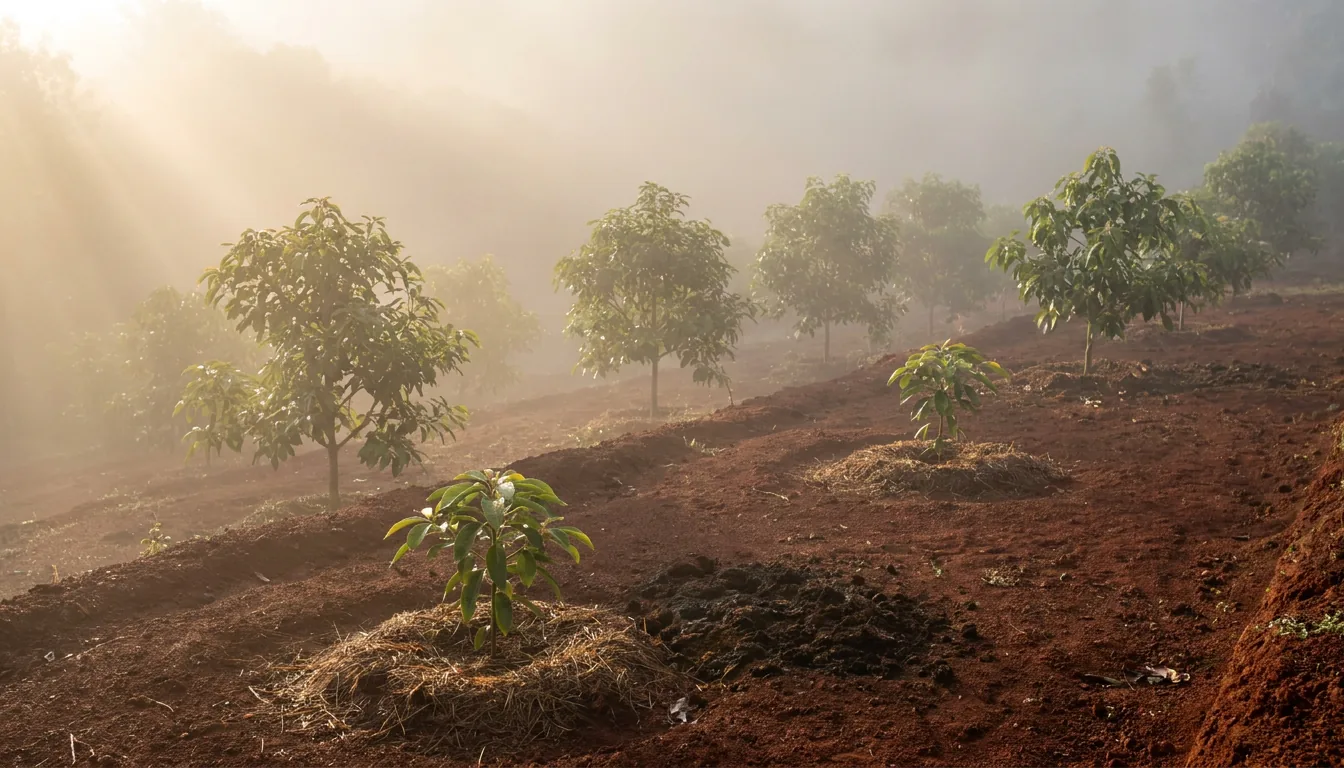
Avocado is being pitched across reels and nursery pages as India’s next big orchard crop, with talk of lakhs per acre and a country that imports most of what it eats. Some of that is true. This guide to avocado cultivation in India covers what the pitch skips: the land, the planting material, the real timeline, the market and the work.
Avocado can be grown commercially in India, but only on well-drained land with mild, frost-free weather, mostly in the southern hills. Grafted trees usually give a first crop in year 3 or 4, while ICAR-IIHR says commercial yields generally begin around year 8. Good grafted plants are scarce, and farm prices have swung sharply as imports surged.
TL;DR
- Land decides first – Avocado needs free-draining soil, 20 to 35°C, no frost and no hot dry winds. Waterlogging brings root rot, its most serious disease.
- Planting material is the first bottleneck – India has little grafted stock and, by one industry account, no commercial rootstock, while seedlings take 5 to 6 years to fruit (ICAR-IIHR).
- First fruit is not first income – Grafted trees fruit in year 3 or 4, and ICAR-IIHR puts the start of commercial yields at about year 8.
- Demand is real, but price is not protected – Imports more than doubled in 2025 by trade estimates, and import gluts pushed prices below cost in some weeks.
- The popular profit figures need a second look – Claims of ₹6 to 10 lakh per acre assume Israeli yields and prices well above a 2026 Kerala farm-price report.
In this guide
Avocado at a glance
| Item | What the sources say |
|---|---|
| Plant | Persea americana, a tropical American fruit tree, called butter fruit in India |
| Climate | Tropical to warmer temperate zones, 20 to 35°C no frost or hot dry winds (FAO paper) |
| Rainfall | 1,000 to 1,500 mm a year |
| Soil and pH | Well-drained, not black soil, pH 5.5 to 6.5 |
| Drainage | Essential; waterlogging worsens Phytophthora root rot |
| Spacing | 6 m x 6 m for grafted trees, about 110 plants per acre |
| First fruit | Grafted: about year 3 to year 3 or 4. Seedling: year 5 to 6 |
| Commercial yields | Generally from about year 8 after planting |
| Harvest | Coorg June to October; Tamil Nadu July to August; Sikkim July to October |
| Main risk | Root rot caused by Phytophthora cinnamomi |
What is avocado, and why is India planting it now
Avocado (Persea americana), known in India as butter fruit, is a tropical American fruit tree, and Indian growers are planting more of it because demand is rising quickly while most of the fruit sold here is still imported.
The tree is not new here. It was introduced from Sri Lanka (then Ceylon) over a century ago, yet it has stayed a small crop. A Bihar Department of Agriculture official, quoted by FreshPlaza in December 2025, put India’s area under avocado at about 1,400 hectares across the southern and north-eastern states.
What changed is the market. More than 55 importers brought in about 7,600 tonnes of avocado between January and May 2025, against 3,000 tonnes in the same months of 2024, according to FreshPlaza (July 2025). Trade estimates reported by Agro & Food Processing in December 2025 put calendar 2025 imports at nearly 19,000 tonnes, against roughly 9,000 tonnes in 2024, and government data showed imports up 135% in FY25.
Demand is also moving beyond the big cities. Bigbasket reported that avocado consumption quadrupled in a year in smaller cities such as Dehradun, Visakhapatnam and Nagpur. The Bihar official projected Indian consumption rising from 10,000 tonnes in 2024 to 40,000 tonnes in 2026 to 27, a projection rather than a measurement.
If you are still choosing between crops, start with how avocado compares with other farm crops per acre. On time to first fruit, avocado sits at the slow end, far from dragon fruit, a crop that fruits in under two years.
Rising demand explains the interest. Whether avocado will grow on a particular piece of land is a stricter question.
Where does avocado cultivation in India succeed, and will your land qualify
Avocado cultivation in India succeeds on free-draining soil with mild temperatures, no frost and no hot dry winds, which today means mainly the southern hills. Your land qualifies only if water does not stand on it after heavy rain, because waterlogging is what kills avocado trees.
ICAR-IIHR’s 2025 article in Indian Horticulture sets the band at tropical to warmer temperate zones, 20 to 35°C and 1,000 to 1,500 mm of rain a year, on well-drained soil of pH 5.5 to 6.5. It rules out black soil and any site that waterlogs. Orchards are mostly rainfed, with summer watering about every two weeks.
Altitude is a useful indicator, not a rule. An FAO paper by Saurindra P. Ghosh, then ICAR’s Deputy Director-General for Horticulture, describes successful orchards at 800 to 1,600 m in Sikkim’s hill ranges, at 12 to 30°C and about 2,000 mm of rain, and says avocado cannot tolerate hot dry winds or frost, which rules out northern India. ICAR-IIHR’s 2025 note gives no altitude at all; it works in temperature, rainfall and soil.
Drainage is the one point every source agrees on. The FAO paper names root rot caused by Phytophthora cinnamomi as the most serious avocado disease, and waterlogging makes it worse. A plot that holds water after heavy rain is a poor site at any altitude.
The map is also shifting. A 2026 PLOS One study led by G. Karunakaran of ICAR-IIHR, reported by ITFNet in January 2026, found Kerala and Tamil Nadu the most suitable areas today, which is where most Indian avocados come from. Under high emissions, it projects suitable land breaking into high-elevation patches by 2070.
Does your land qualify? A quick test
| Check | Your land passes if |
|---|---|
| Drainage | Water does not stand on the plot after heavy rain |
| Soil type | It is not black soil or heavy clay (on such soils, one nursery guide recommends raised beds) |
| Soil pH | 5.5 to 6.5 (ICAR-IIHR, 2025) |
| Temperature | Broadly within 20 to 35°C |
| Frost | None |
| Summer wind | No hot, dry winds |
| Water | 1,000 to 1,500 mm of rain a year, plus a source for summer watering about every two weeks |
| Soil test | Tested for pH, EC, calcium, sodium (SAR) and texture before planting |
A plot that fails the drainage line fails the test. Before you buy land for any orchard, read our guide to checking water and drainage before you buy a plot.
In Karnataka, avocado is grown today in the hill districts of Kodagu (Coorg), Chikkamagaluru and Shivamogga, mostly on mixed hill farms, and ICAR-IIHR’s avocado station sits at Chettalli in Kodagu. Tamil Nadu grows it in Kodaikanal, the Lower Pulney hills and the Nilgiris, home to the Fruit Research Station at Kallar. In Kerala, Ambalavayal in Wayanad has been declared an “Avocado City”. Maharashtra, Sikkim and the North-East also grow avocado, and new plantings are coming up in Telangana, Madhya Pradesh around Bhopal, and Gujarat.
Once the land passes, the next decision is which trees to plant.
Which avocado varieties suit Indian conditions
Hass is the best-known avocado variety, but green-skin types cope better with heat, and ICAR-IIHR’s Arka Supreme and Arka Coorg Ravi were selected in Karnataka for Indian conditions.
Avocados are grouped into three horticultural races: Mexican, Guatemalan and West Indian. India’s older types, such as Purple, Green and Pollock, grew mostly from seed. Today the choice is between ICAR-IIHR’s two releases, TKD-1, which is also noted for commercial cultivation, and imported named varieties.
Indian selections from ICAR-IIHR
| Variety | Released | Flowering type | Fat content | Fruit weight | Notes |
|---|---|---|---|---|---|
| Arka Supreme | 2020 | A | 18 to 20% | 400 to 450 g (370 to 420 g in the release summary) | Seedling selection from CHES Chettalli; regular bearing |
| Arka Coorg Ravi | 2022 | B | 12 to 14% | 450 to 600 g | Pulp recovery above 80%; suitable as a pollinizer for A-type varieties |
Imported varieties offered in India
| Variety | Skin | Flowering type |
|---|---|---|
| Hass | Black | A |
| Lamb Hass | Black | Not stated |
| Pinkerton | Green | A |
| Reed | Green | Not stated |
| Ettinger | Green | B |
| Fuerte | Not stated | B |
| Zutano | Not stated | B |
Why two flowering types? Each avocado flower opens first as female and later as male, at different times of day, and A-type and B-type varieties follow different timings, so an orchard with both types pollinates better. The agri-input guide suggests mixing A and B types at 1:1 or 2:1, and the nursery guide uses Ettinger as the B-type pollinator on 11 to 15% of trees. ICAR-IIHR describes Arka Coorg Ravi, a B-type, as suitable as a pollinizer for A-type varieties such as Arka Supreme.
Fruit quality differs as well. The Bihar official quoted by FreshPlaza described Indian fruit as having about 12% oil, firmer flesh, a smaller size and a shorter shelf life, against more than 18% oil and a longer shelf life in imported varieties. On heat, one nursery guide is direct: where the temperature crosses 35°C, choose green-skin types over black-skin Hass. ICAR-IIHR’s own sources give different yields for the Arka varieties; the yield section below sets out both.
A variety on paper is only useful if you can buy true plants of it, and that is where most Indian growers hit the first wall.
Grafted or seedling – why is planting material the first problem
Grafted plants are the better choice, and planting material is the first problem because grafted plants of named varieties are scarce in India, while seedlings take 5 to 6 years to fruit and vary from tree to tree.
A grafted tree carries a known variety on a rootstock, so its fruit and flowering type are known before planting. ICAR-IIHR propagates its varieties by softwood grafting and by chip and patch budding. Trees raised from seed are slower and differ from one another, which makes an orchard of them hard to plan.
Supply is thin at every level:
- No commercial rootstock. An avocado nursery’s July 2024 industry white paper states there is “not a single commercial avocado rootstock in India”.
- No seed imports. The Plant Quarantine Order 2003 allows avocado plants from listed countries but makes no provision for seeds, and flying live plants in is costly with high losses (same white paper). A nursery guide adds that imported plants spend a year in greenhouse quarantine.
- Limited public supply. ICAR-IIHR’s CHES Chettalli page records about 20,000 grafted Arka Supreme plants and about 15,000 grafted Arka Coorg Ravi plants supplied to farmers, and a licence for a private nursery to multiply Arka Supreme-3.
- Mostly seed-grown trees. Most trees in Kerala, Tamil Nadu and Karnataka are seed-grown, and growers face a shortage of pest-resistant rootstocks and strict import quarantine rules, the Bihar official told FreshPlaza in December 2025.
Working from ICAR-IIHR’s published figures, about 35,000 grafts in total would plant roughly 320 acres at 6 m x 6 m, or about 110 trees an acre. That is the scale of public grafted supply so far. The problem is old: the FAO paper noted that Indian avocado was mainly seed-propagated and that no commercial nursery then produced grafted or budded plants.
What grafted plants cost, and how to avoid a seedling sold under a variety name, is covered in a separate guide on avocado plant prices. For clarity, Hasiru Farms does not sell avocado plants or saplings.With sound plants secured, the orchard layout you choose is fixed for decades.
How do you plant and space an avocado orchard
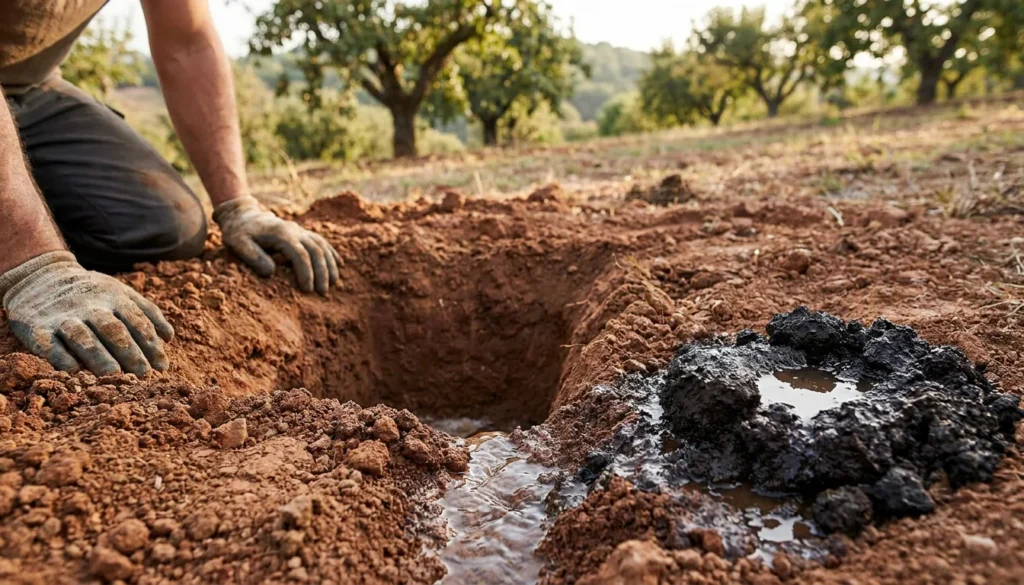
You plant an avocado orchard in 1 m³ pits filled with manure and topsoil, spacing grafted trees about 6 m x 6 m (roughly 110 per acre) and planting with the monsoon, according to ICAR-IIHR’s 2025 article.
ICAR-IIHR’s sequence is simple. Dig pits of 1 m³ in April to May, fill them with farmyard manure (FYM) and topsoil in a 1:1 mix, and plant in June to July or in September. Plan the A-type and B-type mix at this stage, because the rows you set now stay for the life of the orchard.
Avocado spacing and plants per acre
| Plant type | Spacing | Plants per acre |
|---|---|---|
| Grafted | 6 m x 6 m | About 110 |
| Seedling | 8 m x 8 m | About 60 |
| Seedling | 10 m x 10 m | About 40 |
| High density | 3.5 m x 7 m | 165 to 170 |
On black cotton or high-clay soils, the nursery guide recommends raised beds to keep roots out of standing water. Lay drip irrigation before planting, mulch around young trees, and plan for watering about every two weeks through summer, as ICAR-IIHR advises. Drip costs per acre are covered in a separate guide.
Feeding scales up with age. For mature trees, ICAR-IIHR recommends 50 kg of FYM plus N:P:K at 400:200:500 g per plant, split between a pre-monsoon and a post-monsoon application.
How long does an avocado tree take to fruit, and how much does it yield
An avocado tree takes about 3 to 4 years to fruit if grafted and 5 to 6 years if grown from seed, and ICAR-IIHR says commercial yields generally start about 8 years after planting.
Avocado timeline from planting
| When | What happens |
|---|---|
| Year 0 | Planting, with the monsoon |
| Year 3 to 4 | First fruit on grafted trees |
| Year 5 to 6 | First fruit on seedling trees |
| About year 8 | Commercial yields generally begin |
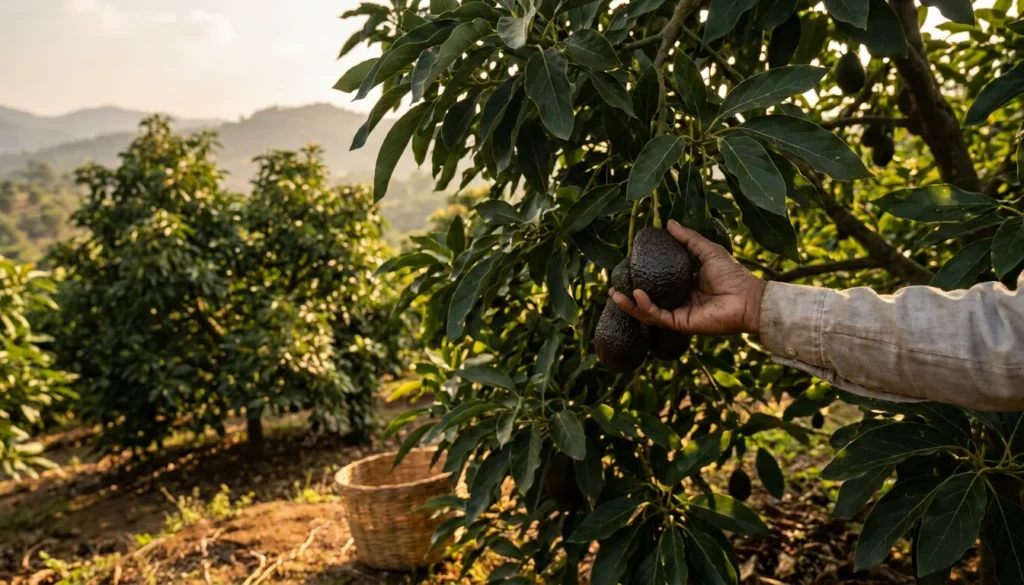
First fruit and first income are different milestones. Many online guides jump from “fruit in three years” straight to profit figures, and one search summary even claims grafted plants bear in about two years. Between a grafted tree’s first crop and ICAR-IIHR’s commercial stage sit four or five more seasons of feeding, drainage work and disease checks.
What work does an avocado orchard need through the year
The work an avocado orchard needs through the year is less frequent than for some fruit crops, but it runs for years: drainage checks, split feeding, summer watering and disease watch, all before the first commercial harvest.
The avocado year
| Season | Work | Why it matters |
|---|---|---|
| Pre-monsoon | First fertiliser split; dig pits in April to May for new trees | Feeds trees ahead of the rains and readies pits for monsoon planting |
| Monsoon | Check drainage after every heavy spell; watch for root rot; plant new trees in June to July | Waterlogging worsens Phytophthora root rot, the most serious avocado disease |
| Post-monsoon | Second fertiliser split; September planting window | Completes ICAR-IIHR’s split dose |
| Summer | Water about every two weeks; keep mulch in place | Mostly rainfed orchards still need summer water |
| Year-round | Light pruning; scout for scales, mealybugs, mites and fruit flies; watch for scab, stem rot and leaf spot | Limits pest and disease losses |
| Harvest | Pick firm fruit in the regional window and move it cool | Shelf life depends on handling and storage temperature |
Avocado season in India depends on the region: June to October in Coorg, July to August in Tamil Nadu and July to October in Sikkim, according to an October 2025 cultivation guide, and February to March in Wayanad, according to a 2026 Dhanam report. The FAO paper confirms Tamil Nadu’s July to August peak and notes that Sikkim’s Purple type ripens in July and its Green type in September to October.
Fruit is picked firm and moved cool. The FAO paper says avocados can travel for up to 14 days and unripe fruit stores for up to four weeks at 5.5 to 8°C, while the October 2025 guide gives 12 to 13°C at 90 to 95% humidity. Indian buyers prefer fruit of 250 to 300 g, so grading by size matters, and in storage the diseases to watch are anthracnose, stem-end rot and Fusarium rot.
India still has no organised marketing system for home-grown avocado. The FAO paper put this down to small, scattered production, and the Bihar official expects organised production to take another 5 to 10 years.
None of this is daily work, yet none of it can be skipped. An owner living in a city cannot see a blocked drain or a mite outbreak from there, so someone has to be on the plot each season. Here is how a managed care team looks after a young orchard.
That care costs money, and the most-quoted cost figures for avocado are often misread.
What does it cost to establish an acre of avocado
The most-cited public table, at older Himachal rates, puts the cost to establish an acre of avocado at about ₹88,700, and all cost lines together at about ₹2.17 lakh an acre, before land, fencing or a water source.
The table is Himachal Pradesh horticulture guidance, reproduced in an October 2026 agri-input guide, worked out per hectare for 277 plants at 6 m x 6 m and converted to per-acre figures by the guide.
Avocado cost table at Himachal rates
| Cost line | Per hectare | Per acre (guide’s conversion) |
|---|---|---|
| Establishment (plants, drip, pits, FYM, planting) | ₹2,19,040 | About ₹88,700 |
| Maintenance (inter-culture, fertiliser, pruning, irrigation, protection) | ₹1,60,000 | About ₹64,800 |
| Harvesting | ₹40,000 | About ₹16,200 |
| Watch and ward | ₹25,000 | About ₹10,100 |
| Packing | ₹50,000 | About ₹20,200 |
| Amortised cost | ₹42,000 | About ₹17,000 |
| Total, all lines | ₹5,36,040 | About ₹2.17 lakh |
Read it with two cautions. First, ₹2.17 lakh an acre is the sum of every line, not the establishment cost that some search summaries call it; establishment on its own is about ₹88,700 an acre. Second, the guide calls these old rates to be re-priced locally, and it does not say whether the maintenance line is annual or one-time.
The costs these tables leave out come with time: about eight years of upkeep before commercial yields, replacing trees lost to root rot, paying for genuine grafted stock, and absorbing price swings when the crop finally sells. Land, fencing and a water source sit outside the table altogether.
Government support for avocado is not settled. The 2024 nursery white paper said avocado has no equivalent of the MIDH support of up to ₹4 lakh per hectare given to kiwi, grapes and passion fruit, while the Bihar official in December 2025 named MIDH support for nurseries, drip-irrigated orchards, cold chains and market links. Support varies by state, so check with your District Horticulture Officer.
Cost is half the picture. The other half is what the fruit sells for.
What price does Indian avocado fetch, and how do imports affect it
The price Indian avocado fetches depends on where it is sold: a Kerala report from August 2026 put prices in producing regions at ₹60 to 70 a kilo, down from about ₹340, while metro shops charged ₹400 to 500.
Avocado prices reported in India
| Price level | Figure | Where and source |
|---|---|---|
| Farm price, producing regions | ₹60 to 70/kg, down from about ₹340/kg | Kerala; Dhanam |
| Metro retail | ₹400 to 500/kg | Kerala report; Dhanam |
| Retail | ₹400 to 500/kg | Telangana; AgroSpectrum |
| Indian avocado, retail | ₹500 to 600/kg | A nursery’s industry white paper |
| Imported Hass, retail | About ₹1,500/kg | Same white paper |
| Wholesale assumption, not a market report | Black skin about ₹200/kg; green skin ₹100 to 150/kg | A nursery’s growing guide |
No official farm-gate price series exists for avocado in India, so these are individual reports, not an index, and the August 2026 figure is one region’s price, not a national one. The distance between ₹60 to 70 at the farm and ₹400 to 500 on a metro shelf is the part of the price a grower does not see.
Imports shape that price. Tanzania supplied about 95% of import volume between January and May 2025 and Kenya most of the rest, with Peru, Chile, Australia and New Zealand among India’s other suppliers. Tanzanian fruit enters India duty-free. In the July 2025 report, the India head of a major importer said pricing had been “under considerable pressure, particularly for Tanzanian fruit, due to excess supply”.
Gluts are the sharper risk. In some 2025 weeks India consumed about 14 to 15 containers while 25 to 30 arrived, and importers described a “rapid price collapse” with fruit sold “at levels far below cost” . Imports prove the demand is real. They do not protect an Indian grower’s price, because duty-free fruit arrives in waves and a glut week hits every seller at once.
Put this price picture next to the eight-year timeline, and the profit claims online start to look different.
Is avocado farming profitable in India
Avocado farming in India can be profitable for a well-sited, well-run grafted orchard once it reaches commercial bearing, but the widely quoted figures of ₹6 to 10 lakh per acre rest on Israeli yields and assumed prices.
What the widely quoted number assumes
A widely quoted nursery estimate puts the figure at around ₹6 to 7 lakh an acre from green-skin varieties and ₹8 to 9 lakh from black-skin varieties. It is built on:
- Yields from Israeli orchards: about 6 tonnes an acre for green skins and about 4.5 tonnes for black skins.
- Assumed wholesale prices of about ₹200/kg for black skins and ₹100 to 150/kg for green, well above the ₹60 to 70/kg farm price in the August 2026 Kerala report.
- A mature orchard, with no cost per acre and no years to first fruit stated.
- The author’s own caveat that these are “conservative estimates” and that “actual returns depends on the market rate of the future”.
Search summaries repeat these figures as fact. By contrast, an agri-input guide published in October 2026 said it “did not find a reliable” farm or retail price and gave no profit figure at all.
What has to go right before an avocado orchard is profitable:
- Land that drains, every monsoon.
- Grafted plants of named varieties, with both A and B types.
- About eight years of care before commercial yields, as ICAR-IIHR describes.
- No serious losses to root rot along the way.
- A buyer at a fair price, outside the import-glut weeks.
This guide gives no profit figure of its own. Hasiru Farms does not lead with speculative returns, and an avocado orchard’s numbers depend on every one of the five conditions above.
For a comparison, see the per-acre numbers for mango over a similar horizon. If you are weighing the land as well as the crop, read what owning managed farmland actually costs.
Those five conditions weigh most on owners who cannot be on the land themselves.
Is avocado a good crop if you don’t live on the land
Avocado can be a good crop if you don’t live on the land and are patient, but the risk sits in the long gap before commercial yield and in a single bad monsoon.
The work is less frequent than for dragon fruit, but avocado’s tasks cannot be skipped. A drainage channel that silts up before the rains, or root rot left unchecked, can cost trees that took years to grow.
Water matters too. Even a mostly rainfed orchard needs summer watering about every two weeks, so the plot needs a dependable water source and someone to run it.
This is the case for managed farmland. The owner holds the land, and a management team on the ground does the seasonal work. If the model is new to you, start with how managed farmland works. For another long-lived orchard crop, compare mango, the orchard crop most Karnataka buyers start with.
A few shorter questions come up often enough to answer on their own.
What else do people ask about avocado farming in India
Can avocado be grown in India?
Yes. Avocado is grown commercially in India on well-drained, frost-free land with mild weather, mostly in the southern hills of Karnataka, Kerala and Tamil Nadu. A Bihar horticulture official put the national area at about 1,400 hectares in December 2025.
How many avocado trees can be planted in one acre?
About 110 grafted avocado trees can be planted in one acre at ICAR-IIHR’s spacing of 6 m x 6 m. Seedling trees at 8 m x 8 m or 10 m x 10 m give about 60 or 40 an acre, and a nursery’s high-density layout of 3.5 m x 7 m fits 165 to 170.
Are avocados hard to farm in India?
Avocados are not hard to farm week to week in India, since they need less weekly labour than some fruit crops, but they leave little room for error. Waterlogging brings Phytophthora root rot, good grafted plants are scarce, and ICAR-IIHR says commercial yields generally start about 8 years after planting.
Can avocado be grown in north India?
Avocado is generally unsuited to north India. An FAO paper by ICAR’s then Deputy Director-General for Horticulture says the tree cannot tolerate hot dry winds or frost, which makes northern India unsuitable.
Why does an avocado orchard need two varieties?
An avocado orchard needs two varieties because each flower opens as female and then as male at different times of day, and A-type and B-type varieties follow different timings. Planting both types, at about 1:1 or 2:1, gives better pollination.
What is avocado called in India?
Avocado is commonly called butter fruit in India. Its scientific name is Persea americana, and it reached India from Sri Lanka, then Ceylon, over a century ago.
When is avocado season in India?
Avocado season in India depends on the region: June to October in Coorg, July to August in Tamil Nadu and July to October in Sikkim, according to an October 2025 cultivation guide. A 2026 report from Kerala ties Wayanad’s harvest to February and March.
Who looks after an avocado orchard if I don’t live nearby?
An owner who lives away needs a team on the ground for drainage checks, feeding, pest scouting and harvest. At Hasiru Farms, that role sits with Hasiru Care, the in-house team that manages and maintains owners’ farmland under a formal Maintenance Agreement with each buyer.
Avocado and orchard crop guides
- The best crops for managed farmland in India
- A complete guide to dragon fruit farming in India
- The complete guide to mango farming in India
Is avocado worth the wait, and who looks after the orchard until year 8
Avocado is worth the wait only on land that drains, in a climate without frost or hot dry winds, and for an owner ready for first fruit around year 3 or 4 and commercial yields around year 8.
Most plots fail that test before anyone plants: black or heavy clay soil, water that stands after rain, dry summer winds, or frost. On plots that pass, one waterlogged monsoon or a seedling sold as a named variety can set an orchard back by years. Avocado in India means real demand, a long wait and very little room for neglect.
The fear buyers of farmland raise most often is paying for a plot that then sits neglected, with surprise costs, and a crop that takes about eight years to reach commercial yield tests that fear hard. At Hasiru Farms, management is a contracted service, not a one-time sale: a Maintenance Agreement is executed between Hasiru and the buyer, under which Hasiru undertakes the management and maintenance of the farmland.
Hasiru Care, the company’s in-house management team, works with an in-house agronomy team and is on the ground at the Kanakapura Road corridor sites. Every buyer receives individual ownership through a registered Sale Deed in their own name. Hasiru Farms has operated since 2021, with 300+ acres delivered and 250+ families.
To see how managed ownership works before you decide on any crop, start with Hasiru Farms managed farmland near Bengaluru, then look at the Vruksha project on the Kanakapura corridor and managed farmland along Kanakapura Road.