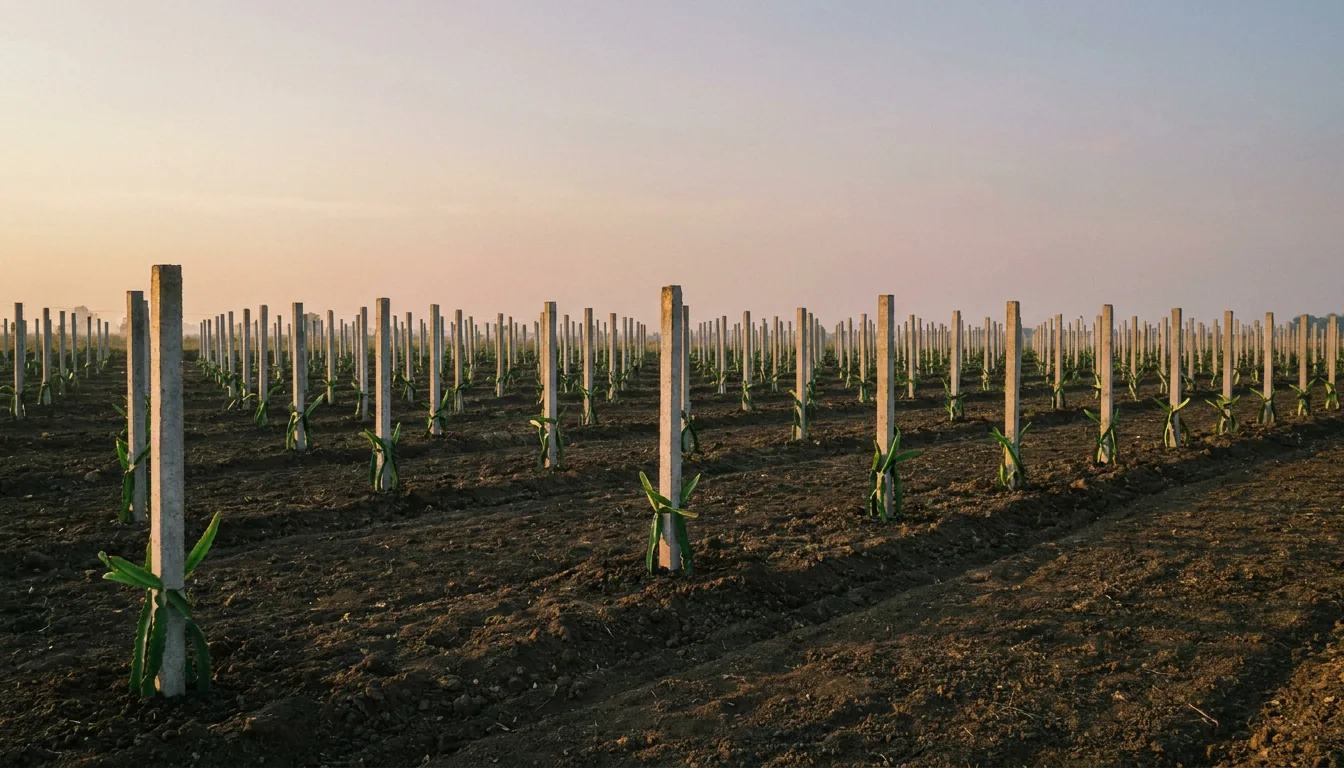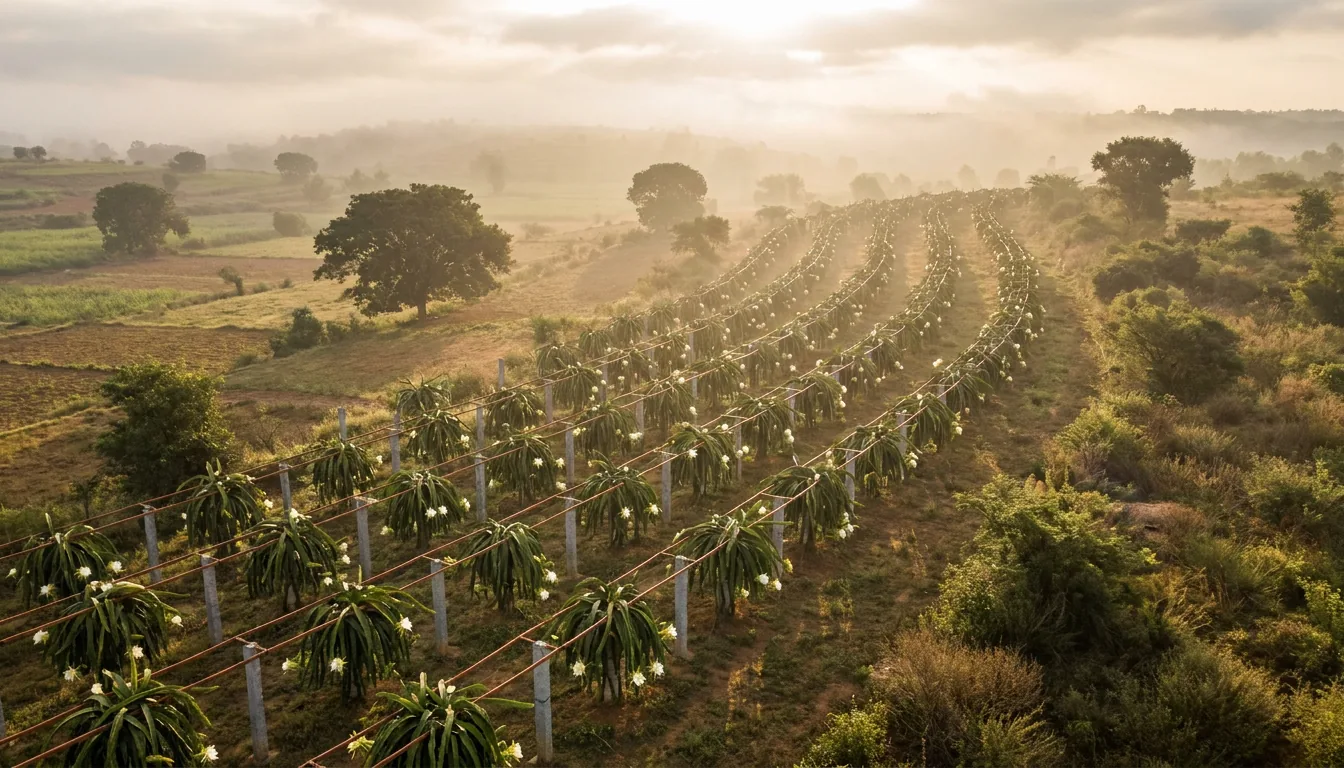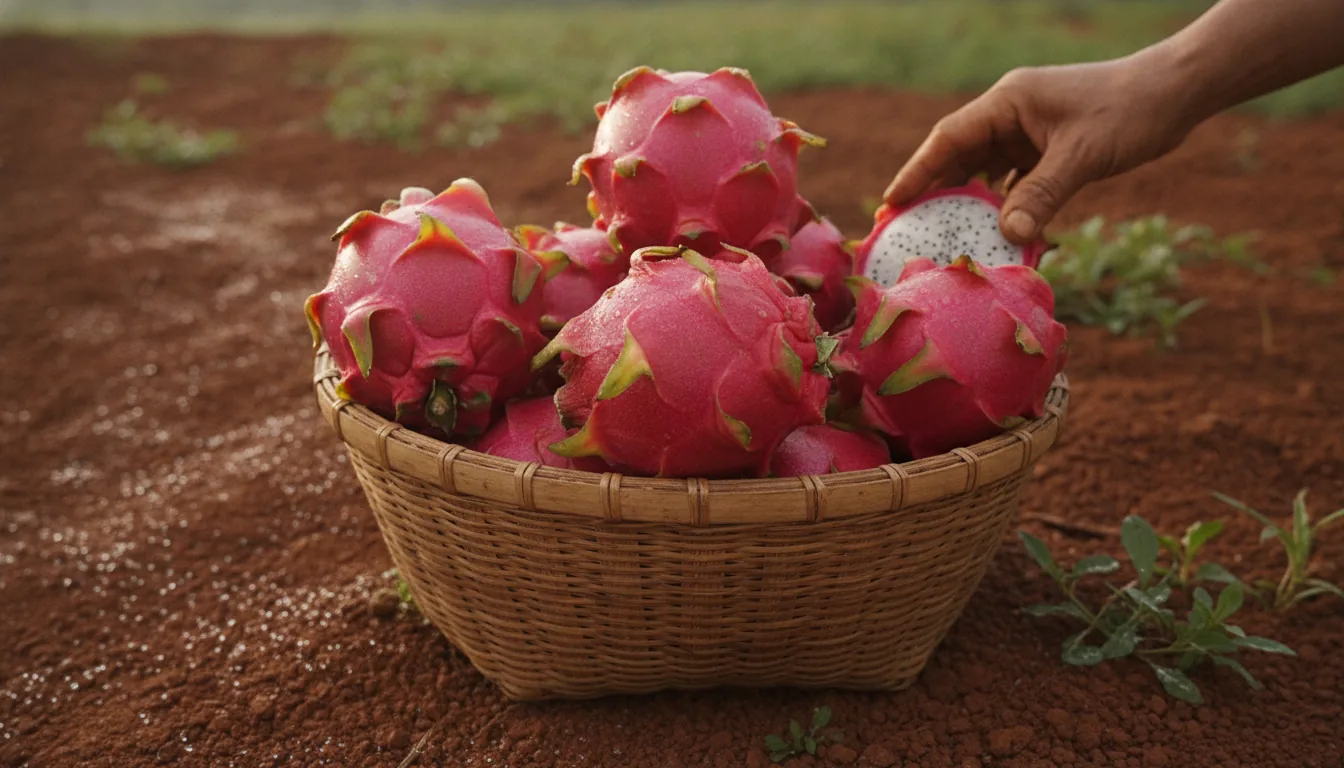
Dragon fruit has a reputation as the low-water crop for dry land. If you are weighing farmland near Bengaluru, the real question is whether it will grow well on your side of the city, and national guides do not answer that. Karnataka’s districts differ in rainfall, soil and groundwater, and those differences decide how a dragon fruit block performs.
Yes, dragon fruit grows well in most of Karnataka’s dry zones, including the Kanakapura and Chikkaballapur sides of Bengaluru. The Kanakapura side gets a normal 823 mm of rain a year and Chikkaballapur about 785 mm, both inside the crop’s 500 to 1,500 mm range. What decides success locally is drainage in heavy red clay, a reliable borewell, and someone on the plot every week in season.
In short, Karnataka is one of India’s leading dragon fruit states, and IIHR in Bengaluru hosts a Centre of Excellence for Kamalam (dragon fruit). Both Bengaluru corridors fall inside the crop’s rainfall range, so the tests that matter are drainage, groundwater and weekly labour. The MIDH subsidy that applies in Karnataka is 40% of a ₹6.75 lakh per hectare cost norm, not 50%.
On this page
Is Karnataka a good state for dragon fruit farming
Yes, Karnataka is a good state for dragon fruit farming. It is one of India’s leading growers, and IIHR in Bengaluru hosts a Centre of Excellence for Kamalam (dragon fruit) under MIDH.
How much land is under the crop depends on who is counting, and the published figures do not agree. Here is what each source says, with its date.
- 2020: 485.6 ha in Karnataka, of which 388.5 ha were new plantings and 97.1 ha were established orchards. The state produced 2,369.9 tonnes, about 19% of India’s output, up from roughly 8 to 10 ha under the crop in 2012.
- October 2023: over 800 hectares across Karnataka, according to Dr G. Karunakaran of IIHR, who described Karnataka as India’s top dragon fruit producer.
- October 2024: 431 ha, up 207 ha on the previous year, with 2022-23 output of 4,501 tonnes worth ₹43.68 crore.
So estimates range from about 430 to over 800 hectares, depending on the source and year. Every count points the same way, though: from about 10 ha in 2012 to several hundred hectares in the latest figures.
The research base sits close to the city. IIHR’s Centre of Excellence for Kamalam at Hirehalli, Bengaluru, was approved under MIDH in 2023 and works on production, post-harvest handling and value addition.
Karnataka at a glance
- Area under dragon fruit: about 430 to over 800 ha, depending on source and year
- Share of national output: about 19% in 2020
- Research base: IIHR Centre of Excellence for Kamalam, Hirehalli, Bengaluru
- Subsidy rate: 40% of a ₹6.75 lakh per ha cost norm, up to 2 ha
If you are still choosing a crop, see how dragon fruit compares with other tree and fruit crops for managed farmland. A state-level picture only goes so far, though. Whether the crop suits your land depends on what it needs from rain and soil.
What climate and soil does dragon fruit need, and where does Karnataka fit
Dragon fruit needs a warm climate of 20 to 30°C, 500 to 1,500 mm of rain a year, and loamy, free-draining soil at pH 5.5 to 6.5 that never becomes waterlogged.
These figures come from ICAR-NIASM Technical Bulletin 27 (2021). The waterlogging line matters more than any other in this table.
| Requirement | What dragon fruit needs |
|---|---|
| Temperature | 20 to 30°C preferred |
| Annual rainfall | 500 to 1,500 mm (the bulletin’s FAQ allows up to 1,700 mm) |
| Soil type | Loamy soil rich in organic matter |
| Soil pH | 5.5 to 6.5 |
| Waterlogging | Cannot tolerate it |
| Root depth | Shallow, under 40 cm |
| Salinity | Tolerates moderately saline soils |
| Drought | Moderately drought tolerant |
Both Bengaluru corridors sit in Karnataka’s eastern dry zone and get about 785 to 823 mm of rain a year. That falls inside the crop’s range, so rainfall is not the constraint here.
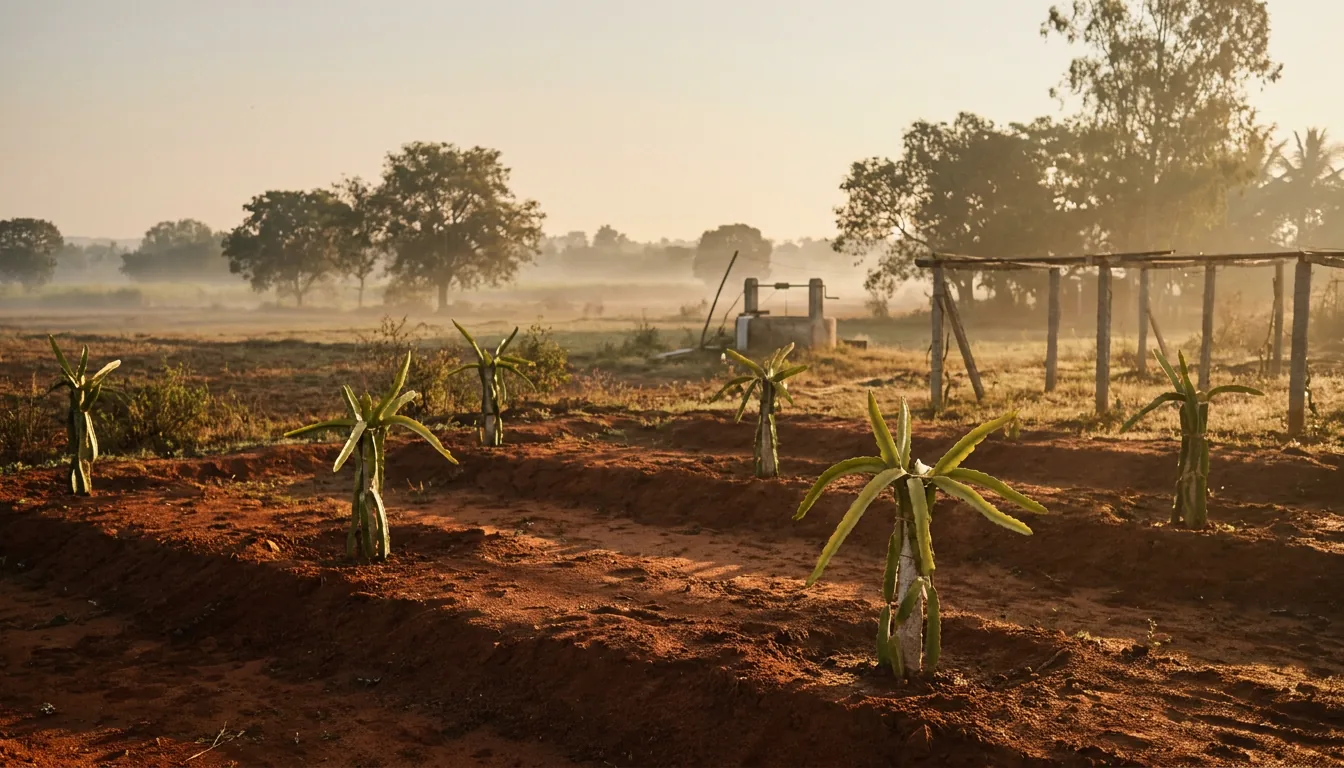
Soil is where the local risk sits. Most soils on the Kanakapura side are red clay, and a shallow-rooted crop that cannot tolerate waterlogging struggles where heavy clay holds water after rain. Raised beds or mounds, with drainage, address that risk.
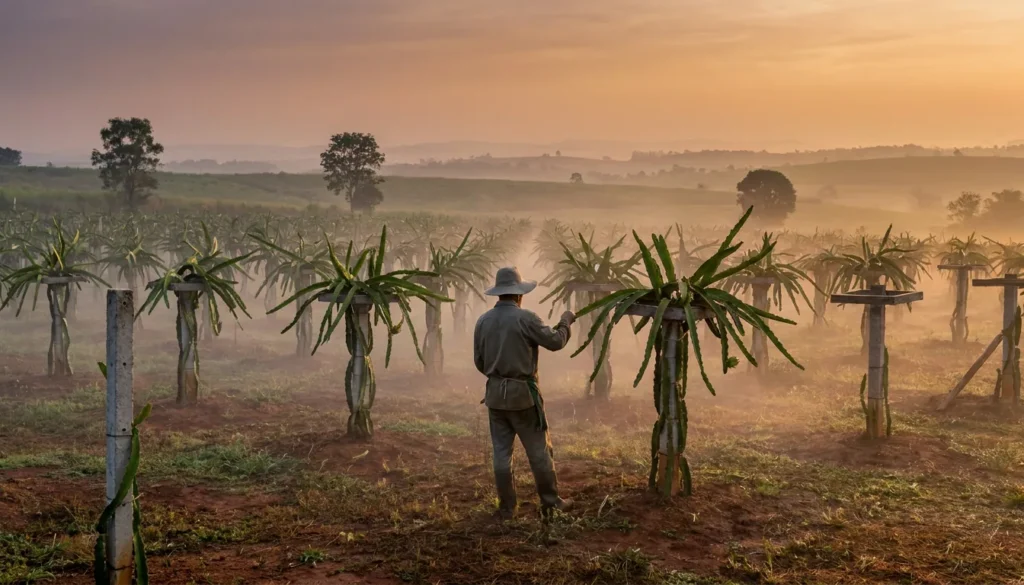
Spacing, trellis design and planting are covered in the full dragon fruit growing guide. Here, the next step is to see how the two corridors around Bengaluru compare, factor by factor.
Does dragon fruit grow well near Bengaluru – Kanakapura and Chikkaballapur compared
Yes, dragon fruit can grow well near Bengaluru on both the Kanakapura and Chikkaballapur sides, because both get rainfall inside the crop’s range. Each corridor carries a different local risk: drainage on the Kanakapura side and groundwater on the Chikkaballapur side.
| Factor | Kanakapura side | Chikkaballapur side |
|---|---|---|
| District | Bengaluru South (formerly Ramanagara) | Chikkaballapur |
| Agro-climatic zone | Eastern Dry Zone (KA-5) | Eastern dry climatic zone, semi-arid |
| Annual rainfall | 823 mm normal, across 63 rainy days | About 785 mm average |
| Dominant soils | Red clay: deep red clay 31.6%, moderately deep red clay 25.6%, shallow red soils 19.3% | Red and lateritic soils |
| Water source and risk | Borewells are the main irrigation source; 68% of cropped area is rainfed | Relies almost entirely on overexploited groundwater; declining water table; fluoride and nitrate contamination |
| What to check before planting | Drainage in deep red clay; plan raised beds or mounds | Water quality test and borewell yield |
What should you check on the Kanakapura side?
On the Kanakapura side, check drainage first, because red clay dominates the soils of Bengaluru South (formerly Ramanagara) district. ICAR-CRIDA’s 2011 contingency plan for Ramanagara records deep red clay on 31.6% of the district, moderately deep red clay on 25.6% and shallow red soils on 19.3%. In heavy clay, raised beds or mounds keep the shallow roots above standing water.
Rain arrives in two seasons. The south-west monsoon (June to September) brings 426 mm and the north-east monsoon (October to December) 230 mm, with 150 mm in summer and 17 mm in winter. For the dry months, water comes mainly from borewells. The district had 47,902 borewells irrigating 36.6 thousand ha, and 68% of its cropped area was rainfed. That makes the borewell on your specific plot more important than any district average.
Perennial fruit is already established here: mango is the district’s dominant fruit crop, on 20,000 ha.
One note on names. Karnataka renamed Ramanagara district as Bengaluru South by notification on 23 May 2025, and Ramanagara continues as the district headquarters. Older data, including the CRIDA plan, is filed under Ramanagara.
What should you check on the Chikkaballapur side?
On the Chikkaballapur side, check the water itself before anything else. The district averages about 785 mm of rain a year, sits in the semi-arid eastern dry climatic zone and is dominated by red and lateritic soils, according to a District NRDMS Centre report to KSCST (April to July 2025).
The same report found that Chikkaballapur relies almost entirely on overexploited groundwater, with a declining water table and fluoride and nitrate contamination. Before you plant, get the borewell’s yield confirmed and the water tested. Dragon fruit is moderately drought tolerant, but a plot that depends on overexploited groundwater needs that check first.
Weighing a corridor? Read about managed farmland on the Kanakapura side or farmland near Nandi Hills in Chikkaballapur. Better still, visit a delivered Hasiru project and meet existing owners on the land.
Bengaluru’s corridors are not the only part of the state where the crop is being tested. The drier north has research plots of its own.
Where else in Karnataka is dragon fruit being grown and tested
Dragon fruit is being grown and tested in Karnataka’s Central and Northern Dry Zones, with research trials and farmer plots at Bagalkot, Arabhavi in Belagavi district and Kadur in Chikkamagaluru district.
A 2025 study linked to UHS Bagalkot, published in Plant Science Today, ran trials and farmer plots at three sites:
- Kadur, Chikkamagaluru (Central Dry Zone)
- KRCCH Arabhavi, Belagavi (Northern Dry Zone)
- MHREC Bagalkot (Northern Dry Zone)
The study grew two species: Hylocereus undatus, which has white flesh, and Hylocereus costaricensis, which has pink flesh. Second-year yields were modest, at about 1,250 to 1,290 kg per acre.
Growers outside the research stations are planting it too. NewsKarnataka cited a grower in Tumakuru, and the Horticulture Department confirmed rising consumption of local fruit.
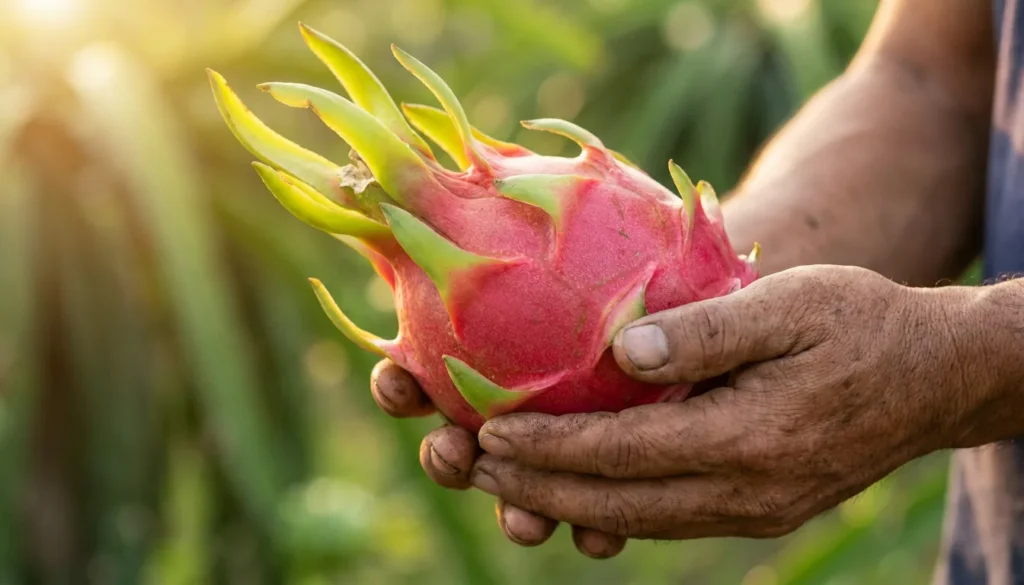
Dragon fruit’s Karnataka map follows the dry zones. For a contrast with another crop, see how avocado’s Karnataka districts differ.
If you are planning a block of your own in any of these zones, the next question is usually subsidy.
Is there a subsidy for dragon fruit farming in Karnataka
Yes, there is a subsidy for dragon fruit farming in Karnataka through MIDH, routed via the state horticulture department. It covers 40% of a ₹6.75 lakh per hectare cost norm, for up to 2 ha, paid in two instalments.
The rule sits in the MIDH Operational Guidelines 2025, under Annexure V, B.2 (Establishment of New Gardens, cost-intensive fruits). The ₹6.75 lakh norm includes material for the trellis and other support systems.
| Subsidy element | MIDH 2025 rule |
|---|---|
| Cost norm for dragon fruit | ₹6.75 lakh per ha, including trellis and support material |
| Assistance in general areas, including Karnataka | 40% of cost, up to 2 ha, pro rata |
| Where the 50% rate applies | North-Eastern and Himalayan states, Scheduled areas and the islands only |
| Payment | Two instalments, 60:40 |
| Survival condition | 80% survival rate in the second year |
| Drip irrigation | Assisted separately under PDMC norms |
Karnataka is a general-category state, so 40% is the rate that applies here. You may see 50% quoted online for Karnataka. Under the 2025 guidelines, that higher rate is reserved for the North-Eastern and Himalayan states, Scheduled areas and the islands.
How do you apply for the dragon fruit subsidy in Karnataka?
You apply for the dragon fruit subsidy through your taluk or district horticulture office, and scheme notifications appear on the Karnataka Department of Horticulture portal, horticulturedir.karnataka.gov.in. The Karnataka Exotic Fruit Farmers Association, a growers’ association rather than an official source, lists Aadhaar, the RTC, bank details and a FRUITS ID where required as the commonly needed documents.
We found no separate Karnataka-only dragon fruit scheme in official sources. Confirm current availability with your district horticulture office before you budget for it, and remember that the second instalment depends on 80% of your plants surviving into the second year.
For the setup bill itself, see what cuttings and the trellis cost before subsidy. Subsidy helps with setup. What the orchard yields, and what the fruit sells for, is a separate and less predictable question.
What yield and price can a Karnataka grower realistically expect
A Karnataka grower can realistically expect modest yields while the orchard is young, and prices that swing with seasonal gluts and imports.
The UHS Bagalkot-linked trials recorded about 1,250 to 1,290 kg per acre in the second year (2025). Figures quoted elsewhere vary widely by source and year, so treat any single yield number with care.
Price is harder still to pin down. ICAR-NIASM (2021) put domestic prices at ₹55 to 250 per kg, rising to ₹300 to 450 per kg off-season, with seasonal gluts driving the swings. Three market facts from the same bulletin sit behind that range:
- Short shelf life: the fruit keeps 5 to 7 days at ambient temperature, so it has to sell fast.
- Weak handling: cold chains and grading are still thin.
- Imports: farmers consider unrestricted imports from countries like Vietnam and Thailand their biggest market problem.
Supply is also set to rise. India had more than 3,000 ha under the crop in March 2023, and acreage is expected to expand to 50,000 ha in five years under MIDH . With supply planned to grow many times over, today’s price is not a number to plan a farm around.
We do not lead with speculative returns, so this page gives no income figure. For setup costs and yield over time, see a sourced per-acre cost and yield model. One more local factor decides the outcome, and it is the one a city owner cannot supply from Bengaluru: the weekly work.
Who looks after a dragon fruit plot if you live in Bengaluru
A dragon fruit plot needs someone looking after it every week from June to November, so an owner who lives in Bengaluru needs a formal management arrangement with people on the ground.
The work is hands-on and tied to the season. Dragon fruit flowers bloom at night, and one Karnataka grower with 11 acres uses honeybees to pollinate them . Fruit is ready 30 to 35 days after flowering, and the harvest runs from June to November.
Dr G. Karunakaran of the IIHR Centre of Excellence told the BBC that “farmers harvest small quantities every month” and that “a family can manage one acre”. That second line assumes the family lives on the land. For a Bengaluru owner, it means someone else has to be on the plot every week for half the year.
Buyers ask us the same thing in different words: what is actually done on my plot if I rarely visit, and will it be maintained after I pay?
At Hasiru Farms, that is settled in writing. A Maintenance Agreement is executed between Hasiru and the buyer, under which Hasiru undertakes the management and maintenance of the farmland. Hasiru Care is already on the ground on the Kanakapura Road corridor, where it manages Malgoodi, for example. All Hasiru projects involve agricultural land, and the agricultural character of the land is retained.
Which crops suit a particular project is worth asking about on a site visit. To see what the arrangement covers, read how Hasiru Care manages farmland for owners.
Dragon fruit farming in Karnataka – frequently asked questions
Which state is the largest producer of dragon fruit in India?
The largest producer of dragon fruit in India depends on the source and year. ICAR-NIASM’s 2020 figures show Gujarat leading on area within a national total of 3,084.6 ha, with Karnataka producing about 19% of national output. In October 2023, IIHR’s Dr G. Karunakaran described Karnataka as India’s top producer.
How many times a year is dragon fruit harvested?
Dragon fruit is harvested in small quantities every month through one season, from June to November in India, according to IIHR and ICAR-NIASM (2021). Each fruit is ready 30 to 35 days after its flower opens.
Does dragon fruit need a lot of water in Karnataka?
No, dragon fruit does not need a lot of water. It is moderately drought tolerant and suits 500 to 1,500 mm of rain a year, but it cannot tolerate waterlogging. In Chikkaballapur, where groundwater is overexploited, test the borewell’s yield and water quality before planting.
Can I grow dragon fruit on farmland I own but do not live on?
Yes, you can grow dragon fruit on farmland you do not live on, provided someone works the plot every week from June to November for night flowering, pollination and monthly harvests. An absentee owner needs a formal maintenance arrangement with people on the ground, and should confirm the crop choice with the manager before planting.
Do I own the land in my own name at Hasiru Farms?
Yes, you own the land in your own name at Hasiru Farms. Every buyer receives individual ownership of their farmland through a registered Sale Deed executed in their own name.
What happens to my land if the managing company shuts down?
Your land stays yours if the managing company shuts down. Because a Hasiru buyer holds individual registered title, the land remains theirs regardless of what happens to the company.
Is dragon fruit a guaranteed income crop?
No, dragon fruit is not a guaranteed income crop. Prices swing with seasonal gluts, the fruit keeps only 5 to 7 days at ambient temperature, and farmers name unrestricted imports from countries like Vietnam and Thailand as their biggest market problem.
What should you do next if dragon fruit fits your corridor
If dragon fruit fits your corridor, and on rainfall it fits both the Kanakapura and Chikkaballapur sides, your next step is to check the plot itself: how it drains, how reliable its borewell is, and who will do the weekly work.
Those three decide the outcome. A drainage check and a water test settle the first two. The third is the one a city owner cannot supply from Bengaluru.
Hasiru Farms has been operating since 2021, with 300+ acres delivered and 250+ families. Every buyer receives individual ownership through a registered Sale Deed executed in their own name, and a Maintenance Agreement sets out how Hasiru manages and maintains the farmland.
To see a Hasiru project on one of these corridors, look at Vruksha on the Kanakapura side. For the wider picture, read our guide to managed farmland near Bengaluru, or start at Hasiru Farms.