On This Page
Sandalwood farming in India is legal, potentially valuable, and long in horizon. Most guides sell the fantasy of quick crores and skip the law, the wait and the risk. This guide covers the legal position, the growing method and the honest economics, so you can weigh sandalwood as a real use of land rather than a headline.
In short: sandalwood farming is legal on private land in India, permitted in Karnataka from the 2001 state reform and later liberalised in other southern states. Trees take about 12 to 15 years to reach harvest, must be registered with the forest department, and are sold through regulated channels. It rewards patient, well-managed land. It does not reward anyone chasing a quick return.
TL;DR Sandalwood is a slow, legal, tightly regulated crop. The law opened up in stages between 2001 and 2022, the trees need host plants and 12 to 15 years, and the money question is tangled up with permits, theft risk and government-controlled sale. The honest path is patient, well-managed land, not a fast return.
Is sandalwood farming legal in India
Yes. Sandalwood farming is legal on private land in India. Karnataka permitted private individuals to plant and grow sandalwood through the Karnataka Forest (Amendment) Act, 2001, and later reforms widened who a grower may sell to. Harvest and trade remain regulated by the forest department.
The full picture is more reassuring than the one-line version most pages give, because the law moved in stages. For over two centuries the state, not the landowner, held control of the tree.
| Year | What changed |
|---|---|
| 1792 | Mysore State declared sandalwood a Royal Tree, taking state control of it. For more than 200 years a landowner could not sell sandalwood, even trees that grew naturally on their own land. |
| 2001 | The Karnataka Forest (Amendment) Act, 2001 allowed private individuals to plant and grow sandalwood. The government still controlled the trade. |
| 2008 | Two state agencies, KSDL and KSHDC, were authorised to buy sandalwood directly from private growers. |
| 2022 | The rules changed again to let farmers sell to any entity, not only government agencies. |
Timeline drawn from government and industry reporting.
Planting is only the start of the legal path. A sandalwood tree must be registered with the forest department, and felling and transporting the harvested wood each require a separate permit. This is why the legality question and the sale question are really one question, worked through in full in the full legal position on sandalwood farming.
For a buyer, legality also means clean title to the land the trees stand on, which is a separate matter from the tree law. That side is set out in exactly what you own when you buy Hasiru farmland.
How do you actually grow sandalwood – Soil, climate, host trees and spacing
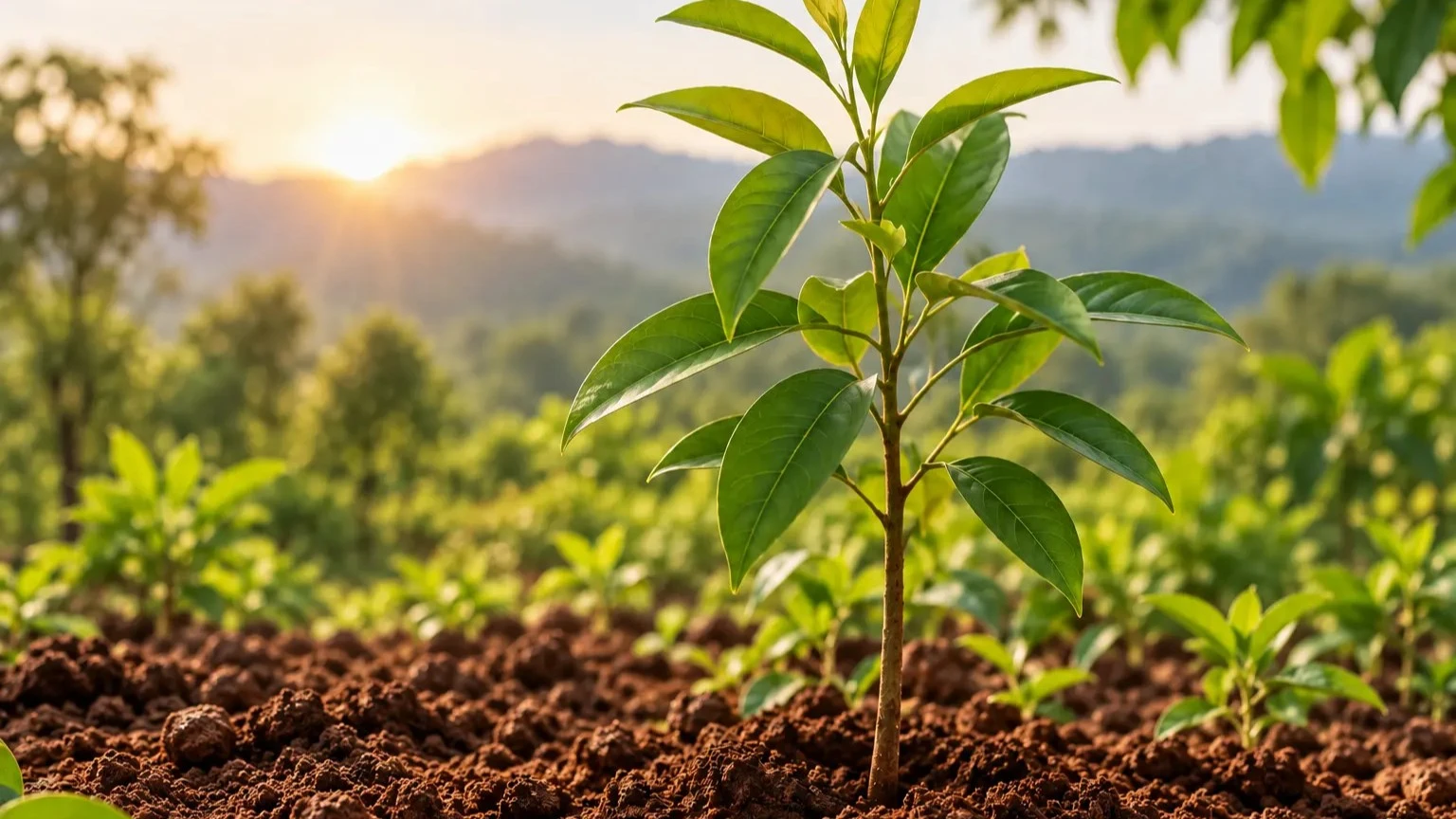
Sandalwood is a hemiparasite. It draws part of its nutrition through the roots of neighbouring host plants, so it cannot be grown alone. It needs red loamy soil, a pH of 6.5 to 7.5, warm temperatures, and a compatible host tree planted beside each sapling.
The species grown for oil is Santalum album, also called Indian or white sandalwood. As a partial root parasite, each young tree must sit next to a host that feeds it through shared roots. Common hosts include pigeon pea (red gram), casuarina, Melia dubia, Sesbania, Pongamia pinnata, Cassia siamea and custard apple.
Sandalwood grows across a wide band of southern India. It tolerates temperatures from about 10 to 40 degrees Celsius and altitudes from roughly 300 to 1,100 metres. It does best in well-drained red loamy or ferruginous soil with a pH between 6.5 and 7.5. Irrigation needs stay modest once the trees establish, and many growers intercrop in the early years while the trees are small.
| Spacing | Approx. trees per acre |
|---|---|
| 15 x 15 ft | About 193 |
| 12 x 12 ft | About 302 |
| 10 x 10 ft | About 435 |
Density figures drawn from industry planting guides.
Spacing is a genuine trade-off between tree count and host resources, so the step-by-step of raising a single tree, from sapling to host pairing to pruning, is covered in how to grow a sandalwood tree, step by step.
How long does a sandalwood tree take to grow and harvest
A sandalwood tree takes about 12 to 15 years to reach commercial harvest in India. The valuable heartwood begins forming around 8 years, but fuller, denser heartwood can need longer. Growth and survival vary from plot to plot, so no fixed tree count is guaranteed at harvest.
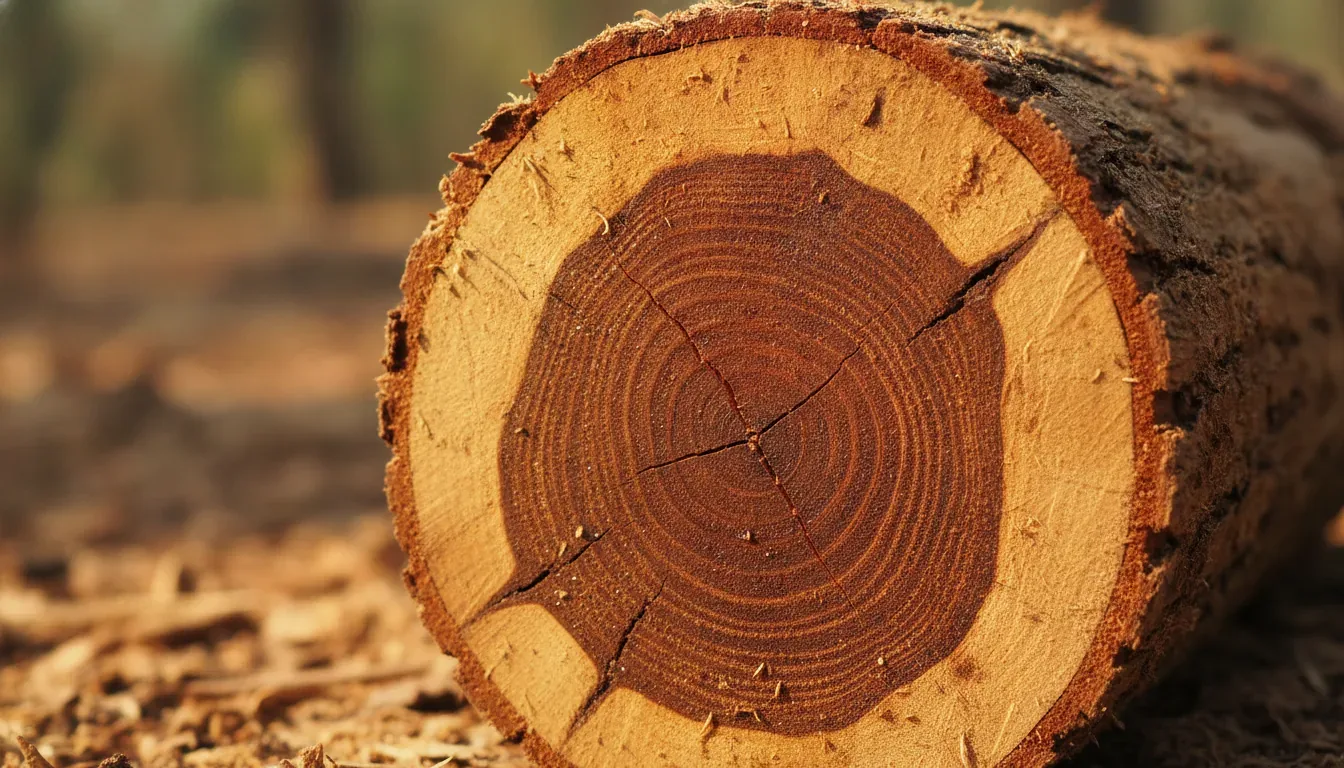
Heartwood is the scented, oil-bearing core of the tree, and it is the part that carries the value. It forms slowly. Development can begin at about 8 years, yet strong heartwood often needs well beyond that, which is why longer rotations are common. Survival is not a given either. In one documented planting, about 1,000 saplings left roughly 650 surviving trees at 15 years, and even those carried less heartwood than hoped.
The number a plantation actually harvests depends on soil, host health, water, care and protection over the full period. Because heartwood weight and grade drive the eventual value far more than tree age alone, the money question is handled in the profitability section below rather than by any single per-tree price.
Red vs white sandalwood: which is grown
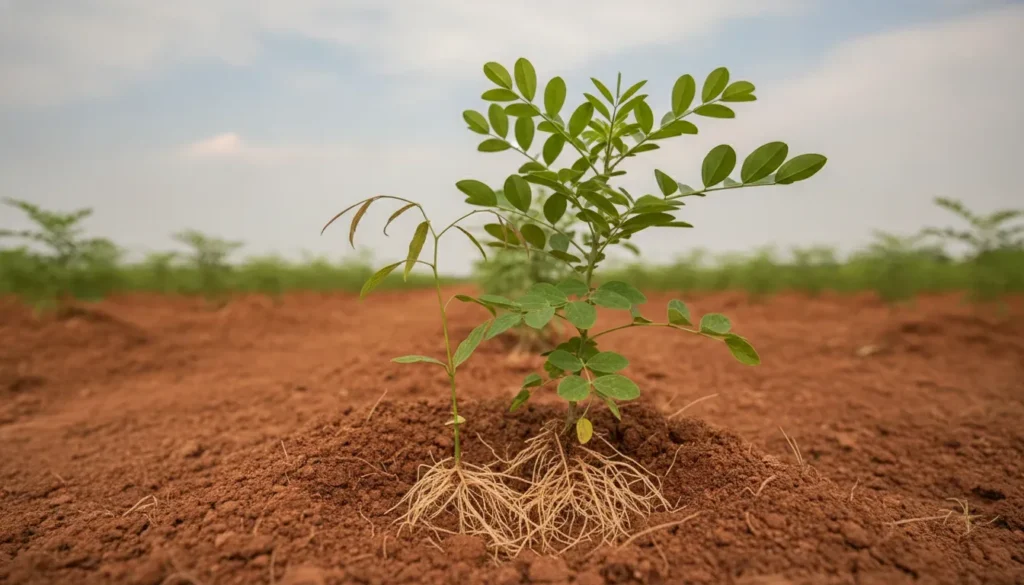
White sandalwood (Santalum album) is the oil-bearing species most farmers grow, harvested at about 15 to 20 years. Red sandalwood (Pterocarpus santalinus) is a different tree, carries no aromatic oil, grows far slower, and is tightly regulated, with its own rules and heartland in Andhra Pradesh.
| Feature | White sandalwood (Santalum album) | Red sandalwood (Pterocarpus santalinus) |
|---|---|---|
| Aromatic oil | Yes, the source of sandalwood oil and santalol | No aromatic oil; valued for the wood and its colour |
| Typical rotation | About 15 to 20 years | Much longer |
| Regulation | Regulated; cultivation liberalised in southern states | Tightly regulated under a distinct legal regime |
| Main region | Karnataka and the southern belt | Andhra Pradesh |
The two are often confused because both are called sandalwood, but they are separate species with separate economics. How red and white sandalwood differ covers the split in full, and red sandalwood farming in Andhra Pradesh covers the red variety and its own rules.
Which states allow sandalwood farming, and where is it grown most
Sandalwood cultivation is liberalised in Karnataka, Tamil Nadu, Kerala, Andhra Pradesh and Telangana. Karnataka holds the largest share of India’s natural sandalwood extent, around 60 percent, and remains the centre of both cultivation and the regulated trade in the tree.
Karnataka is the historical and current heartland, which is also why its 2001 and 2022 reforms set the pattern other states followed. Tamil Nadu and Kerala share much of the same growing belt. Andhra Pradesh and Telangana are more associated with red sandalwood. Rules differ by state, so where you grow shapes both what you can plant and how you must sell.
Growing sandalwood in Karnataka goes into the state’s specific rules and corridors. The picture also shifts year on year as more land comes under cultivation, tracked in sandalwood farming in India in 2026.
Is sandalwood farming profitable in India
Sandalwood can be valuable, but profit turns on grade, heartwood weight and the long wait, not on a headline per-acre figure. High-quality heartwood has been valued at up to about Rs 78 lakh per tonne, roughly Rs 7,800 per kg. Against that sit 12 to 15 years, permits, theft risk and no guaranteed survival.
The demand behind those numbers is real and easy to verify. Indian sandalwood production fell from about 4,000 tonnes a year in the 1960s to roughly 350 tonnes by 2014. As of 2022, only around 130,000 mature trees were estimated to remain across Karnataka, Tamil Nadu and Kerala combined. India imported nearly 20,000 kg of sandalwood from Australia between 2019 and 2024, worth about Rs 100 crore, and the IUCN listed Indian sandalwood as vulnerable back in 1997. Supply is short and shrinking, which is what supports the price.
None of that makes a plantation a quick win. A single tree may yield roughly 12 to 18 kg of heartwood at about 15 years, but yield, grade and survival all vary, and the capital stays locked for well over a decade before any sale. Treat published prices as market context, not as a projected return on your land. Managed farmland is not a fast financial product. It is ownership of a real, tended place that happens to hold a slow, valuable crop.
The number-crunching, acre by acre, is done in realistic sandalwood profit per acre in Karnataka, and the honest yes-or-no sits in is sandalwood farming actually profitable.
What are the real risks and rules of sandalwood farming
The main risks are time, theft and regulation. Capital is locked for 12 to 15 years, mature trees are a frequent theft target, and every harvest, felling and transport step needs a forest-department permit. Sale runs through regulated channels, not the open market.
Theft is the risk the hype pages skip. A grown sandalwood tree is portable value, and thieves know it. One grower reported losing mature trees worth about Rs 40,000 in a single year, then spending around Rs 2.5 lakh on CCTV to protect the rest. Security is a real, recurring cost across the full rotation, not a one-off.
How you get paid is regulated too. In the traditional route a grower cannot simply sell harvested logs on the open market. The wood is auctioned by the government through state depots on the grower’s behalf. Historically the grower received the large majority of the auction price, with industry reporting describing about an 80 percent share to the grower after a 20 percent government deduction. The 2022 Karnataka change widened who a grower may sell to, easing that constraint, though registration and permits still apply.
Add the survival uncertainty and the decade-plus lock on capital, and the honest summary is that sandalwood rewards patience, protection and clean paperwork. Those three are exactly where a managed model earns its place.
Who looks after a sandalwood plantation for 12 to 15 years
A managed-farmland model handles it. If you own a plot but cannot tend it daily, a management company plants, guards and maintains the trees under a formal agreement, while the land stays registered in your name. That is the practical answer to a crop that takes 12 to 15 years.
This is the operational gap most sandalwood content leaves open. Hasiru Farms has operated since 2021 and delivered 300+ acres across 250+ families, with on-ground Hasiru Care teams maintaining sites on the Kanakapura Road corridor. The registered entity is Hasiru Farms Enterprises Pvt Ltd, run from a Bengaluru office.
Ownership is individual and registered. Every buyer receives exclusive title to a specific parcel through a registered Sale Deed executed in their own name. Each plot is individually surveyed and demarcated before sale, an 11E sketch is approved in the buyer’s name, the khata is mutated to the buyer, and an individual survey number is assigned. Across the transaction the buyer receives a Payment Receipt and Letter of Promise at booking, a Sale Agreement before registration, the Registered Sale Deed at registration, and after mutation the RTC, Encumbrance Certificate, Akarband, Mutation Register Extract, Patta Book and latest Tax Receipts. You do not need to be a farmer to buy; non-agriculturists are eligible. Because these are sales of agricultural land, not residential or commercial development, the projects fall outside RERA.
That answers the question almost every buyer asks first. Do you own the land in your own name, and what happens to it if the company disappears. You hold individual registered title, so the land remains yours regardless of what happens to the company. A separate maintenance agreement between you and Hasiru governs the ongoing care and management of the farmland, and the management cost is set per plot under that agreement rather than by a flat published fee.
Because the crop needs a decade and a half of tending, that maintenance agreement is the point, not an add-on. Before any project, Hasiru runs legal due diligence including parent-title verification for 60 years or more where available, Encumbrance Certificates, RTC and mutation checks, PTCL verification, a litigation check, a nil-tenancy check and zoning. Owners stay free to sell or transfer, under a Right of First Refusal policy: if Hasiru declines, the owner may sell to a third party through Hasiru on agreed terms.
For sandalwood specifically, that managed model is Parva, our managed sandalwood project on Kanakapura Road. The logic is the one this guide has built toward: individual registered title, professional management across the full 12 to 15 years, and security for a crop that needs guarding, rather than a promise of a number.
Sandalwood farming FAQs
How much profit is in 1 acre of sandalwood?
There is no guaranteed figure. Returns depend on how many trees survive, the heartwood weight and grade at harvest, and the market price 12 to 15 years out. High-quality heartwood has sold for up to about Rs 7,800 per kg, but that is context, not a promise. The acre-by-acre working sits in the sandalwood profit per acre guide.
How many sandalwood trees can be planted in 1 acre?
Roughly 300 to 435 trees, depending on spacing. At 12 by 12 feet a plantation holds about 302 trees per acre, and at a tighter 10 by 10 feet about 435. Wider 15 by 15 foot spacing gives around 193. Closer spacing raises the count but competes for host resources.
What is the price of a 20-year-old sandalwood tree?
There is no single price. A tree’s value comes from the weight and grade of its heartwood, not its age, so two 20-year-old trees can be worth very different amounts. Older trees usually carry more heartwood, which is why longer rotations are common, but grade still decides the figure.
How much does 1 kg of sandalwood cost?
High-quality sandalwood heartwood has been valued at up to roughly Rs 7,800 per kg, based on industry and government reporting. The rate is grade-dependent, so lower grades fetch considerably less, and prices move with the ongoing supply shortage.
How do I get a licence for a sandalwood plantation?
In liberalised states such as Karnataka you do not need a licence simply to plant sandalwood on your own private land. You do register the trees with the forest department, and you need permits for felling and for transporting the harvested wood. Registration and permits, not a planting licence, are the real legal steps.