On This Page
If you have looked at dragon fruit on a reel or a nursery website, you have probably seen the same pitch: poles go up, fruit arrives in 18 months, and an acre pays back lakhs a year. The crop is real, and it does grow well across much of India. What the pitch leaves out is what dragon fruit cultivation in India actually involves: the trellis bill, the measured yields, what the fruit sold for in 2026, and who does the work at night.
Dragon fruit is a climbing cactus grown on concrete poles, and in India it usually starts fruiting 12 to 20 months after planting, with full bearing from about year three. Setting up an acre is commonly put at Rs 3 to 5 lakh, most of it poles. It can work, but farmgate prices in one Karnataka district had fallen to Rs 40 to 70 a kilo by July 2026, and the crop needs pollination at night and picking every few days through the season.
Dragon fruit at a glance
| What | Figure |
|---|---|
| Plant type | Climbing cactus, genus Hylocereus, family Cactaceae |
| Introduced to India | Late 1990s |
| First fruit | 12 to 20 months after planting |
| Full bearing | From about year three, after 36 months |
| Published orchard life | 20 to 25 years, the same life quoted for cement poles |
| Standard layout | About 450 poles an acre at 12 by 8 feet, 4 cuttings a pole, roughly 1,800 plants |
| High-density model | 10,000 plants a hectare at 2 by 2 m, about 4,050 an acre (derived) |
| Setup cost, one acre | About Rs 2.6 lakh to Rs 5.2 lakh, land excluded |
| Flowering | 4 to 5 flushes, May to September |
| Harvest | 3 to 4 flushes, June to October, fruit 35 to 40 days after flowering |
| Shelf life | 5 to 7 days at ambient conditions, up to 20 days reported |
| Main risks | Monsoon rain during flowering, anthracnose, stem canker, fruit fly, sunburn above 42 C, price swings in the June to November glut |
What is dragon fruit, and why is dragon fruit cultivation in India growing so fast
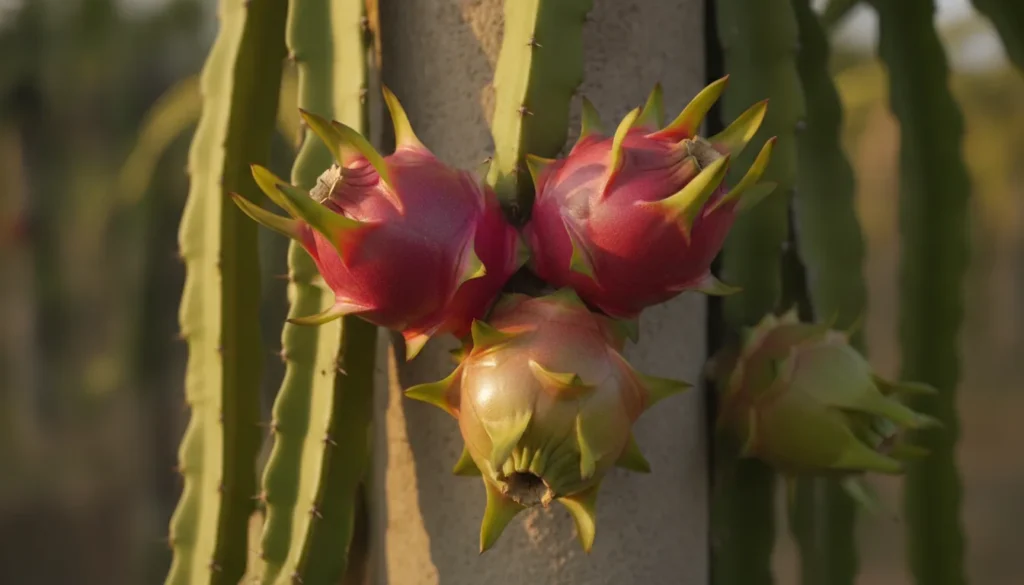
Dragon fruit is the fruit of a climbing cactus in the genus Hylocereus, introduced to India in the late 1990s. Cultivation is growing fast because the crop bears within two years, tolerates dry conditions and now sits inside government horticulture targets.
The plant is a cactus, not a tree. Four species account for almost all commercial planting: Hylocereus undatus, with red skin and white flesh; H. polyrhizus, with red flesh; H. costaricensis; and H. megalanthus, which has yellow skin. Internationally the fruit is called pitaya. In January 2021 Gujarat renamed it kamalam, citing the lotus-like shape of the fruit, and government documents now use both names.
The planted area has moved fast. An ICAR-NIASM technical bulletin put the all-India area at about 3,084.6 hectares in 2020. By August 2025, an ICAR article in Indian Farming reported about 14,510 hectares producing about 53,720 tonnes. Working from those two published figures, the area grew roughly 4.7 times in five years. In March 2023, when the reported area was still more than 3,000 hectares, the Mission for Integrated Development of Horticulture, MIDH, set a target of 50,000 hectares within five years.
Most of the dragon fruit sold in India used to be imported. Vietnam produces about 1.4 million tonnes a year from about 55,000 hectares, according to the August 2025 ICAR article, and Vietnamese fruit made up 99.74 per cent of India’s dragon fruit imports in 2015-16. India’s own first commercial export consignments went to London and Bahrain, announced by the Commerce Ministry on 4 August 2021.
Speed to the first fruit is the crop’s main attraction. Set against a slower orchard crop like mango , which takes several years to come into bearing, dragon fruit asks for its money early and starts answering within two years. If you are still choosing between crops, it is worth reading how dragon fruit compares with other farm crops per acre before committing an acre to poles.
Where it will actually grow is the next question, and it is narrower than the marketing suggests.
Where does dragon fruit grow well in India
Dragon fruit grows well on warm, sunny, well-drained land with a soil pH of 5.0 to 7.0. Heat above 40 degrees Celsius and waterlogging are the real limits, not dry weather. Gujarat, Karnataka and Maharashtra are the major growing states.
On temperature, a 2026 industry guide puts the optimum at 25 to 35 degrees Celsius, with the plant stressed below 10 and above 40, and stem sunburn above 42. It suggests 10 to 30 per cent shade net through peak summer. The August 2025 ICAR article agrees that sustained temperatures above 40 degrees are harmful and adds that the plant is frost-sensitive. Six to eight hours of direct sun is the working figure in both.
On rainfall, the same ICAR article records plantings from 500 mm at Baramati to 2,500 mm in Tripura. The NEC/NEDFi package of practice gives a band of 1,145 to 2,540 mm. The 2026 industry guide puts the optimum lower, at 50 to 60 cm, and calls for raised beds and drainage above 80 cm. Read together, those figures say the plant handles a wide rainfall band as long as water leaves the root zone quickly.
Soil should be loose and fertile, sandy to loam, and the 2025 ICAR account rules out waterlogged low-lying land. Raised beds are standard practice where rainfall is high. A farming-information website suggests planting moringa or melia dubia as a shade tree on the orchard edge to reduce summer sunburn, which is a cheaper answer than shade net on a large block.
That rainfall band is why the state questions have different answers. Gujarat is among the major growing states, so dragon fruit farming there is well established. Kerala sits at the wet end of the published band, closer to the 2,500 mm Tripura plantings than the 500 mm Baramati ones, so drainage and raised beds matter more there than irrigation does.
Karnataka
Karnataka’s planted area went from roughly 8 to 10 hectares in 2012 to about 485.6 hectares producing 2,369.9 tonnes in 2020, according to the ICAR-NIASM bulletin. A Lok Sabha answer dated 14 December 2021 gives a lower figure for the same period, 222.22 hectares on the third advance estimate for 2020-21, alongside a MIDH area target of 300 hectares for Karnataka in 2021-22. The two official sources disagree, and both are given here rather than picked between. In March 2023 a Centre of Excellence for Kamalam was approved under MIDH at the ICAR-IIHR experimental station at Hirehalli, near Bengaluru, which is the closest public research support a Karnataka grower has.
Before climate or variety matters, the plot has to have water and drainage. Checking water and drainage before you buy a plot settles more dragon fruit plans than any agronomic decision that follows it.
Which dragon fruit variety should you plant
Red-skinned types are what Indian buyers ask for, so most commercial plantings use them. Moroccan Red, Jumbo Red and Vietnam Red are the red-fleshed varieties preferred in India, according to the August 2025 ICAR article.
| Type | Skin and flesh | Notes |
|---|---|---|
| Hylocereus undatus | Red skin, white flesh | The most widely planted species |
| H. polyrhizus | Red skin, red flesh | Red-fleshed types are the ones Indian buyers prefer |
| H. costaricensis | Red skin, red flesh | Named among the species grown in India |
| H. megalanthus | Yellow skin, white flesh | Often needs cross-pollination, per a 2026 industry guide, so it adds work |
| Moroccan Red, Jumbo Red, Vietnam Red | Red flesh | The red-fleshed types preferred in India |
| PAU Red Dragon 1, PAU White Dragon 1 | Red and white flesh | Recommended for Punjab in 2023 after five years of trials at PAU Ludhiana |
Variety choice is a market decision as much as an agronomic one. Price is set by grade and by colour preference, so the variety that grows easily is not always the one that sells best in a given city. This guide names no nursery and makes no sapling recommendation. Plant and cutting prices by variety are covered separately.
Once the variety is settled, the structure is the next and largest decision.
How do you set up a dragon fruit orchard – poles, spacing and plants per acre
The standard layout is about 450 cement poles an acre at 12 by 8 feet spacing, with four rooted cuttings to a pole, which works out to roughly 1,800 plants. Other layouts give different counts, so plant numbers quoted elsewhere will not always match.
The poles are the orchard. RCC or cement poles stand 5 to 7 feet above ground, each topped with a ring or frame that the cactus drapes over as it grows. The 2025 ICAR account describes a bicycle tyre fixed on top doing the same job. T-bar and wire trellis systems are also in use.
Pole costs and working life, from a 2026 industry guide: cement at Rs 250 to 400 each installed with a 20 to 25 year life, steel at Rs 400 to 600, and wood at Rs 150 to 250 with a life of only 4 to 7 years. The August 2025 ICAR article quotes concrete poles higher, at Rs 500 to 600 each. Choosing wood to save money in year one means rebuilding the structure inside a decade, under a crop that is still standing.
Plant density depends entirely on the layout. The 1,800 figure holds for 12 by 8 feet pole spacing. The Google AI answer for this query quotes 1,200 to 1,500 plants an acre. ICAR’s high-density model plants at 2 by 2 metres, 10,000 plants a hectare, which works out to about 4,050 an acre from that figure. Since price is set by grade, and grade A fruit is above 400 g, the layout is worth settling with the district horticulture office rather than from a headline plant count.
Planting material is rooted stem cuttings of 20 to 30 cm, and the planting window is July and August in both the ICAR account and the NEC/NEDFi package of practice, so the cuttings establish with the monsoon. Drip goes to every pole, with mulch or weed mat over the planting line, and raised beds where rainfall is high.
With the structure in the ground, the question becomes how long before it pays anything back.
How long does dragon fruit take to fruit, and how much does an acre yield
First fruit usually comes 12 to 20 months after planting, and full bearing from about year three. Published yields range widely, from about 0.9 tonnes an acre as a 2020 national average for new plantings to about 6.5 to 9.7 tonnes an acre under good practice from year three.
The 18-month figure quoted everywhere is one point inside a range. The NEC/NEDFi package of practice says harvest starts 12 to 15 months after planting. A 2026 industry guide puts first flowering at 16 to 20 months. The August 2025 ICAR article puts full bearing at 36 months. Treat first fruit as a window, not a date.
Claimed yields against measured yields
| Type | Figure |
|---|---|
| Claimed | 10 to 15 tonnes an acre |
| Claimed | Average economic yield after 2 years of planting is 10 tonnes an acre |
| Claimed | Year 2: 3 to 4 t an acre. Year 3: 6 to 8. Year 4 onward: 8 to 10 |
| Measured | 2.2 tonnes a hectare for new plantings, about 0.9 t an acre (derived) |
| Measured | 10.7 tonnes a hectare for plantings over 4 years old, about 4.3 t an acre (derived) |
| Good practice under drip | Year 1 up to 4.5 t a hectare. Year 2: 7.5 to 10. Year 3 onward: 16 to 24. About 1.8, then 3.0 to 4.0, then 6.5 to 9.7 t an acre (derived) |
| National range | 15 to 25 t a hectare in India against more than 30 t a hectare internationally, about 6 to 10 t an acre (derived) |
| Package of practice | 8 to 10 t a hectare a year on average, with the cost table built on 8 |
| High density | 62 to 85 t a hectare at 2 by 2 m spacing |
The spread in that table is not noise. The high per-acre figures come from well-run mature orchards at good densities. The 2020 measured averages are what the national crop actually produced, and in the early years they are a fraction of the claims. The 62 to 85 tonnes a hectare result belongs to a high-density research planting at roughly four times standard density, so it shows that density changes yield and nothing more.
A March 2026 FreshPlaza report describes a grower near Bengaluru with about 4.5 hectares producing around 220 tonnes a year. That is one farm’s reported figure and it sits far above every research average above, so it is not a planning number.
No source consulted for this guide gives a standalone year-five yield. The published figures stop at year three and then say year three onward, or year four and above. Anyone quoting a precise year-five tonnage is extrapolating, and should say so.
Reaching the good-practice end of that range depends less on the planting decision than on what happens in the orchard every week.
What work does a dragon fruit orchard need, week by week
More than the low maintenance label suggests. Flowers open at night and usually need hand pollination, fruit ripens 35 to 40 days after flowering in three to four flushes, and monsoon rain during flowering causes flower drop and stem disease.
Pollination happens after dark
The flowers open at night, between 7 and 9 pm. They are hermaphrodite but heterostyled, which means a flower’s own pollen does not reach its own stigma, so the plant cannot simply pollinate itself on the stem. Bats are the only pollinators reported in the August 2025 ICAR account. Where bats are scarce, growers pollinate by hand with a fine brush between 7.30 and 8.30 pm. A 2026 industry guide reports fruit set dropping below 60 per cent where pollinator numbers are falling.
Flowering and harvest come in flushes
The ICAR account records four to five flowering flushes from May to September and three to four fruiting flushes from June to October, with 35 to 40 days from flowering to maturity. Industry sources and the Google AI answer give the shorter figure of 30 to 35 days. The NEC/NEDFi package describes three to four harvests a month during the fruiting season. Picking is therefore a recurring job across four to five months, not a single harvest week.
| Months | What the orchard needs |
|---|---|
| March to May | Shade net where summer temperatures go above 42 C, and a watch for stem sunburn |
| May to September | Flowering, four to five flushes. Night pollination by hand where bats are scarce |
| June to August | Zinc and boron sprays |
| June to October | Fruiting, three to four flushes. Picking three to four times a month in season |
| July to October | Rain risk: flower and fruit drop, pollen wash, stem rot. Disease watch and quick response |
| Every three months | Fertiliser applied in splits |
| After each flush | Pruning, and sealing the cut ends |
| Dry spells | Drip at about 1.5 to 2 litres per plant a day |
Rain is the biggest single risk
Excess rain during flowering, roughly July to October, causes flower and fruit drop and rotting. The ICAR-NIASM bulletin reports losses of up to 40 per cent, and 70 to 100 per cent in some rain events. Rain also washes pollen away, which is the difference between a flush that sets and one that does not.
Disease and pests are not absent
Anthracnose, caused by Colletotrichum, is reported at 10 to 60 per cent incidence and can kill plants. Stem canker, caused by Neoscytalidium dimidiatum, is reported in India, as are stem rot and cactus virus X. Fruit flies cause losses of up to 35 per cent, and rats and birds 5 to 8 per cent. Sunburn and stunted growth were reported by 80 to 95 per cent of the farmers surveyed for the ICAR-NIASM bulletin. The common claim that dragon fruit has no major pest or disease problem does not survive those numbers.
The fruit will not wait
Shelf life is 5 to 7 days at ambient conditions in the ICAR-NIASM bulletin, and up to 20 days in the 2025 ICAR account. The fruit is non-climacteric, meaning it does not ripen much after picking, so it has to come off the plant at full colour and move quickly. A cold chain and a buyer lined up before the flush matter as much as the agronomy does.
This is the part of dragon fruit that does not fit around a weekend visit, which is why how a managed care team handles weekly orchard work is a practical question for anyone buying land they will not live on.
That weekly calendar also explains where the money goes after the poles are up.
What does it cost to start an acre of dragon fruit
Published setup figures for one acre run from about Rs 2.6 lakh to about Rs 5.2 lakh, and poles are the biggest single item in every breakdown. None of these figures includes the price of the land.
| Item | Published figure |
|---|---|
| Cement poles and top frames, about 450 | Rs 1.35 lakh to Rs 2.25 lakh |
| Concrete poles, 453 | Rs 2,26,500 |
| Planting material, about 1,800 cuttings | Rs 45,000 to Rs 90,000 |
| Rooted plants, 1,812 | Rs 90,600 |
| Drip | Rs 35,000 to Rs 50,000 |
| Land preparation and pits | Rs 25,000 to Rs 40,000 |
| Farmyard manure and fertiliser | Rs 20,000 to Rs 30,000 |
| Labour | Rs 15,000 to Rs 25,000 |
| Mulch or weed mat | Rs 25,000 to Rs 60,000 |
| Setup total, one acre | Rs 3.0 lakh to Rs 5.2 lakh |
| Year one total, one acre | Rs 4,61,700 |
| Saplings, drip and trellis | Rs 6.5 lakh to Rs 7.5 lakh a hectare, about Rs 2.6 lakh to Rs 3.0 lakh an acre (derived) |
| Establishment cost as reported by a grower | Nearly Rs 4 lakh an acre |
| Annual upkeep from year two | Rs 73,000 to Rs 1.06 lakh |
Poles are between a third and a half of the setup in every version of this table, which is why pole choice drives the total. Cement, at a 20 to 25 year quoted life, is the common answer.
One caution on published cost sheets. The February 2025 sample acre’s own year two and year three line items add up to Rs 71,000 rather than the Rs 61,000 the page states, so its multi-year totals are not reused here. Cost sheets for this crop are worth adding up yourself before you plan around them.
On support, dragon fruit has been included in MIDH area-expansion targets. Assistance rates and eligibility vary by state, so the District Horticulture Officer for the plot’s district is the place to confirm what currently applies.
Hasiru Farms does not sell dragon fruit plants or cuttings. The figures above are published ranges, collected so a buyer can sanity-check a quote rather than take one on trust.
Cost is only half the calculation. The other half moved sharply in 2026.
What price does dragon fruit fetch in India today
It depends on grade, season and where you sell. Reported 2026 figures run from Rs 40 to 70 a kilo at the farm gate in Davanagere in July to Rs 90 to 130 a kilo paid by wholesalers nationally in October.
| Level | Price |
|---|---|
| Retail, fruit brought in from outside the state | Rs 250 to Rs 300 a kilo |
| Farmgate, early years | Rs 90 to Rs 100 a kilo |
| Farmgate, current at the time of the report | Rs 40 to Rs 70 a kilo |
| Trader buying price | Rs 30 to Rs 50 a kilo |
| Small fruit | As little as Rs 20 a kilo |
| Paid by wholesalers, national | Rs 90 to Rs 130 a kilo for much of the preceding months |
| Wholesale, national | Generally Rs 120 to Rs 150 a kilo |
| By grade | Rs 55 to Rs 250 a kilo. Grade A above 400 g, grade B 200 to 400 g, grade C below 200 g |
| Off-season Indian fruit | Rs 300 to Rs 450 a kilo |
| Imported fruit | About Rs 600 per 9 kg box in most weeks, against Rs 900 to Rs 1,000 in August and September 2025 |
What happened in Davanagere
The Davanagere report is one district’s experience and is worth reading in full rather than as a headline. K. Manjanna, who says he was the first to grow dragon fruit in the district, told ETV Bharat in July 2026 that farmgate prices had fallen from Rs 90 to 100 a kilo in the early years to Rs 40 to 70. The reasons given in the report were rapid expansion of planting in surrounding villages, higher production and oversupply, alongside weakening demand. Growers there have asked the state government for a minimum or average price. National wholesale figures in October 2026 were higher, so this is a district-level price fall and not a nationwide crash.
Why the bottom of the market softens – the glut window
Glut production runs roughly June to November, which is also when Indian harvests overlap with imports. India brings in more than 20,000 tonnes a year, mainly from Vietnam, and growers say those arrivals pull prices down. In 2015-16 imports were about 23,166 tonnes, 99.74 per cent of it Vietnamese. Set that against the domestic area growing roughly 4.7 times in five years, working from the 2020 and 2025 published figures, and softness at the lower grades is not a surprise. The October 2026 trade report notes the domestic season running longer than importers expected, into October, with imported fruit cheaper than the year before.
Grade is the lever. The 2021 bulletin’s grade spread, Rs 55 to Rs 250 a kilo, is wider than the gap between a good year and a bad one, and small fruit is where a glut bites first. That is exactly what the Rs 20 figure from Davanagere is. Off-season Indian fruit at Rs 300 to Rs 450 a kilo is the other end of the same logic, and it is a timing question more than a growing one.
Dragon fruit has no minimum support price, and there is no official price series for it. Anyone planning on a price has to work from dated reports like these and from the buyers within reach of the plot. India’s commercial exports began in August 2021, so that route exists, but the figures above are domestic.
Is dragon fruit farming profitable in India
It can be, for well-run orchards selling good grades at good times. The widely quoted figure of a net Rs 4 to 7 lakh a year, which the Google AI answer repeats, assumes yields and prices that the 2026 price reports and the measured national averages do not support everywhere.
This guide does not put a number on what an acre will make. What it can do is list what has to go right for the optimistic version to hold.
- A pole system that lasts the orchard’s life. Cement at Rs 250 to Rs 600 a pole with a 20 to 25 year quoted life, rather than wood that needs replacing in 4 to 7 years.
- Good-practice yields rather than the national average. The gap between about 0.9 tonnes an acre and 6.5 to 9.7 tonnes an acre is the whole business.
- Fruit that grades A and B. Grade A is above 400 g, grade C is below 200 g, and grade C is what a glut discounts first.
- Selling outside the June to November glut window, or direct, or both. Off-season Indian fruit has been reported at Rs 300 to Rs 450 a kilo against Rs 40 to Rs 70 at the farm gate during a glut.
- No heavy monsoon loss. Rain during flowering has cost growers up to 40 per cent, and 70 to 100 per cent in individual events.
- Someone doing the night and harvest work, every week, through a four to five month season.
Who publishes the confident numbers
It is worth noticing where the profit figures on this topic come from. The guide that ranks first for this crop is published by an agri-input company that links to its own products inside the article, and its own figures do not agree with each other: the introduction says Rs 5 to 7 lakh net from year three, the table in the same guide says Rs 3 to 4 lakh, and the FAQ at the bottom says Rs 6 to 8 lakh. The most-watched income videos on this crop come from nursery channels. At least one managed-farmland seller in the Bengaluru region ranks on these searches using language about huge profits and cites no sources at all.
None of that makes dragon fruit a bad crop. It does mean the number most people have already seen was published by someone with something to sell, and that the measured figures earlier in this guide are the better starting point.
For a longer-horizon comparison, how mango compares per acre over a longer horizon is a useful contrast, since it trades speed for orchard life. And if you are weighing the land and the crop as separate decisions, what owning managed farmland actually costs is the other half of the sum.
Is dragon fruit a good crop if you don’t live on the land
Dragon fruit is one of the more hands-on orchard crops, because its work is nightly and weekly in season rather than yearly. Pollination happens after dark, picking comes round three to four times a month, and the monsoon disease watch cannot wait for a weekend visit.
Put the calendar in plain terms. From May to September the orchard flowers in four to five flushes, and each flush has to be pollinated within the hours the flowers are open. From June to October it fruits in three to four flushes, and each flush has to be picked at full colour, because the fruit does not ripen after harvest. From July to October rain can drop flowers, wash pollen and start stem rot, and the response to that is a spray and a pruning decision taken within days.
A missed fortnight in the wrong month is not a delay. It is a flush that did not set, or fruit that went to grade C, or anthracnose that was at 10 per cent incidence and is now higher.
That is the practical case for managed farmland on a crop like this one. How managed farmland works matters less as a convenience than as the question of whether the agronomic calendar gets met by someone who is actually there.
The part that decides whether it works
Dragon fruit is a workable crop across much of India, and it reaches first fruit faster than almost any other orchard crop. It is not a set-and-forget one. The flowers open after dark and often need a brush. The fruit comes off three to four times a month for four to five months. The monsoon brings flower drop and stem disease, and the response has to be quick. A fortnight with nobody there, in the wrong month, shows up as a flush that never set and grades that slipped.
That is the gap most buyers of farmland do not price in. The common worry is a plot that sits neglected while costs keep arriving, and on a crop with a weekly calendar that worry is well founded.
Hasiru Farms handles this through Hasiru Care, its in-house team for managing the farmland. Ongoing management is a contracted service, not a one-time sale. A maintenance agreement is executed between Hasiru and the buyer, under which Hasiru undertakes the management and maintenance of the farmland, and there is a formal agreement between Hasiru and the owner covering maintenance and management. There is an in-house agronomy team, and Hasiru Care is on the ground at the Kanakapura Road corridor sites. Hasiru Farms has been operating since 2021, with 300+ Acres delivered and 250+ Families.
Every buyer receives individual ownership of their farmland through a registered Sale Deed executed in their own name.
Hasiru does not put yield or income promises on crops. That is why this guide reports what the research measured and what sellers claim, and stops there. Competitors sell farmland with amenities. We sell a place with an identity, managed for life after the sale.
To see how that works on the ground, look at Hasiru Farms managed farmland near Bengaluru, Hasiru Care , the Vruksha project on the Kanakapura corridor or managed farmland along Kanakapura Road .
Frequently asked questions
How many years does a dragon fruit plant produce?
Published guides put the productive life of a dragon fruit orchard at 20 to 25 years, the same life quoted for the cement poles that carry it. Wooden poles are quoted at only 4 to 7 years, so the structure rather than the plant is often the limit.
Which month is best to plant dragon fruit in India?
July and August, according to the ICAR account and the NEC/NEDFi package of practice. Planting with the monsoon gives the rooted cuttings moisture while they establish.
Does dragon fruit need a lot of water?
No. It is a cactus, and the August 2025 ICAR account puts drip irrigation at roughly 1.5 to 2 litres per plant a day during dry spells. Waterlogging is the real danger, and low-lying land that holds water is unsuitable.
Why does dragon fruit need hand pollination?
Its flowers are hermaphrodite but heterostyled, so a flower’s own pollen does not reach its own stigma. The flowers open at night and bats are the only pollinators reported, so where bats are scarce, growers pollinate by hand with a fine brush between 7.30 and 8.30 pm.
How long does dragon fruit keep after it is picked?
Five to seven days at ambient conditions in the ICAR-NIASM bulletin, and up to 20 days in the 2025 ICAR account. The fruit is non-climacteric and does not ripen much after harvest, so it has to be picked at full colour and moved quickly.
What is kamalam?
Kamalam is the name Gujarat gave to dragon fruit in January 2021, citing the lotus-like shape of the fruit. It is the same crop, and both names now appear in government documents.
Is there a subsidy for dragon fruit farming in India?
Dragon fruit has been included in MIDH area-expansion targets. Assistance rates and eligibility vary by state, so the District Horticulture Officer for the plot’s district is the place to confirm what is currently available.
Who looks after a dragon fruit orchard if the owner does not live nearby?
On managed farmland the work is contracted rather than left to the owner. At Hasiru Farms it sits with Hasiru Care, the in-house farmland management team, under a maintenance agreement executed between Hasiru and the buyer, with an in-house agronomy team and people on the ground at the Kanakapura Road corridor sites.