ON THIS PAGE
Starting a mango orchard from bare land is doable, but it is a multi-year, hands-on project, not a plant-and-wait one. This guide walks the real order: land and soil, saplings, planting and spacing, watering, and first-year care. It also gives the honest timeline, so you know what you are signing up for before you buy a single sapling.
QUICK ANSWER
To start mango farming, choose deep, well-drained land, test the soil, then buy grafted saplings of a variety suited to your region. Plant them at 10 x 10 m spacing, about 40 trees per acre, at the onset of the monsoon, and water and protect them through the first year. Expect a first small crop in 3 to 4 years and a commercial yield only around year 6 to 8.
IN SHORT: Mango farming is a slow, hands-on crop. Get the land, soil and grafted saplings right, plant at the correct spacing in the monsoon, water and care through year one, then wait 3 to 4 years for the first fruit and 6 to 8 for a real crop.
Is mango farming a good choice for a beginner, and how long until it fruits
Mango farming suits a patient beginner, not someone wanting a quick crop. A grafted tree bears its first small fruit in 3 to 4 years and reaches commercial yield only around year 6 to 8, needing care and irrigation through those years. Plan for the wait.
The honest picture matters here. In the first few years the tree grows more than it fruits. Early grafted trees often set just 10 to 20 fruits, and full production can take until year 10 to 15. During establishment the trees need watering close to year-round, so this is a genuine commitment, not a passive one.
Timing your planting to the season helps young trees settle. Mango is planted from July to December, during and just after the monsoon, so saplings establish in warm, moist soil.
People often ask whether mango farming is profitable. That depends on land, variety, market and a long horizon, and mango is a slow-return crop with no guaranteed earnings. The economics sit outside this getting-started guide; the numbers are covered separately in mango farming profit per acre.
What land and soil do you need to start mango farming
Mango needs deep, well-drained red loamy soil, full sun and a frost-free site. Test the soil before planting: check texture, drainage and pH, aiming for roughly 6.5 to 8.0 (some guides cite 5.5 to 7.5), with aeration to at least 1.5 m depth. Avoid waterlogged or shallow ground.
A soil test first is the step most beginner guides skip, and it saves years of trouble. Send a sample to a local soil-testing lab or agricultural office and check pH, texture and drainage before you commit to a site.
Mango dislikes waterlogging. It wants ground that drains freely and lets roots breathe to a depth of at least 1.5 m. Deep red loamy soils on gently sloping, sunny land are ideal. Shallow, rocky, saline or boggy plots make establishment much harder.
Sunlight and shelter matter too. Pick an open, frost-free site with good air movement, and keep young trees away from heavy shade.
How do you choose mango saplings, and avoid the costliest mistake
Always buy grafted saplings, never seedlings: grafted trees fruit in 3 to 4 years while seedlings can take 7 to 10. The costliest beginner mistake is unknown rootstock, so ask the nursery for a certificate confirming both the scion variety and the rootstock. Choose a variety suited to your region.
Grafting joins a fruiting variety, the scion, onto a hardy root system, the rootstock. It is what gives you a true-to-type tree that fruits years sooner than a seed-grown one.
Here is the mistake that quietly wrecks orchards: buying saplings with unknown or mismatched rootstock. It is one of the most common causes of underperforming mango orchards in India, and it is entirely avoidable. Ask the nursery, in writing, for a certificate that names both the scion variety and the rootstock. If they cannot provide it, walk away.
Pick sturdy, one-year-old grafts, roughly 6 to 8 ft tall, with a clean graft union and healthy leaves. Keep that graft union above the soil when you plant.
Variety choice depends on your climate and market. Regional favourites differ across India, and the right pick is a topic in itself, so use this guide for variety selection rather than choosing on looks alone.
How do you plant mango trees, and what spacing should you use
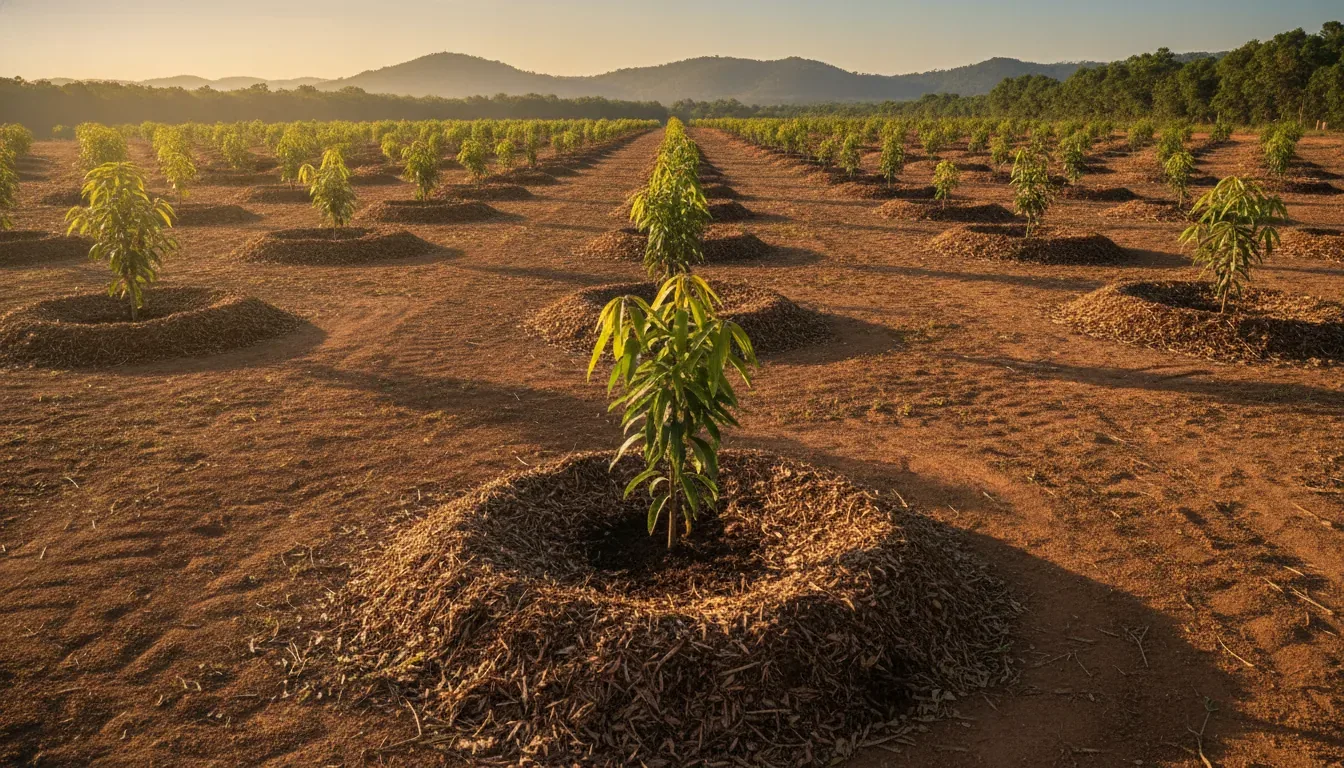
Plant grafted saplings from July to December in pits about 1 x 1 x 1 m, filled with topsoil and composted manure. Standard spacing is 10 x 10 m, which works out to about 40 trees per acre, with the graft union kept above the soil line. Denser systems can fit more trees per acre.
Dig the pits well ahead of planting and let them weather. A pit around 1 x 1 x 1 m (smaller pits of about 60 x 60 x 60 cm are also used) filled with a mix of topsoil and well-composted farmyard manure gives roots a good start.
Set the sapling so the graft union stays above ground, firm the soil gently, water it in, and stake it if the site is windy.
On spacing, the standard regular layout is 10 x 10 m. That gives roughly 40 trees per acre and leaves wide, workable gaps between trees. Closer systems exist and pack in many more trees, which is a separate technique covered under high-density mango planting. The exact planting distance you choose drives the tree count, so the numbers are worth getting right, which is the next section.
How much and how often should you water young mango trees
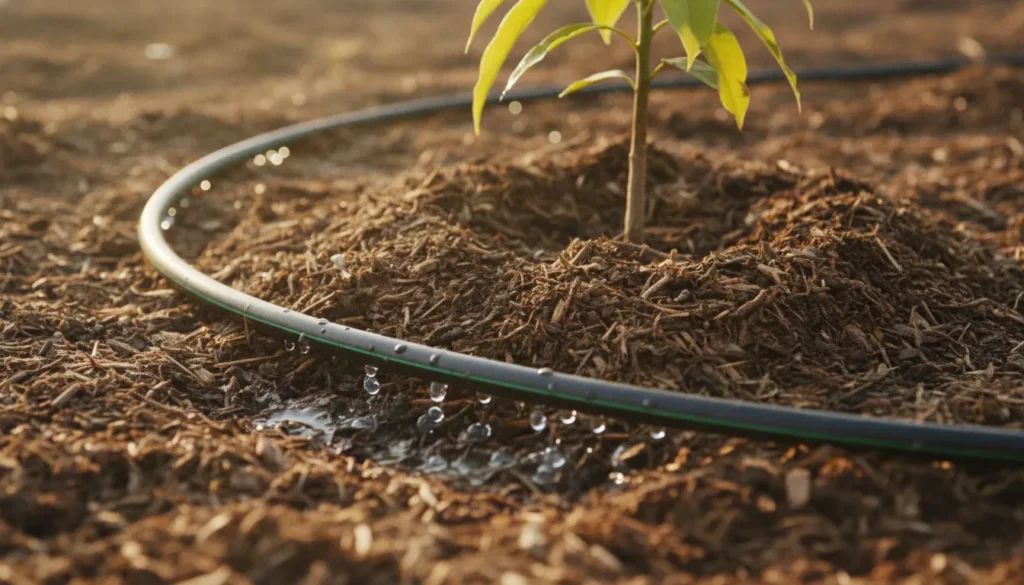
Young mango trees need regular, moderate watering, ideally by drip. In the first two years, give up to about 100 litres per tree per week, or roughly 20 to 30 litres per tree per day by drip in dry months. Water more in summer, less in the rains.
Consistency matters more than volume with young mangoes. Drip irrigation delivers water slowly to the root zone and wastes little, which suits the wide spacing and the long establishment period.
As a first-year guide, published ranges put watering at up to about 100 litres per tree per week in the first two years, around 20 to 30 litres per tree per day by drip in dry months, and roughly 15 to 20 litres per tree every two days through a year-one summer. Treat these as ranges, not fixed rules, and adjust for your soil and weather. Cut back in the monsoon when the rain does the work.
A thick mulch ring around each tree holds moisture, keeps the root zone cool and suppresses weeds.
One note for later: once trees mature, growers often withhold irrigation for a spell around October to January to encourage flowering. That is a mature-tree practice, not something you do in year one.
What does first-year mango tree care involve
First-year care is about protecting and shaping young trees. Stake them against wind, keep a weed-free, mulched basin around each trunk, and watch for pests. Do only light formative pruning to build a strong framework. Short-duration intercrops can use the wide inter-row space during the unproductive early years.
Support and protect first. Stake young grafts so wind does not rock the root ball, and guard the tender bark from livestock and sun scald.
Keep the basin around each tree clean. Weeds compete for water and nutrients, so weed regularly and top up the mulch. Scout the leaves for common pests such as hoppers and for signs of disease, and act early rather than late.
Prune lightly and with purpose. In the first year you are training the shape, removing weak or crossing shoots to build a strong, open framework, not cutting for fruit.
Those wide 10 x 10 m gaps need not sit idle. In the three to four years before the canopy closes, many growers plant short-duration intercrops in the inter-row space to make use of the land. Keep intercrops clear of the young mango basins so they do not compete for water. If you plan to grow without synthetic inputs, that is a distinct approach covered under growing mangoes organically.
Why do mango trees-per-acre figures disagree online
Online figures disagree mostly because of a mix-up between per acre and per hectare: 1 acre is about 0.4 hectare. At the standard 10 x 10 m spacing, mango is planted at about 100 trees per hectare, which is roughly 40 trees per acre, not 100.
| Spacing | System | Trees per hectare | Trees per acre |
|---|---|---|---|
| 10 x 10 m | Regular | about 100 | about 40 |
| 5 x 5 m | High density (HDP) | about 400 | about 160 |
| 3 x 2 m | Ultra-high density (UHDP) | higher | about 670 (up to about 1,100) |
Two quick reference points close this section. First, that acre-to-hectare conversion is the source of most of the confusion you will see online. Second, on time to fruit: grafted saplings bear in about 3 to 4 years, while seedlings take 7 to 10, which is the single strongest reason to buy grafted stock.
Prefer to own a mango farm without doing the work yourself
If you want to own a mango farm but not do years of hands-on establishment yourself, a managed model is the alternative. You own the land under a registered Sale Deed in your own name, and a professional team handles the agronomy and maintenance for you.
Everything above is real work: choosing land, testing soil, sourcing certified grafts, planting, watering and caring for young trees for years before the first crop. It is rewarding, and it is a real commitment.
Hasiru Farms builds and sells managed farmland. The buyer owns the land and Hasiru manages and maintains it under a formal management agreement. Ownership is individual and registered: every buyer receives a Sale Deed in their own name conveying title to their specific parcel. The land is agricultural and keeps its agricultural character, and because the title is individually registered, the land remains yours regardless of what happens to the company.
The agronomy is handled in-house, so the establishment work described in this guide is done by the team rather than by you. Hasiru’s managed mango project is Mango Dew, on the Ramanagara corridor.
The mindset is different from a quick-money product. This is about owning a real, maintained place, not a speculative yield play.
Frequently asked questions
Is mango farming profitable?
Mango is a long-horizon crop with no guaranteed earnings, and profitability depends on land, variety, market and a multi-year wait before commercial yield. The detailed economics sit in our profit-per-acre breakdown, not in this getting-started guide.
Who maintains the land if I rarely visit?
In a managed model, an in-house team maintains your plot under a management agreement, so upkeep continues whether or not you visit. You can still come whenever you like, and a site visit is the clearest way to see how a plot is looked after.
What happens to my land if the company shuts down?
Your ownership is an individual registered Sale Deed in your own name, so the land remains yours regardless of what happens to the company. The title is not tied to the company’s continued existence.
Do I receive produce from a managed mango farm?
What ownership and management include is best confirmed for the specific project, so ask directly or on a site visit. The managed model centres on owning a real, maintained place rather than a promised return.
Is there a yearly maintenance fee?
Fee details are confirmed per project rather than quoted as a blanket figure, so the accurate way to get them is a direct enquiry or a site visit. Ask for the current maintenance terms for the project you are considering.
Do I have to farm the mangoes myself, or can it be managed for me?
You can do either. Doing it yourself means years of hands-on establishment and care as set out above; a managed model means a professional team does the agronomy while you hold individual registered title to the land.