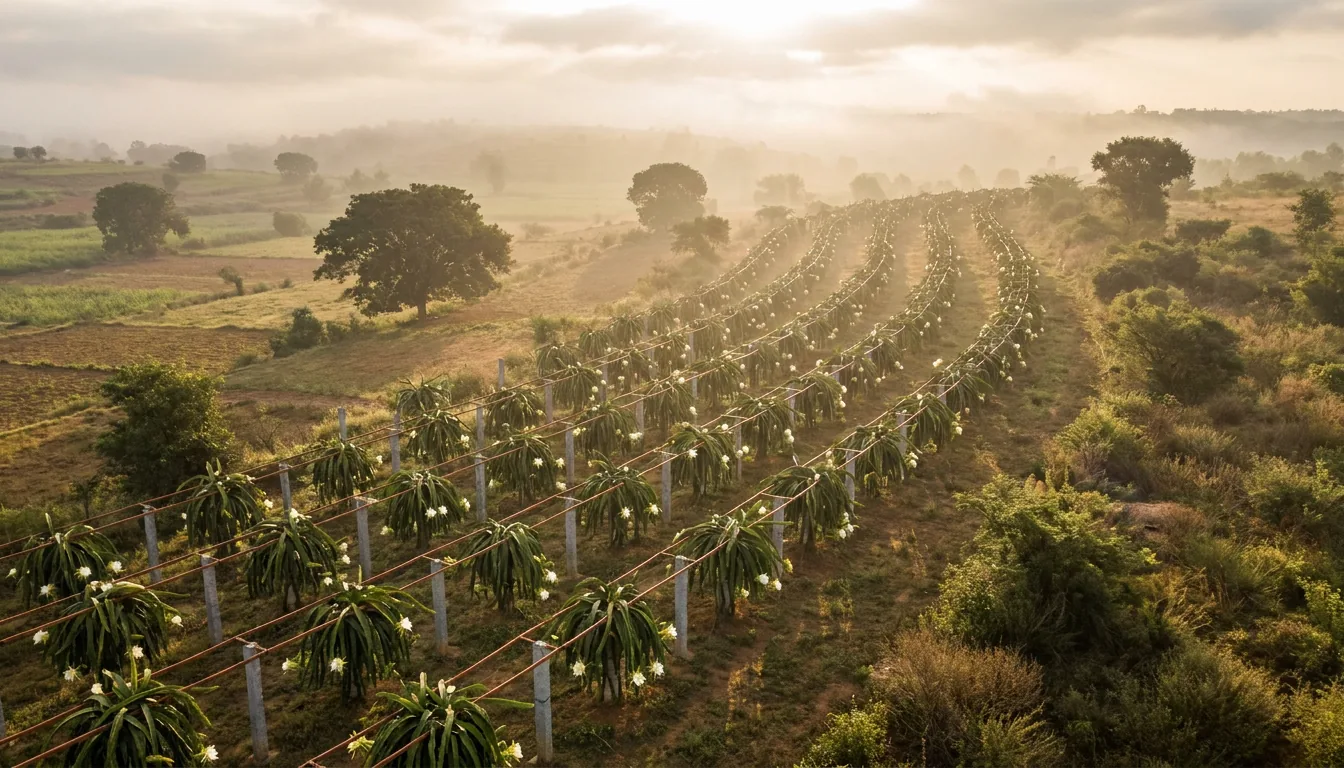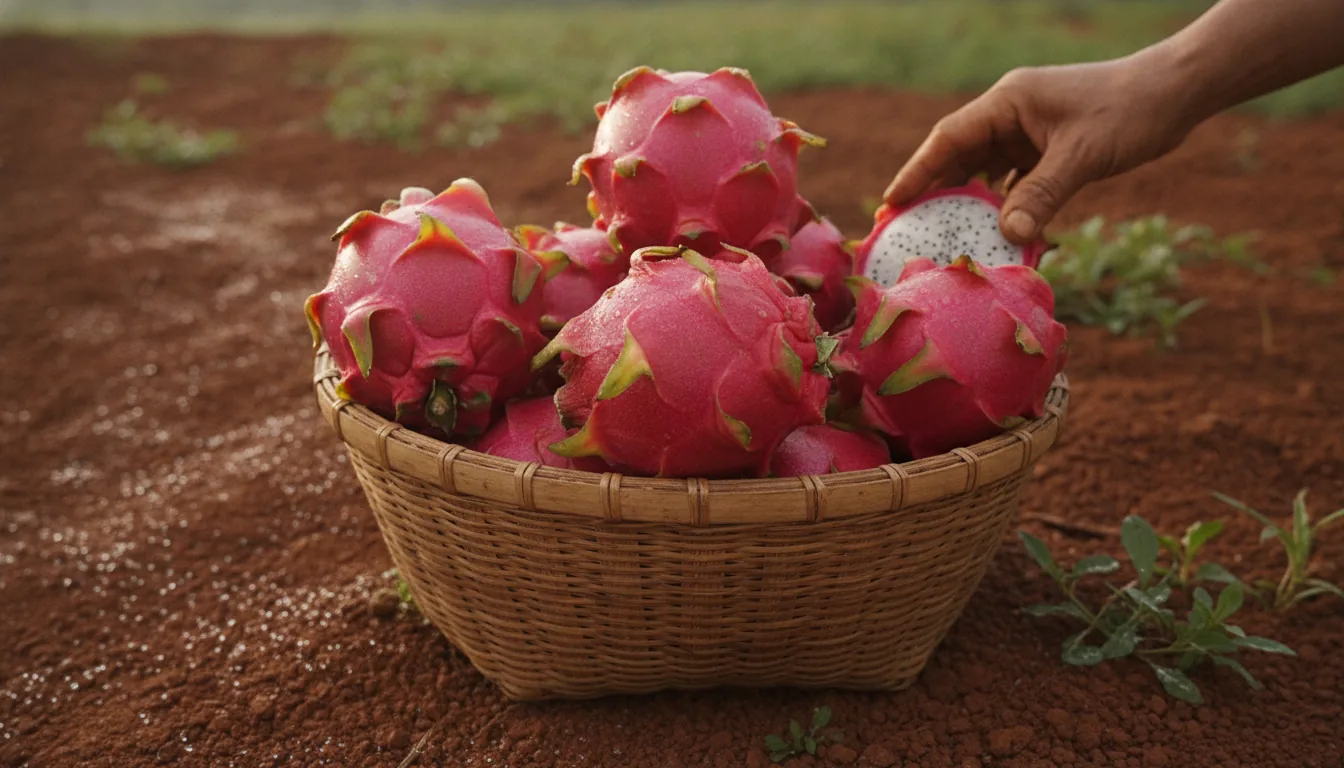
A dragon fruit plant listed online at Rs 99 says very little about what an acre will cost. The dragon fruit plant price on a nursery page is for one potted plant, with no poles, no drip and no total. This guide sets out dated prices for cuttings, rooted plants and poles, the full one-acre setup, and what the orchard keeps costing after planting.
TL;DR
- Potted plants online cost about Rs 80 to Rs 500 each. Farm cuttings cost Rs 25 to Rs 60 each in bulk.
- One acre takes about 1,800 plants on 450 poles, and cement poles cost roughly Rs 210 to Rs 600 each, the biggest setup line.
- Year 1 setup for one acre comes to about Rs 3 lakh to Rs 5.2 lakh in 2025 and 2026 cost tables, before land, fencing and water.
- Upkeep from Year 2 runs about Rs 73,000 to Rs 1.06 lakh a year in one May 2026 table.
- Hasiru Farms does not sell dragon fruit plants, cuttings or poles. Every price here is sourced and dated
In this guide
What does each item in a dragon fruit setup cost
Each item in a dragon fruit setup is priced separately, and a pole costs several times more than a plant. No official price series exists for planting material or poles, so every figure here is a dated published or listing price. Check current quotes before you buy.
Dragon fruit price snapshot
| Item | Price | Unit |
|---|---|---|
| Fresh cutting | Rs 25 to 50 | Per cutting, bulk |
| Rooted cutting in poly bag | Rs 40 to 60 | Per plant, bulk |
| Potted retail plant | Rs 79 to 499 | Per plant, single |
| Cement (RCC) pole, listed | Rs 350 to 550 in most listings | Per pole, bfore transport and fitting |
| Cement (RCC) pole, installed | Rs 250 to 400 | Per pole, fitted |
| Concrete pole, ICAR costing | Rs 500 to 600 | Per pole |
| Top tyre on the pole | Rs 100 | Per pole |
| Drip irrigation | Rs 35,000 to 50,000 | Per acre |
| Year 1 setup, all lines | Rs 3 lakh to 5.2 lakh | Per acre |
The gap between the first and third rows matters most, because a farm buyer and a home gardener are paying for different products.
What is the dragon fruit plant price in India
The dragon fruit plant price in India depends on what you buy and how many. A single potted plant online costs about Rs 80 to Rs 500, while farm planting material bought in bulk is quoted at Rs 25 to Rs 60 a plant.
In dragon fruit listings, a “sapling” means a rooted cutting, not a different plant. ICAR-NIASM groups planting material as fresh cuttings and rooted saplings with or without soil bags, so the useful split for a buyer is fresh cutting, rooted cutting and potted retail plant.
| Planting material | What you get | Price per plant |
|---|---|---|
| Fresh cutting | A cut stem piece, calloused but not yet rooted | Rs 25 to 50 |
| Rooted cutting | A cutting rooted in a poly bag, often listed as a sapling | Rs 40 to 60Rs 50 in two other sources |
| Potted retail plant | A rooted plant in a pot or grow bag, sold singly for home gardens | Rs 79 to 499 in shopping listingsRs 600 to 980 on some nursery pages |
B2B supplier directories sit in between. Listings checked in October 2026 showed Rs 15 to Rs 100 a piece, and Rs 200 to Rs 220 a plant on local business listings. A per-piece quote can mean a fresh cutting or a rooted plant, so confirm which before you compare.
What 1,800 plants for one acre would cost, working from these figures
- Fresh cuttings at Rs 25 to 50 come to Rs 45,000 to Rs 90,000.
- Rooted cuttings at Rs 40 to 60 come to Rs 72,000 to Rs 1,08,000.
- Potted plants at a typical listing price of Rs 150 to 349 come to Rs 2.7 lakh to Rs 6.3 lakh.
Multiplying a home-garden price by an acre’s plant count overstates the plant bill several times over, and it still leaves out the poles, which cost more than the plants. For how the crop is grown, see the complete dragon fruit farming guide. The lower farm price only holds if the material roots and survives, which is where the choice between cuttings and rooted plants comes in.
Should you buy dragon fruit cuttings or rooted plants for a farm
For a farm, buy rooted plants. Rooted dragon fruit cuttings cost more than fresh cuttings but reduce establishment failure in Year 1. Agriplast’s May 2026 guide advises paying 30 to 50% more for rooted cuttings from a nursery with three or more years of operation.
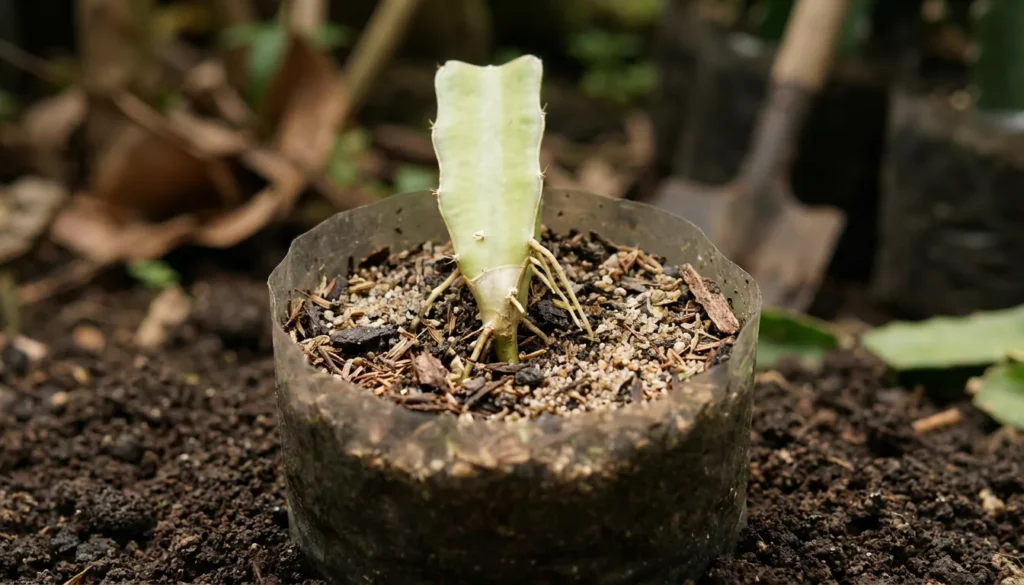
Dragon fruit roots easily from a stem cutting, which is why Agriplast says grafted plants are not used commercially. Mango is the opposite case, where orchards start from grafted saplings, as covered in choosing planting material for a first orchard.
What should you check before buying dragon fruit cuttings?
Check the mother plant, the cutting and the seller before you pay. Sources differ on sizes, so each point gives what each source says.
- Mother plant age – Agriplast says cuttings should come from 2-year-old mother plants. ICAR takes stems from one-year-old growth.
- Cutting length – Agriplast gives 12 to 18 inches. ICAR gives 20 to 30 cm, and 15 to 25 cm for rooted cuttings. FarmAtma wants rooted material at least 8 to 10 inches above the soil.
- Clean stem – The cutting should be free of black spots and stem rot, with a clean cut at the base.
- Callousing – Agriplast calls for 5 to 7 days of callousing. Ask how long the batch was calloused.
- Rooting medium – ICAR roots cuttings in poly bags of soil, sand and FYM or vermicompost (three parts, one part, one part) or in cocopeat, with fungicide-treated media.
- Seller track record – Agriplast suggests a nursery with three or more years of operation. FarmAtma suggests a trusted nursery or fellow farmers.
Timing matters as much as quality. ICAR’s article gives a planting window of July to August, with cuttings collected June to October and rooted plants field-ready 5 to 8 months after rooting. In practice, rooted stock for a July to August planting has to be arranged well before the monsoon. That leaves one question before counting plants, whether the variety changes the price.
Do some dragon fruit varieties cost more to plant
Dragon fruit varieties do not consistently cost more to plant. In online listings checked in October 2026, red, white, pink and yellow types all sat roughly between Rs 79 and Rs 500 a plant, and the price followed the seller and pot size more than the variety.
Listings name red skin with white flesh, red skin with red flesh and yellow skin with white flesh, sometimes under the botanical names Hylocereus or Selenicereus undatus. ICAR’s August 2025 article prefers red-fleshed types such as Moroccan Red, Jumbo Red and Vietnam Red, and Agriplast’s guide names PAU Red Dragon 1 and PAU White Dragon 1. On the ground, ICAR-NIASM’s 2021 bulletin found only one or two varieties readily available, red skin with white flesh and red skin with red flesh.
Where variety does change the price is the fruit. Seller-published wholesale ranges from May 2026 show the gap between types in fruit prices, not plant prices, and the farming guide linked above carries dated fruit prices. For cost planning, the number that matters more than variety is how many plants the acre holds.
How many dragon fruit plants and poles does one acre need
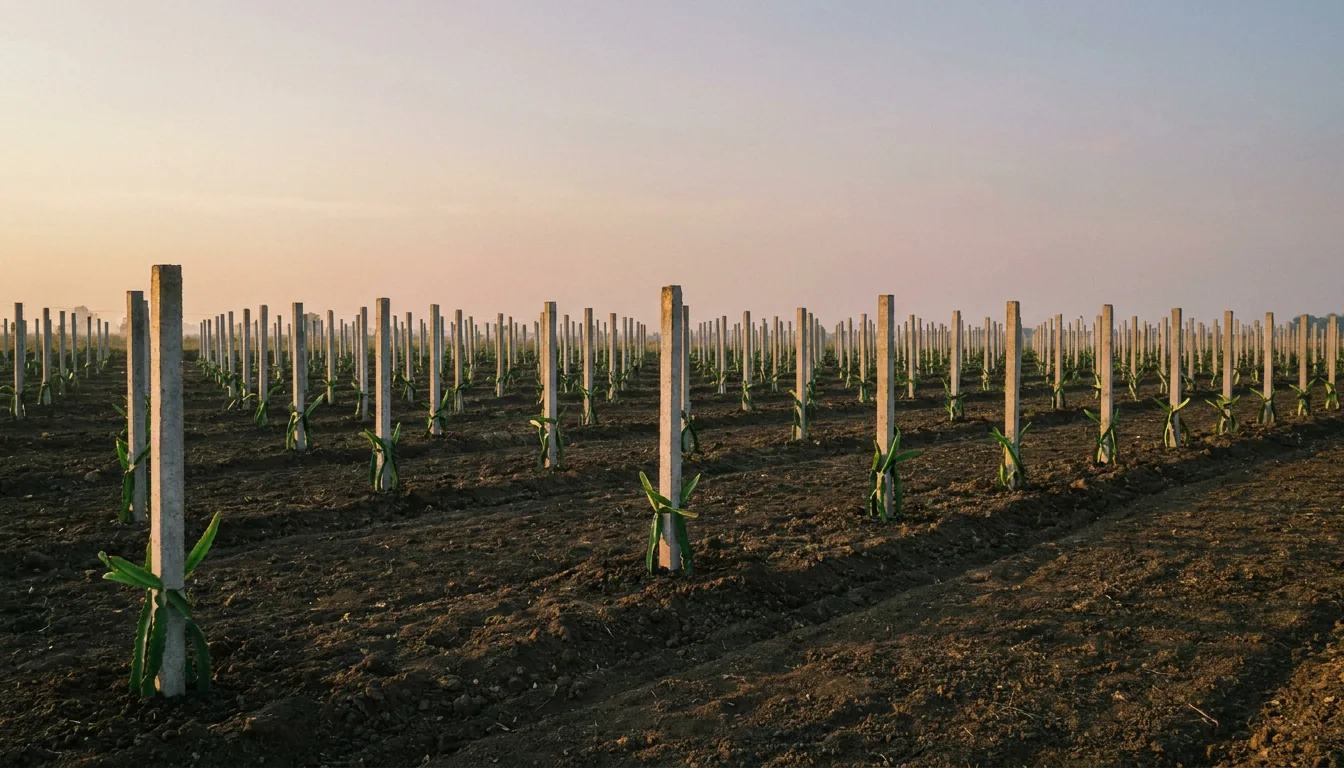
One acre needs about 450 poles and 1,800 dragon fruit plants on a 12 x 8 ft layout, with 4 plants on each pole. FarmAtma’s February 2025 table counts 453 poles and 1,812 plants for the same spacing. For a side-by-side view across crops, see how dragon fruit setup compares with other farm crops.
| Layout | Poles per acre | Plants per acre |
|---|---|---|
| 12 x 8 ft | About 450 | About 1,800, at 4 per pole |
| 3 x 3 m | 444 | About 1,780 to 2,660, at 4 to 6 per post (working from the post count) |
| 2 x 2 m, high density | About 1,010 (2,500 per hectare, converted) | About 4,050 (10,000 per hectare, converted) |
ICAR plants 4 cuttings around each pole, one on each side about 30 cm from the base, and notes that 2 per pole is an option for easier canopy management.
Layout drives the whole budget. ICAR’s high-density model costs Rs 25,50,000 per hectare including first-year inputs, which works out to about Rs 10.3 lakh an acre. That figure shows the effect of spacing, not a typical acre.
Plant and pole count multiply every price on this page, so fix the layout before you ask for quotes. Every one of those poles has a price, and together they make the largest line in the setup.
What do dragon fruit poles and trellis cost
Dragon fruit poles and trellis are the biggest setup cost. A cement (RCC) pole costs about Rs 250 to Rs 400 installed in Agriplast’s May 2026 guide and about Rs 500 to Rs 600 in ICAR’s August 2025 article, while most October 2026 listings sit at Rs 350 to Rs 550.
Pole types and installed prices (Agriplast, May 2026)
| Pole type | Installed price per pole | Life | What to know |
|---|---|---|---|
| Cement (RCC) | Rs 250 to 400 | 20 to 25 years | The pole costed in the Agriplast, FarmAtma and ICAR tables |
| Steel angle or pipe | Rs 400 to 600 | 15 to 20 years if galvanised | Heats up in summer and can scorch stems |
| Wood or teak | Rs 150 to 250 | 4 to 7 years | Needs replacing about twice over a 20-year crop |
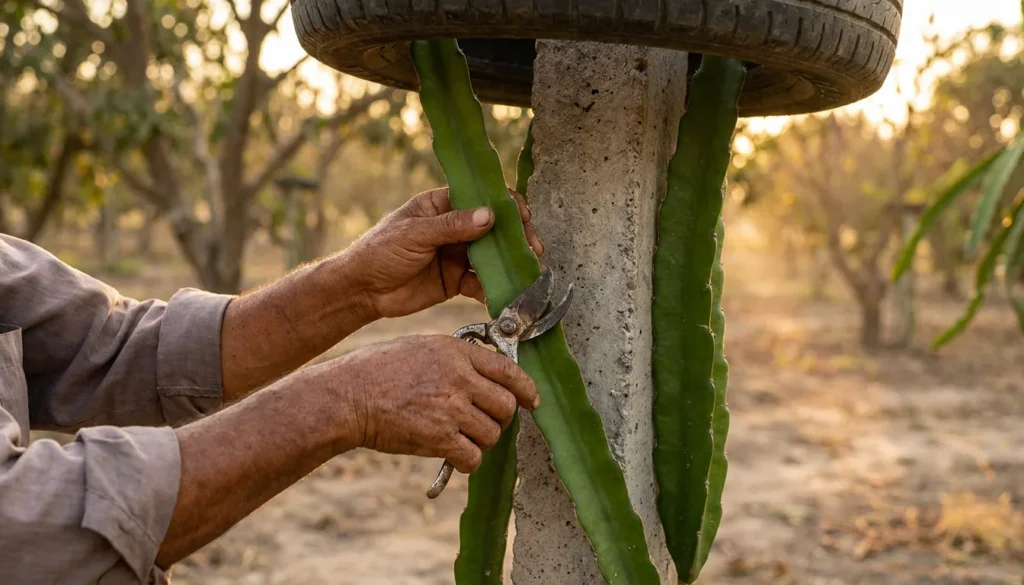
ICAR’s August 2025 article specifies a concrete pole 6 to 7 ft tall and 4 to 6 inches across, reinforced with three 8 to 10 mm rods and set 1 ft deep in a concrete base. A bicycle tyre sits on top on 2 to 3 ft iron rods, costing at Rs 100 a tyre. FarmAtma’s February 2025 table prices a concrete pole with T support at Rs 500.
A listed pole price is the price at the supplier’s yard. Listings checked in October 2026 ran between Rs 150 and Rs 950 a pole, with a Bengaluru supplier at Rs 210 for a 6 ft pole, and one supplier set a minimum order of 100 poles at about 40 kg each. Transport, the concrete base, the top ring and fitting labour all come on top of the listed price.
Working from these figures
- 450 poles at Rs 210 to Rs 600 come to about Rs 0.95 lakh to Rs 2.7 lakh.450 top tyres at ICAR’s Rs 100 add Rs 45,000.
- Wooden poles bought three times over 20 years cost Rs 450 to Rs 750 per position, against Rs 250 to Rs 400 for one cement pole.
ICAR also describes a wire trellis, with angle-iron T-bars set 1 to 1.5 m apart carrying 2 to 3 galvanised wires. Ask for it to be quoted against the same acre before you choose.
Poles are the largest line, but they are still one line in a longer setup bill.
What does the full dragon fruit setup for one acre cost
The full dragon fruit setup for one acre costs about Rs 3 lakh to Rs 5.2 lakh in Year 1, according to cost tables published in 2025 and 2026. An older ICAR-NIASM estimate from 2021 works out to about Rs 2.6 lakh to Rs 3 lakh an acre, but it covers only planting material, drip and trellis.
Year 1 setup for one acre
| Line | Rs per acre |
|---|---|
| Cement poles and top frames (450) | 1,35,000 to 2,25,000 |
| Planting material (1,800 cuttings) | 45,000 to 90,000 |
| Drip irrigation | 35,000 to 50,000 |
| Land preparation and pit digging (450 pits) | 25,000 to 40,000 |
| FYM and fertiliser, Year 1 | 20,000 to 30,000 |
| Planting labour | 15,000 to 25,000 |
| Mulching or weed mat | 25,000 to 60,000 |
| Year 1 total | 3,00,000 to 5,20,000 |
Poles and top frames are about 45% of the low total (Rs 1.35 lakh of Rs 3 lakh) and 43% of the high total (Rs 2.25 lakh of Rs 5.2 lakh). In FarmAtma’s table, the poles are 49% of the total (Rs 2.27 lakh of Rs 4.62 lakh).
How four published estimates compare
| Source | Date | Year 1 per acre | What it covers |
|---|---|---|---|
| Agriplast guide | May 2026 | Rs 3 lakh to 5.2 lakh | Poles and frames, plants, drip, land and pits, FYM and fertiliser, labour, mulch |
| FarmAtma | February 2025 | Rs 4.62 lakh | Land preparation, rooted plants, poles with T support, drip, fertilisers, pesticides, irrigation, labour and maintenance |
| ICAR-NIASM Technical Bulletin 27 | August 2021 | About Rs 2.6 lakh to 3 lakh (Rs 6.5 to 7.5 lakh per hectare, converted) | Planting material, drip and trellis only |
| ICAR, Indian Farming, 2 x 2 m high density | August 2025 | About Rs 10.3 lakh (Rs 25.5 lakh per hectare, converted) | About 1,010 poles and 4,050 plants, with first-year inputs |
What do these tables leave out? Neither the Agriplast nor the FarmAtma table includes land, fencing, a borewell, a pump or power. Budget for each of these separately, because none of them appears in a plant or pole quote. See what fencing a farm plot costs and checking water before you plant.
Why do some totals online look so low? Some cost pages that rank for this search give much lower totals. One guide’s total has no separate line for poles or supports at all. Another quotes Rs 60,000 to Rs 80,000 an acre including 444 concrete posts, installation and planting material, yet 444 posts at the lowest pole listing found in October 2026 (Rs 210) already come to about Rs 93,000. Before trusting any total, check that it has a pole line.
Can you get a subsidy on dragon fruit plants, poles or drip
Dragon fruit plants, poles and drip can qualify for a subsidy under MIDH (the Mission for Integrated Development of Horticulture) and some state schemes, through area-expansion assistance that covers planting material, drip and trellis. A December 2021 Lok Sabha answer on MIDH support for cost-intensive crops lists dragon fruit as Kamlam in its annexures, and Bihar runs its own dragon fruit scheme for 2025-26. Rates differ by state and change each year, so check with the District Horticulture Officer before you buy.
A subsidy lowers the setup bill once. It does not touch the cost that comes back every year.
What does a dragon fruit orchard cost after planting
A dragon fruit orchard costs about Rs 73,000 to Rs 1.06 lakh an acre each year from Year 2, in Agriplast’s May 2026 table. That covers nutrition, pruning, bio-inputs, harvest labour and irrigation.
| Yearly line from Year 2 | Rs per acre a year | The work behind it |
|---|---|---|
| Fertiliser and nutrition | 25,000 to 35,000 | Buying and applying fertiliser and nutrients |
| Pruning labour | 15,000 to 20,000 | Pruning the plants on every pole |
| Bio-inputs | 5,000 to 9,000 | Buying and applying bio-inputs |
| Harvest labour | 20,000 to 30,000 | Labour at harvest |
| Irrigation | 8,000 to 12,000 | Running the drip system |
| Total | 73,000 to 1,06,000 |
Working from these figures – Nine more years after the planting year, at Agriplast’s range, come to about Rs 6.6 lakh to Rs 9.5 lakh at today’s rates.That is roughly 7 to 21 times the Rs 45,000 to Rs 90,000 spent on fresh cuttings for the acre.Wooden poles, with a 4 to 7 year life, would also need replacing inside that window.
No published source gives a ten-year upkeep total, so treat this as arithmetic from one dated table, not a forecast.
Each line is work that someone has to do on the plot every year, even if the owner rarely visits. See how a managed care team handles yearly orchard work. This page stops at cost, and the companion page sets out what an acre produces against these costs.
What else do first-time growers ask about dragon fruit plant prices
How much does one dragon fruit cutting cost?
One dragon fruit cutting costs about Rs 25 to Rs 50 as a fresh cutting, or Rs 40 to Rs 60 rooted in a poly bag, when bought in bulk for a farm (Agriplast, May 2026). A single potted plant online costs more, about Rs 80 to Rs 500 in October 2026.
Which month is best to plant dragon fruit in India?
The best months to plant dragon fruit in India are July and August, the planting window given in ICAR’s August 2025 article. Rooted plants take 5 to 8 months to be field-ready, so order rooted stock well ahead of that window.
How long before a rooted dragon fruit cutting is ready to plant?
A rooted dragon fruit cutting is ready to plant in the field 5 to 8 months after rooting, according to ICAR’s August 2025 article. ICAR collects cuttings for rooting between June and October.
Do you need grafted dragon fruit plants for a farm?
You do not need grafted dragon fruit plants for a farm. Agriplast’s May 2026 guide says grafted plants are not used commercially because dragon fruit roots easily from cuttings, and ICAR notes that grafted plants grow more slowly early on.
Who does the yearly work on a dragon fruit orchard?
The yearly work on a dragon fruit orchard is pruning, feeding, bio-inputs, irrigation and harvest labour, costed at about Rs 73,000 to Rs 1.06 lakh an acre a year in a May 2026 table. An owner who rarely visits needs hired labour or a contracted management service to do it.
Does Hasiru Farms sell dragon fruit plants?
Hasiru Farms does not sell dragon fruit plants, cuttings or poles. Hasiru works in managed farmland, so the prices on this page come from published sources and current listings, each dated, with no product of its own to sell.
Is the plant price the real cost of a dragon fruit orchard
The plant price is not the real cost of a dragon fruit orchard. Cuttings for an acre cost tens of thousands of rupees, the poles about Rs 1 lakh to Rs 2.7 lakh, and the orchard then needs pruning, feeding, irrigation and harvest labour every year for as long as it stands.
That yearly work adds up. Working from one May 2026 table, the nine years after planting come to about Rs 6.6 lakh to Rs 9.5 lakh, several times the plant bill. It is also the part buyers worry about most, a plot paid for and then left without care. The real cost is years of upkeep, and someone has to be on the ground to do it.
Hasiru Farms handles that work through Hasiru Care, its in-house management model. A formal Maintenance Agreement between Hasiru and the buyer sets out that Hasiru undertakes the management and maintenance of the farmland, as a contracted service rather than a one-time sale. Hasiru Care is on the ground at the Kanakapura Road corridor sites, backed by an in-house agronomy team.
Hasiru Farms has been operating since 2021, with 300+ acres delivered and 250+ families. To see how the model works, read how managed farmland works or look at the Vruksha project on the Kanakapura corridor. For the crop itself, see how dragon fruit is grown in India.