Most dragon fruit farming profit per acre figures online come from businesses that sell plants, inputs or land, and few of them show a cost side or a bad year. This page sets out the published cost sheets, the yield curve and 2026 prices instead, line by line, so you can build your own spreadsheet. Then it works out what an acre needs just to pay its way.
TL;DR
- Setup costs about Rs 1.5 lakh to Rs 5.2 lakh an acre in published sheets, and poles are close to half of it.
- Running costs are about Rs 40,000 to Rs 1.06 lakh a year, before land, interest, transport and commission.
- Yields reach full production in years 3 to 5, but the averages ICAR-NIASM measured in 2020 sat well below seller curves.
- In 2026, Davanagere growers got Rs 40 to 70/kg at the farm gate (July), while wholesalers nationally paid Rs 90 to 130/kg (October).
- Worked from published figures (not a forecast), the setup money comes back between year 3 and year 8, and yield and price decide which.
In this guide
What does it cost to set up one acre of dragon fruit
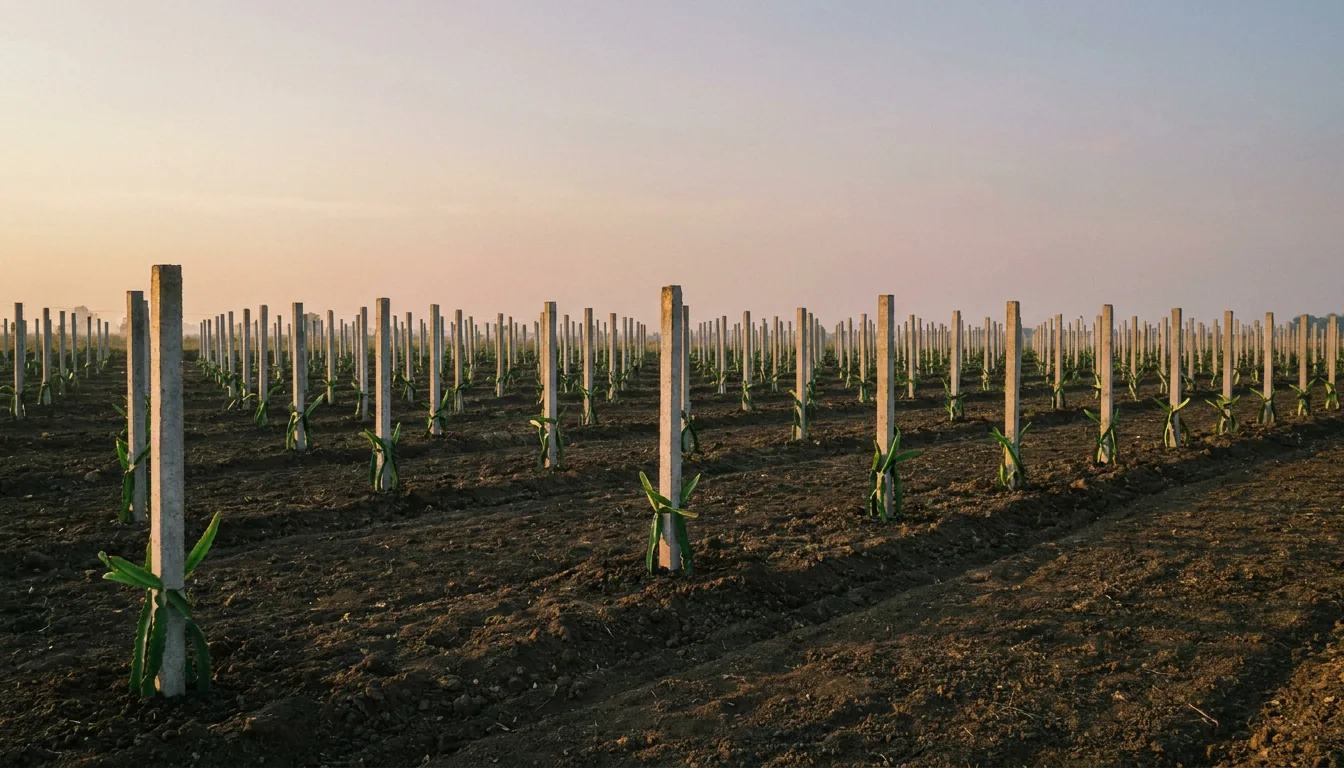
Setting up one acre of dragon fruit costs about Rs 1.5 lakh to Rs 5.2 lakh in the published sheets, and the cement poles and top frames that form the trellis are the single biggest line.
The low end is a 2025 UHS Bagalkot farmer-field figure and the high end an itemised supplier guide from May 2026. The two most detailed sheets compare like this.
| Setup cost line, per acre | Supplier guide, May 2026 | Sample acre, Feb 2025 |
|---|---|---|
| Cement poles and top frames (trellis) | Rs 1,35,000 to 2,25,000 (450 poles) | Rs 2,26,500 (453 poles with T support) |
| Planting material | Rs 45,000 to 90,000 (1,800 cuttings) | Rs 90,600 (1,812 rooted plants) |
| Drip irrigation | Rs 35,000 to 50,000 | Rs 45,000 |
| Land preparation and pits | Rs 25,000 to 40,000 (450 pits) | Rs 1,600 |
| FYM and fertiliser, year 1 | Rs 20,000 to 30,000 | Rs 5,000 (fertiliser) |
| Labour | Rs 15,000 to 25,000 (planting) | Rs 80,000 (labour and maintenance, year 1) |
| Mulch or weed mat | Rs 25,000 to 60,000 | Not listed |
| Pesticides and irrigation running cost | Not listed | Rs 13,000 (Rs 10,000 and Rs 3,000) |
| Total | Rs 3,00,000 to 5,20,000 | Rs 4,61,700 |
| Poles as a share of the total (worked) | About 43 to 45% | About 49% |
The sample acre is planted at 12 x 8 ft, and its year-1 total includes some first-year running costs.
Poles explain most of the spread. Cement or RCC poles last 20 to 25 years against 4 to 7 years for wood, so a cheaper wooden trellis defers part of the cost rather than removing it.
Spacing and planting are covered in our guide on how a dragon fruit orchard is set up. If setup cost is the deciding line for you, see which farm crops cost least to establish per acre first.
Setup is paid once. The yearly bill comes next.
What does an acre of dragon fruit cost to run each year
Running an acre of dragon fruit costs about Rs 40,000 to Rs 1.06 lakh a year in the published sheets, and fertiliser and harvest labour are the two largest lines.
Only the supplier guide itemises the yearly bill.
| Yearly running cost line, from year 2 | Rs per acre per year |
|---|---|
| Fertiliser and nutrition | 25,000 to 35,000 |
| Harvest labour | 20,000 to 30,000 |
| Pruning labour | 15,000 to 20,000 |
| Irrigation | 8,000 to 12,000 |
| Bio-inputs | 5,000 to 9,000 |
| Total | 73,000 to 1,06,000 |
Against the other sheets, the supplier figure sits at the upper end.
| Source | Rs per acre per year | Note |
|---|---|---|
| Supplier guide (May 2026) | 73,000 to 1,06,000 | From year 2, itemised above |
| Sample acre (Feb 2025), years 2 and 3 | 71,000 | Its line items add up to Rs 71,000, though the page states Rs 61,000 |
| UHS Bagalkot farmer-managed fields (2025) | 53,396 in year 1, then 40,169 a year | Measured on farmers’ own fields |
| UHS Bagalkot experimental field (2025) | 50,841 in year 1, then 33,935 a year | Research plot |
| NEC/NEDFi package of practice | About 87,800 (Rs 2,17,000 a hectare) | Includes land rent (Rs 20,000 a hectare) and marketing (Rs 12,000 a hectare) |
What do dragon fruit cost sheets leave out
Most published dragon fruit cost sheets leave out five lines that a real acre still pays.
- The cost of the land itself.
- Interest on the setup money.
- Transport of fruit to market.
- Trader commission.
- Replacing wooden poles, which last 4 to 7 years against 20 to 25 for cement.
NEC/NEDFi is the one exception, since its sheet includes land rent and marketing. Drip is in every setup sheet, so confirm water on the plot first. Our guide to checking water before you buy a plot covers borewell feasibility.
Costs are the easier half. The harder half is kilos, and when they arrive.
What is the dragon fruit yield per acre, year by year
The dragon fruit yield per acre is little or nothing in year 1 and builds to full production in years 3 to 5, according to ICAR-NIASM, but the averages it measured in 2020 sat well below the curves that sellers publish.
| Year | Supplier guide (May 2026) | Sample acre (Feb 2025) | ICAR-NIASM good practice (2021) | ICAR-NIASM measured average (2020) |
|---|---|---|---|---|
| 1 | 0 t | 0.5 t | Up to 1.8 t | About 0.9 t (plantings under 18 months) |
| 2 | 3 to 4 t | 6 t | 3.0 to 4.0 t | Not reported separately |
| 3 | 6 to 8 t | 10 t | 6.5 to 9.7 t (year 3 onward) | About 4.3 t (established plantings) |
| 4 and later | 8 to 10 t | Not given | As year 3 | As year 3 |
Tonnes per acre. No source gives a separate year-5 figure. ICAR-NIASM columns are converted from per-hectare figures. The sheets assume about 450 poles an acre with four plants to a pole, or 1,800 plants.
Other published averages sit nearer the measured column. Down To Earth, citing ICAR-NIASM authors, puts a well-managed orchard at up to five tonnes an acre, with economic yields after three years. NEC/NEDFi gives about 3.2 to 4.0 tonnes an acre (8 to 10 t/ha). ICAR-NIASM’s ceiling is up to 35 t/ha, about 14 tonnes an acre.
Because no source gives a year-5 figure, any year-5 number you see has been assumed, not measured. Yields also decline in orchards older than 5 to 6 years, though the plant’s economic life runs past 20 years.
High-density planting is a separate model. At 2 m x 2 m, the ICAR Research Complex for NEH Region reports 62 to 85 t/ha from 2,500 poles a hectare, on a cost sheet of Rs 25.5 lakh a hectare, so do not read it against this table.
Kilos turn into money at a price, and 2026 showed how far that price can fall.
What price does dragon fruit fetch at the farm gate in 2026
Dragon fruit fetched Rs 40 to 70/kg at the farm gate in Davanagere in July 2026, while wholesalers nationally paid Rs 90 to 130/kg in October 2026, and fruit grade decides where an acre’s crop lands in that range.
No official farmgate price series exists for dragon fruit, so each price below is labelled by where it was paid.
| Level in the chain | Price per kg | Where and when |
|---|---|---|
| Small fruit, retail | As low as Rs 20 | Davanagere, July 2026 |
| Trader buying price | Rs 30 to 50 | Davanagere, July 2026 |
| Farm gate | Rs 40 to 70 | Davanagere, July 2026 |
| Sold to wholesalers | Rs 90 to 130 | National, October 2026 |
| Wholesale selling price | Rs 120 to 150 | National, October 2026 |
| By grade (A over 400 g, B 200 to 400 g, C under 200 g) | Rs 55 to 250 | 2021 |
| Off-season | Rs 300 to 450 | 2021 |
The Davanagere figures are one district’s experience. Grower K. Manjanna of Siddanur village told ETV Bharat that “as more farmers took up cultivation, production increased, and prices collapsed.” He recalled earlier growers getting around Rs 150/kg, while the same report puts early-year prices at Rs 90 to 100. Growers have asked for an MSP, and dragon fruit has none. Nationally, October 2026 was firmer, with the domestic season running into October.
Grade decides the rest. ICAR-NIASM found in August 2020 that 40 to 70% of fruit in young orchards was tiny (36 to 49 mm), which is where a glut price bites hardest.
Sheet assumptions vary just as widely, at Rs 140/kg (UHS Bagalkot), Rs 80/kg (NEC/NEDFi and the sample acre) and Rs 90 to 120/kg. For city markets and imports, see dragon fruit prices across India in 2026.
With costs, kilos and prices in hand, the arithmetic follows.
What does the arithmetic say about dragon fruit farming profit per acre
The arithmetic says dragon fruit farming profit per acre turns on two numbers, yield and price. Once yields build, running costs are covered even at low prices, but the setup money takes three to eight years to come back.
The break-even price is the price per kilo that covers one year’s running costs. The payback year, or break-even year, is when fruit sales catch up with everything spent on the acre, setup included.
What price per kilo covers a year’s running costs?
The price per kilo that covers a year’s running costs is the yearly upkeep divided by the kilos harvested. That comes to about Rs 6 to 25/kg for an established acre, but Rs 32 to 118/kg for a young one.
| Yield per acre | Where the yield comes from | Upkeep Rs 40,169 (UHS farmer fields) | Upkeep Rs 73,000 (supplier guide, low) | Upkeep Rs 1,06,000 (supplier guide, high) |
|---|---|---|---|---|
| 0.9 t | ICAR-NIASM 2020 average, new plantings | Rs 45/kg | Rs 81/kg | Rs 118/kg |
| 1.25 t | UHS Bagalkot farmer fields (1,248 kg) | Rs 32/kg | Rs 58/kg | Rs 85/kg |
| 4.3 t | ICAR-NIASM 2020 average, established plantings | Rs 9/kg | Rs 17/kg | Rs 25/kg |
| 6.5 t | ICAR-NIASM good practice, year 3 onward, low end | Rs 6/kg | Rs 11/kg | Rs 16/kg |
Worked from published figures. Not a forecast. Excludes land, interest and transport.
Once an orchard is established, running costs are rarely the problem. At the 0.9-tonne young-orchard average, though, even the lowest upkeep needs about Rs 45/kg, close to the top of the Rs 30 to 50/kg Davanagere traders paid in July 2026. The real weight is the setup money.

In which year does the setup money come back?
Worked from published figures, the setup money on one acre of dragon fruit comes back in year 3 in the best case and in year 8 in a low-price case.
| Case | Yield per acre | Price | Year the setup money is back (worked) |
|---|---|---|---|
| A. Good practice yields, low end of the October 2026 wholesaler price | Year 2 3.0 t, year 3 on 6.5 t | Rs 90/kg | Year 3 |
| B. 2020 measured averages, same price | Year 2 0.9 t, year 3 on 4.3 t | Rs 90/kg | Year 4 |
| C. 2020 measured averages, glut farmgate price | As B | Rs 55/kg | About the end of year 5 |
| D. Case C with one 40% monsoon loss in year 4 | As B, year 4 at 60% | Rs 55/kg | Year 6 |
| E. 2020 measured averages, low farmgate price | As B | Rs 40/kg | Year 8 |
Worked from published figures. Not a forecast. Excludes land, interest and transport.
The same acre can pay back in year 3 or in year 8, and yield and price make the difference, both shaped by management and timing. Case E also runs into the yield decline after 5 to 6 years, so it may take longer still. Dragon fruit fruits early, but the setup money can take most of a decade.
What did a Karnataka farmer field actually show?
A 2025 UHS Bagalkot study of farmer-managed dragon fruit fields in Karnataka recorded 1,248 kg an acre against yearly upkeep of Rs 40,169, a benefit-cost ratio of 4.34 at Rs 140/kg.
| Per acre (Plant Science Today, May 2025) | Experimental field | Farmer-managed field |
|---|---|---|
| Establishment cost | Rs 1,43,681 | Rs 1,54,562 |
| First-year maintenance | Rs 50,841 | Rs 53,396 |
| Maintenance from year 2 | Rs 33,935 | Rs 40,169 |
| Yield | 1,293 kg | 1,248 kg |
| Price used | Rs 140/kg | Rs 140/kg |
| Benefit-cost ratio | 5.33 | 4.34 |
This is the most local measured data available, with one caution. The benefit-cost ratio divides fruit sales by yearly maintenance only, and the study’s own figures confirm it, since 1,293 kg at Rs 140 divided by Rs 33,935 gives exactly 5.33.
At Rs 140/kg the farmer field covers its running costs easily. At the Rs 30 to 50/kg Davanagere traders paid in July 2026, it would only just do so, against a break-even price of about Rs 32/kg.
All of this assumes nothing goes wrong beyond price.
What can go wrong with a dragon fruit acre in a bad year
Four things push a dragon fruit acre towards the worst case in a bad year, namely a price glut, rain at flowering, disease and pests, and missed picking or pollination.
- Price glut: Davanagere farmgate prices fell to Rs 40 to 70/kg by July 2026 as more farmers planted. MIDH set 2021-22 area targets of 4,118.5 hectares for dragon fruit, 300 of them in Karnataka , and ICAR-NIASM calls the November glut a key price risk.
- Rain at flowering: Losses reach up to 40% at one harvest stage and 70 to 100% in some cases. Case D above models one 40% loss.
- Disease and pests: Anthracnose incidence “may vary from 10 to 60% in the plantations resulting into drying of plants”. Fruit fly takes up to 35%, birds and rats 5 to 8%, and 80 to 95% of farmers report sunburn and stunted growth. Poor planting material can spread disease.
- Missed picking or pollination: Hand pollination is critical for fruit set, and harvests run three to four times a month in season.
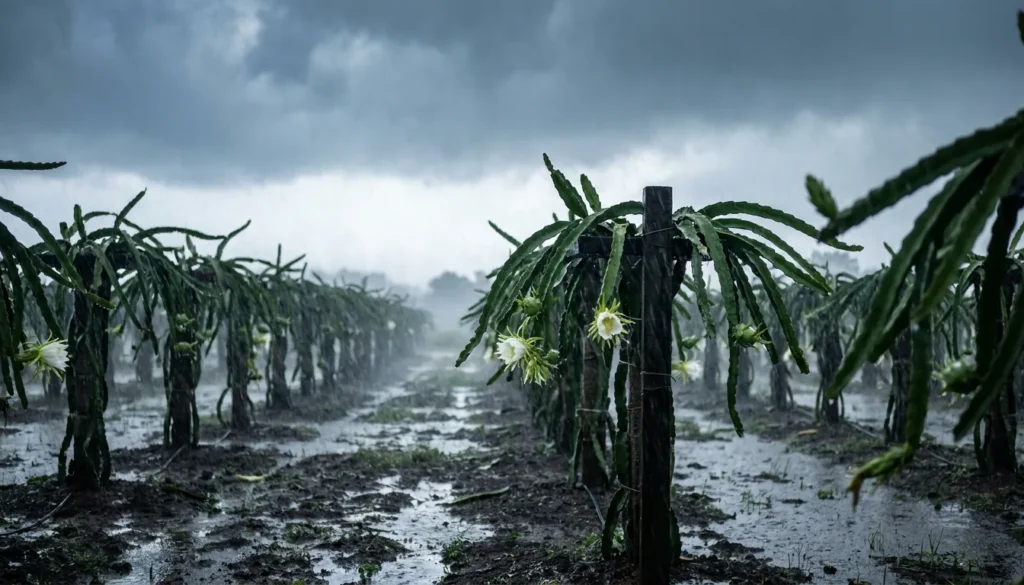
The harvest window is the loss that cannot be recovered. Dragon fruit does not ripen significantly after picking and keeps about 7 to 20 days, so fruit missed in one round is downgraded or lost, never held back for a better price.
For an owner who rarely visits, this shows up later as fewer kilos and lower grades. If you will not be on the plot yourself, read what in-house farm management covers before you buy.
Bad years explain part of the spread in online figures. How those figures are built explains the rest.
Why do dragon fruit profit figures online disagree so much
Dragon fruit profit figures online disagree because most come from businesses that sell inputs, plants or land, and many mix units, years, or one-time and yearly costs in the same sum.
- An agri-plastics supplier’s guide (May 2026) gives three net figures on one page, Rs 5 to 7 lakh, Rs 4 to 5 lakh and Rs 6 to 8 lakh an acre. Its table does not add up either, since Rs 5 to 7 lakh of sales minus Rs 1 lakh of cost is Rs 4 to 6 lakh.
- A farming guide’s sample acre states its year 2 and 3 running costs as Rs 61,000, while its own items add up to Rs 71,000.
- NEC/NEDFi’s 30 to 35 kg a post from a three-year-old planting implies 33 to 39 t/ha at about 1,111 posts a hectare, around four times its own 8 to 10 t/ha.
- The UHS Bagalkot net income of Rs 1,34,551 an acre on farmer fields is fruit sales minus yearly maintenance. The Rs 1,54,562 setup is not deducted.
- A widely cited farming blog mixes one-time and yearly costs and states a net figure of Rs 10 lakh or more at Rs 150/kg, with no source or date.
- An agrochemical seller’s guide says its Rs 5 to 12 lakh range is drawn “from blogs and individual success stories”, advises planning on 5 tonnes an acre, and calls dragon fruit “not a get-rich-quick crop”.
- Automated search summaries built on these sources repeat Rs 3 to 10 lakh or more a year.
How to read a dragon fruit profit claim
- Is the price farmgate or retail, and is it dated?
- Is the yield measured or claimed, and for which year?
- Is the setup cost deducted?
- Are land, interest and transport included?
- Is there a bad year in the sum?
These checks are also why Hasiru does not put yield or income promises on crops, as our note on why Hasiru does not publish crop returns explains.
The same checks apply when dragon fruit is set against other crops.
How does dragon fruit compare per acre with mango or sandalwood
Dragon fruit’s main per-acre appeal is the short wait to first fruit, while longer-horizon crops such as mango and sandalwood trade that early harvest for a different risk shape.
Comparing headline figures across crops misleads for all the reasons above. Read mango’s per-acre cost and yield sheet and sandalwood economics in Karnataka with the same five checks in hand, and compare setup cost, years to first harvest and price risk line by line. Each page carries its own sources, so no other-crop figures are repeated here.
What else do people ask about dragon fruit profit per acre
How much income does 1 acre of dragon fruit give?
The income from 1 acre of dragon fruit is the kilos sold times the price per kilo, minus running costs, and both inputs swing widely by year and grade. Hasiru does not publish an income figure, and the payback cases above show the same acre recovering its setup money anywhere between year 3 and year 8.
How many kilos does one dragon fruit pole give?
Published guides claim about 15 to 35 kg a pole from a mature planting. Spread over 450 poles an acre, the 4.3-tonne average ICAR-NIASM measured in established plantings in 2020 is about 10 kg a pole.
When does a dragon fruit acre start paying for itself?
A dragon fruit acre usually covers its running costs once yields build past the first year or two, and it reaches full production in years 3 to 5 (ICAR-NIASM). Worked from published figures, the setup money comes back between year 3 and year 8.
Is dragon fruit farming profitable in India in 2026?
Dragon fruit farming can be profitable in India in 2026 if yields build and the fruit sells near the Rs 90 to 130/kg that wholesalers paid in October. At the Rs 40 to 70/kg farmgate price Davanagere growers reported in July 2026, a young orchard may not cover its running costs.
Is there a subsidy for dragon fruit farming in Karnataka?
The national MIDH scheme supports cost-intensive crops at 40% of a maximum cost of Rs 4 lakh a hectare, for up to 4 hectares a grower, covering planting material, drip and trellis. That is about Rs 64,750 an acre if the crop and the grower qualify, so confirm the current dragon fruit norm with your District Horticulture Officer.
Does dragon fruit yield fall as the orchard ages?
Dragon fruit yield and fruit size fall in orchards older than 5 to 6 years, according to ICAR-NIASM, even though the plant’s economic life is more than 20 years.
Who looks after a dragon fruit plot if I don’t live nearby?
A dragon fruit plot needs someone on the ground for pollination, picking and disease checks, so an owner who lives away needs the plot managed under contract. At Hasiru Farms, the in-house Hasiru Care team manages the farmland under a formal Maintenance Agreement between Hasiru and the owner.
What are the two things that break the dragon fruit model
The two things that break the dragon fruit model are a missed harvest window and no one on the plot to manage it.
A missed harvest window loses fruit that cannot be won back. Picking runs three to four times a month in season, and fruit not picked on time is downgraded or lost, because it does not ripen further after harvest and keeps only 7 to 20 days.
No one on the plot costs more slowly. Pollination, picking rounds and monsoon disease checks are regular field work that cannot be done from the city, and a neglected orchard ends up as Case D or E with the yearly upkeep still being paid.
That is why Hasiru treats ongoing management as a contracted service, not a one-time sale. Hasiru Care is Hasiru’s in-house model for managing the farmland. A Maintenance Agreement is executed between Hasiru and the buyer, under which Hasiru undertakes the management and maintenance of the farmland, with an in-house agronomy team behind it. Hasiru Care is on the ground at the Kanakapura Road corridor sites.
Hasiru Farms has been operating since 2021, with 300+ acres delivered and 250+ families. Every buyer receives individual ownership of their farmland through a registered Sale Deed executed in their own name, and the agricultural character of the land is retained.
To see how this works, start with Hasiru Farms managed farmland near Bengaluru, read what owning managed farmland really involves, or look at the Vruksha project on the Kanakapura corridor and managed farmland along Kanakapura Road.