Kesar is India’s saffron hued, aroma led mango, and growing it well is a variety specific job, not a generic mango exercise. This guide covers the Kesar Mango variety end to end: where it comes from, the climate and soil it wants, how you plant and care for it, when it fruits, and what it yields. It is written for a grower weighing the decision, so the numbers are honest ranges, not projections. Let’s get learn about Kesar Mango Farming.
The short answer: how do you grow Kesar mango
Kesar mango is grown from grafted saplings in warm, dry regions on well drained soil with a pH of about 6.5 to 7.5, spaced roughly 9m by 9m at about 70 trees per acre. Grafted trees begin bearing in about 3 to 4 years, flower in the cool months, and are harvested between April and June depending on the region, yielding roughly 5 tonnes per acre in a well managed orchard.
TL;DR Kesar is a grafted, dry heat loving variety that fruits in 3 to 4 years and ripens April to June by region. It needs well drained soil, wide spacing, and a dry flowering window. The GI protected name ‘Gir Kesar’ belongs only to Gujarat’s Gir zone; everyone else grows the Kesar variety on its own regional merit. Karnataka’s Koppal belt has become a serious Kesar region, which is why a South Indian grower can plant it with confidence.
Table of Contents
What is Kesar mango, and where did it come from
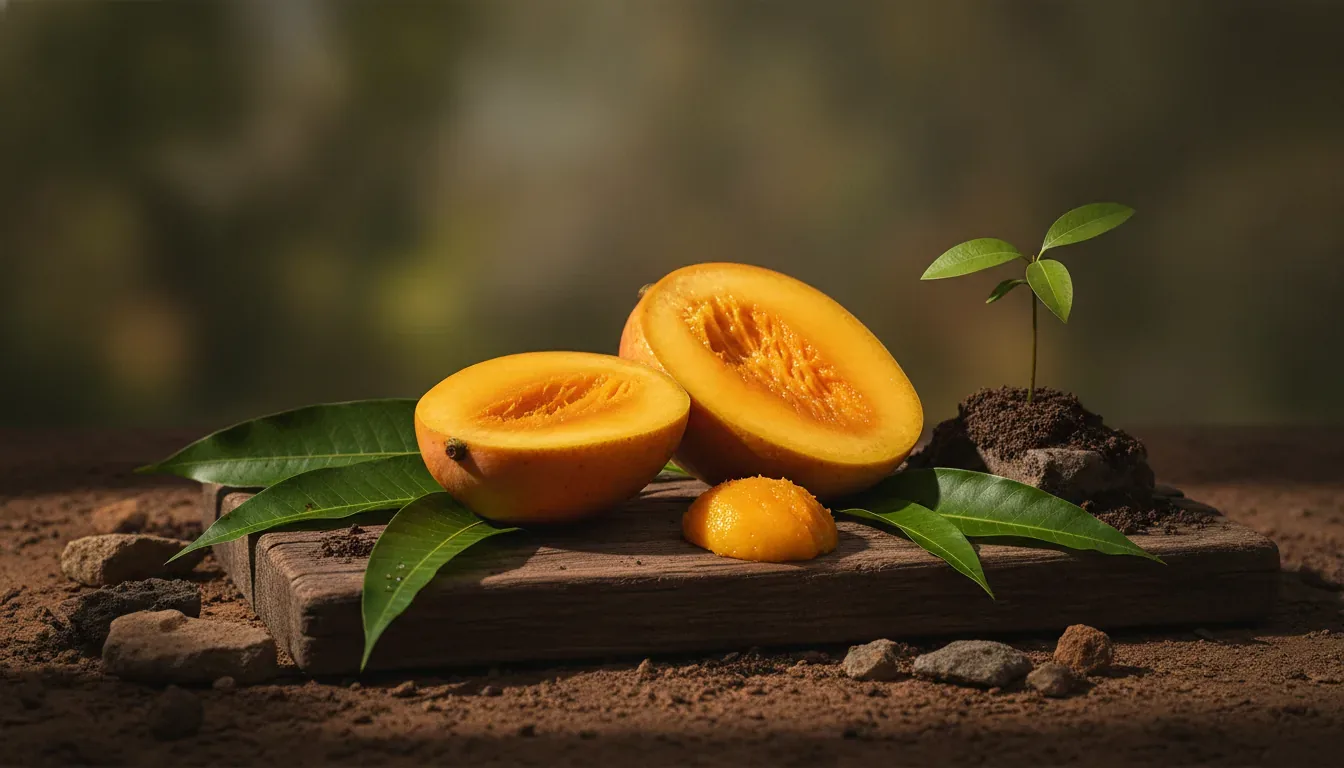
Kesar is a mango variety from Gujarat, named for the saffron colour of its pulp. It was first grown in 1931 in the Gir area by Junagadh’s Wazir Sale Bhai, and named ‘Kesar’ in 1934 by Nawab Muhammad Mahabat Khan III, after that deep saffron flesh.
The variety is tied to the Gir sanctuary belt of Saurashtra, and over the decades it spread outward into other hot, dry mango belts. Its identity rests on two things a grower should hold onto: the saffron pulp that gives it its name, and its comfort in dry heat. Those traits are what make it travel well across regions and why it now grows far beyond its Gujarat home. The name itself is the first entity to fix, because the difference between the Kesar variety and the protected ‘Gir Kesar’ name is where most confusion starts.
Does the Kesar GI tag apply to every Kesar grower
No. The Geographical Indication protects the name ‘Gir Kesar’, not the variety. The GI was granted in 2011 by the Geographical Indication Registry in Chennai, and it covers only mangoes grown around the Gir sanctuary area, in the Junagadh and Amreli districts of Saurashtra. A grower outside that zone grows the Kesar variety, but cannot sell the fruit as ‘Gir Kesar’ GI produce.
The application was filed by Junagadh Agricultural University in 2010. It became Gujarat’s first agricultural GI and India’s second mango GI, after Uttar Pradesh’s Dasheri. For a grower in Karnataka or Marathwada, the practical takeaway is simple: you can plant, grow and sell Kesar mangoes, and you market them on their own regional merit, not under the Gir Kesar name. That is exactly what the growing Karnataka and Maharashtra Kesar belts already do.
What climate and soil does Kesar mango need
Kesar wants warm, dry conditions and well drained soil. It is hardy across a wide temperature band, roughly 0 to 46C, and does best around 27C. It suits both low rainfall zones (about 25 cm) and high rainfall zones (about 250 cm), but it needs dry weather at flowering, because rain and cloud during the flowering window harm fruit set.
Soil
- Alluvial or sandy loam, well drained, is ideal.
- Target a pH of about 6.5 to 7.5, and avoid soils above 7.8.
- The variety tolerates up to about 10 percent lime in the soil.
The dry heat tolerance is the point worth underlining, because it is the trait that lets Kesar succeed where more humidity dependent varieties struggle. That single characteristic sets up almost every planting and care decision that follows.
How do you plant Kesar mango: spacing, saplings and trees per acre
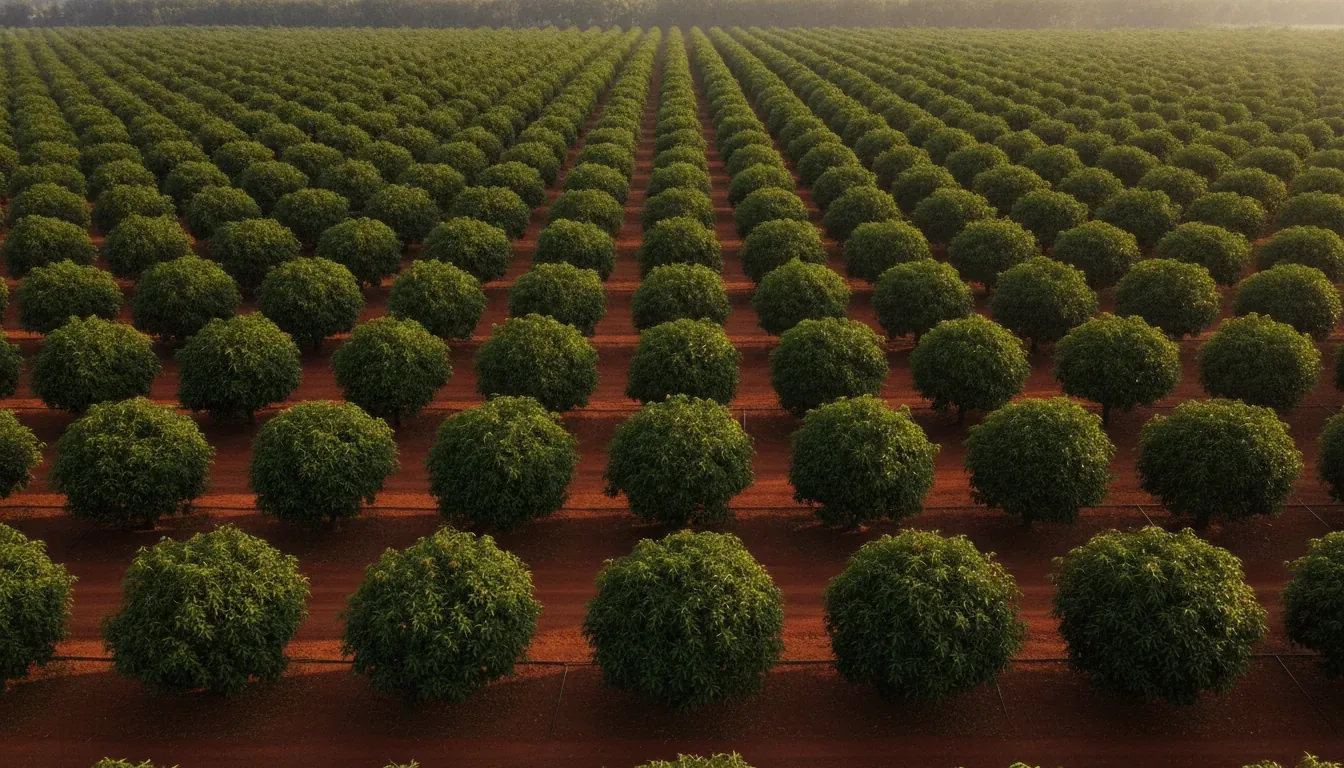
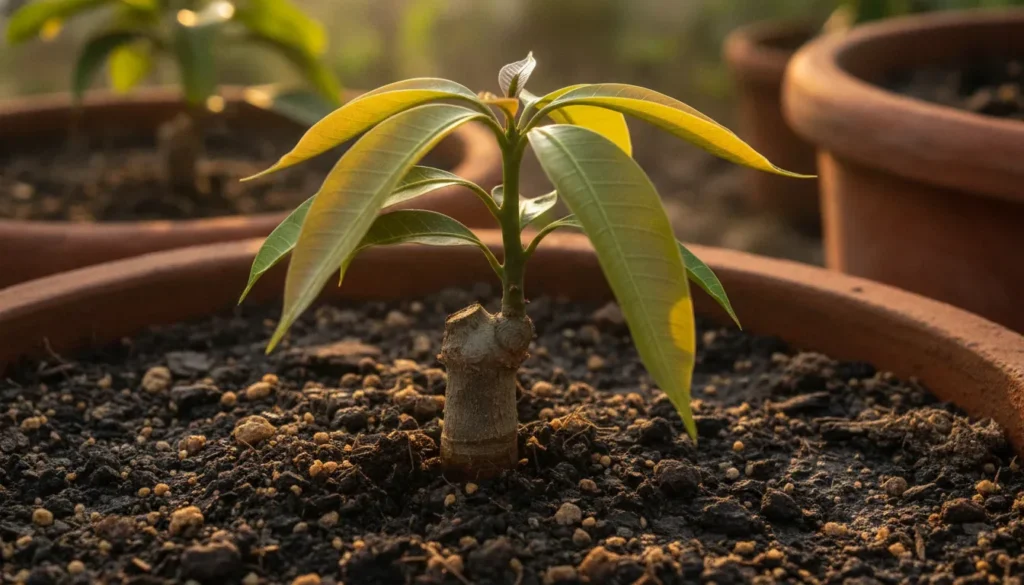
Plant grafted Kesar saplings, not seed grown trees, at a standard spacing of about 9m by 9m, which gives roughly 70 trees per acre. On fertile soil you can go wider at 12m by 12m. For higher density, ultra high density planting can reach 600 or more trees per acre with tighter management.
Pit preparation
- Dig pits of 1m by 1m by 1m, about a month before planting.
- Fill each pit with 30 to 40 kg of farmyard manure plus about 1 kg of single super phosphate (SSP).
Spacing is a genuine decision, not a default. Standard 9m by 9m orchards are easier to manage and let each tree size up fully. Ultra high density planting packs far more trees per acre and can lift total yield, but it demands disciplined pruning, irrigation and feeding to work. If you are weighing the two systems seriously, treat that as its own study rather than a footnote here. Once the trees are in, the orchard’s success turns on water and feeding.
How do you care for a Kesar orchard: water, feeding and the flowering window
Kesar care comes down to staged irrigation, age based feeding, and protecting the dry flowering window. Young trees need frequent water, mature trees need far less, and every tree needs the soil kept dry when it flowers so fruit sets cleanly.
Irrigation
- Young trees: water every 2 to 3 days initially.
- Bearing trees: water every 10 to 15 days.
- Withhold water at flowering, when dry conditions favour good fruit set.
Feeding, by tree age
- Young trees: about 5 to 20 kg of cow dung plus NPK, scaling with age.
- Mature trees: about 100 kg of cow dung, plus roughly 500 g urea, 1 kg SSP and 1 kg muriate of potash (MOP) per tree per year.
On pest and disease control, Kesar follows the same practices as any commercial mango orchard, so a variety specific guide is the wrong place for the full protocol. The one Kesar specific care rule to hold is the flowering window: keep it dry, because rain and cloud at flowering cut the crop. For the broader orchard health playbook, full mango cultivation picture.
When is Kesar mango season, and does it differ by region
Kesar season runs broadly from April to June, but it shifts by region, and the spread is wide enough to matter for a grower planning market timing. Karnataka’s crop is the earliest of the major belts, roughly two months ahead of Gujarat’s.
Region by region harvest calendar
- Gujarat (Gir, Saurashtra): flowering from October onward after the monsoon; fruit ready April to May; main market May to June.
- Kutch Kesar: about a month later than Gir, ripening early June.
- Marathwada (Maharashtra): flowering mid November to December; first ripening in April; peak harvest June; newer Konkan orchards expanding.
- Karnataka (Koppal): harvest around mid April, roughly two months ahead of Gujarat.
That early Karnataka window is a commercial edge, because fruit that reaches the market ahead of the main flush tends to command better prices. It is one reason the Koppal belt has grown so fast, which the Karnataka section below covers in full.
How much does Kesar mango yield, and how long until it fruits
Grafted Kesar trees begin bearing in about 3 to 4 years. A mature tree yields roughly 150 to 200 kg, and a traditional orchard averages around 5 tonnes per acre, rising toward about 10 tonnes per acre under ultra high density planting and good management. These are ranges, not guarantees.
Yield depends heavily on soil, water, spacing and how well the orchard is managed, so treat every figure here as a band that a real orchard lands somewhere inside, not a number you can bank on. Kesar is a long game: three to four years before the first meaningful crop, then decades of bearing if the trees are cared for. For the economics of mango growing per acre, including cost and income modelling, that is a separate study rather than something to compress into a variety guide.
Can you grow Kesar mango in Karnataka and South India
Yes, and Karnataka has become one of India’s fastest growing Kesar regions. The dry heat of the Koppal district, where summer temperatures reach up to 45C, suits Kesar well: unlike Alphonso, which needs humidity, Kesar thrives in dry conditions, and that dryness prevents the sourness and sponginess that humidity can cause.
The scale of the shift is real. In Koppal, Kesar cultivation grew from about 1,300 hectares in 2017 to around 5,000 hectares across roughly 60 villages. Farmers there have reported prices of about Rs 150 to 250 per kg by quality, up from around Rs 10 per kg before 2016, with expected production near 60,000 tonnes and exports reaching Sri Lanka, Dubai, Bahrain, Bangladesh and Europe. Karnataka’s crop also harvests around mid April, roughly two months ahead of Gujarat, which helps it reach markets early. These figures are farmer and region reports, quoted as third party context, not a projection of what any individual orchard will earn.
For a South Indian grower, the takeaway is that Kesar is not a Gujarat only crop. It grows, sells and exports from the dry Deccan, which is Hasiru’s home ground too.
Kesar vs Alphonso: which should a grower choose
For a grower in a hot, dry belt, Kesar is often the more forgiving choice, because it tolerates dry heat and is far less humidity dependent than Alphonso. Alphonso rewards humid coastal conditions; Kesar holds up where the air is dry and the days are hot.
| Kesar (grower angle) | Alphonso (grower angle) |
|---|---|
| Tolerates dry heat; less humidity dependent | Needs humidity; suited to humid coastal belts |
| Prized aroma; nicknamed the Queen of Mangoes | Sibling variety with its own growing needs |
| Handles heat and transport well; strong export pull | Covered in its own dedicated growing guide |
This is a decision comparison, not an Alphonso planting guide. If a hot, dry site is what you have, Kesar’s dry heat tolerance is the deciding trait. If you specifically want to grow Alphonso, that variety has its own agronomy and its own guide.
Kesar at a glance
The scannable facts in one place, for quick reference and comparison.
| Attribute | Kesar at a glance |
|---|---|
| Propagation | Grafted saplings (not seed grown) |
| Soil | Alluvial or sandy loam, well drained, pH about 6.5 to 7.5 (avoid above 7.8); tolerates up to about 10 percent lime |
| Climate | Hardy across 0 to 46C, best around 27C; suits low (about 25 cm) to high (about 250 cm) rainfall zones; dry weather needed at flowering |
| Standard spacing | About 9m by 9m, roughly 70 trees per acre; wider 12m by 12m on fertile soil |
| High density (UHDP) | Can reach 600 or more trees per acre |
| Time to bear | Grafted trees begin bearing in about 3 to 4 years |
| Yield range | About 150 to 200 kg per mature tree; roughly 5 tonnes per acre traditional, up toward 10 tonnes per acre under UHDP and good management |
| Harvest window | Karnataka (Koppal) around mid April; Gujarat (Gir) April to May, market May to June; Kutch about early June; Marathwada first ripening April, peak June |
Frequently asked questions
Which month are Kesar mangoes harvested?
Kesar is harvested between April and June, depending on region. Karnataka’s Koppal crop comes in around mid April, Gujarat’s Gir crop is ready April to May with the main market in May to June, Kutch Kesar ripens about early June, and Marathwada first ripens in April with a June peak.
How many Kesar trees can be planted per acre?
At the standard 9m by 9m spacing, about 70 Kesar trees fit per acre. Closer traditional spacing can raise that toward 80 to 100 per acre, and ultra high density planting can reach 600 or more trees per acre with intensive management.
How much does a Kesar mango plant cost?
Grafted Kesar saplings are widely sold by nurseries, and prices vary by sapling size, source and quantity. Buy grafted plants from a certified nursery rather than seed grown stock, and confirm current pricing directly with the nursery.
What is the price of 1 kg of Kesar mango?
Kesar farm gate prices vary by region, grade and season. As one regional example, farmers in Koppal, Karnataka have reported roughly Rs 150 to 250 per kg by quality. That is a region and season specific report, not a fixed rate or an income projection.
How do you identify a real Kesar mango?
Kesar is known for its deep saffron coloured pulp, which is where the name comes from, and for its prized aroma. Fruit sold specifically as ‘Gir Kesar’ should come from the GI protected Gir zone in Junagadh and Amreli; Kesar grown elsewhere is the same variety, sold on regional merit rather than under the Gir Kesar name.
What if I want the harvest without running the orchard myself?
If a 3 to 4 year wait and hands on orchard management do not fit your plans, managed farmland is the alternative: you own the land and a management team runs the orchard. The section below explains how that model works with Hasiru.