Mango is the most widely grown fruit in India, and a mango orchard is a long-horizon farm asset rather than a quick seasonal crop. India produced about 22.837 million tonnes of mango in 2024-25, roughly 1.96 per cent more than the year before. The orchard rewards the grower who settles the site, the planting system and the variety before a single sapling goes into the ground.
The short answer
Mango farming in India means establishing grafted trees on deep, well-drained loam, choosing a variety and planting density suited to your region, and managing water, pests and pruning across a three to eight year run-up to commercial yield. Done well on the right land, a mango orchard can then produce for several decades.
On this page
Is mango farming actually feasible in India, and where does it grow best
Yes, mango farming is feasible across most of India, because the tree suits warm tropical and sub-tropical climates with a dry, frost-free flowering window. It grows best in the established belts of Uttar Pradesh, Andhra Pradesh, Karnataka, Bihar, Gujarat, West Bengal and Telangana.
India is the natural home of the mango. The country grows close to 1,000 varieties and is the world’s largest producer, with Uttar Pradesh alone accounting for about 26.56 per cent of national output in 2024-25. Indian mangoes are exported chiefly to the UAE, the UK, the USA, Kuwait and Canada, so there is both a large domestic market and an export pull behind the crop.
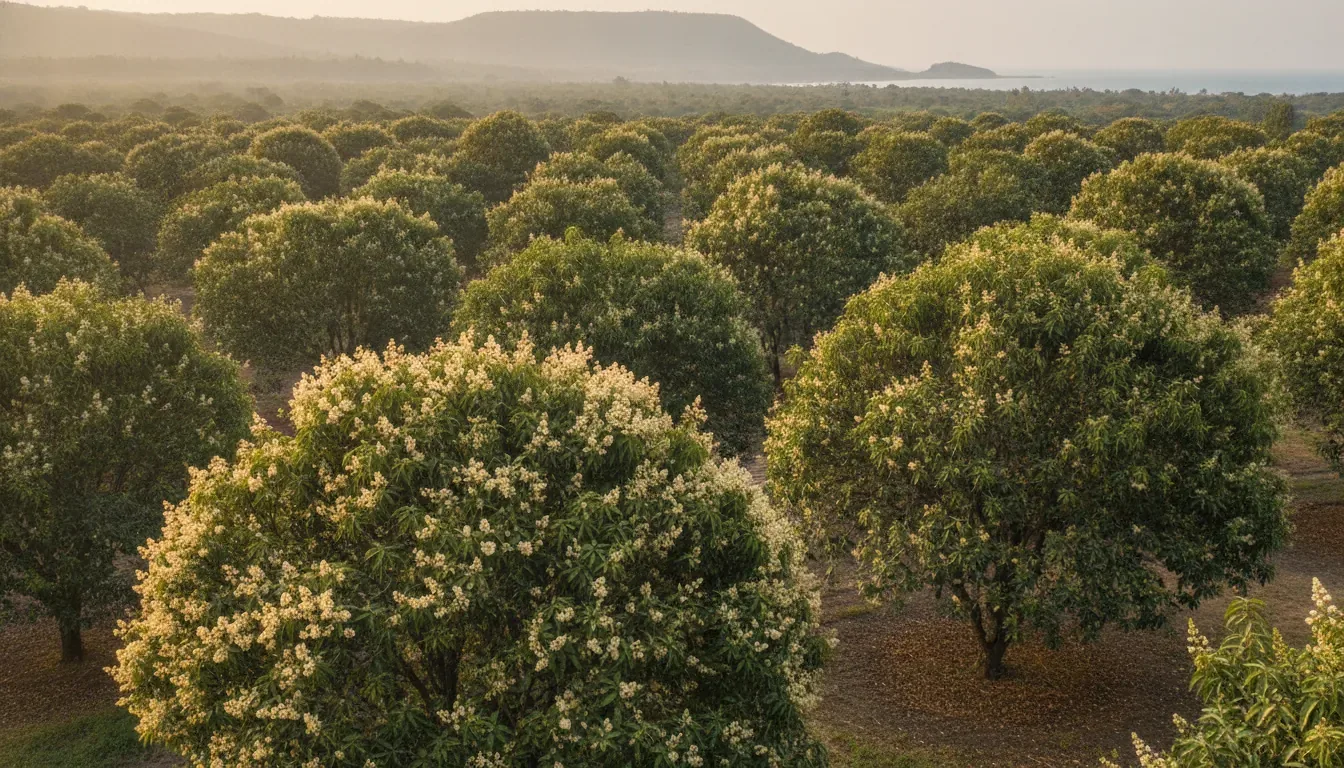
For a grower near Bangalore, the most relevant story is Karnataka. Karnataka is the second-largest mango-producing state in India, with orchards spread across more than 1.7 lakh hectares. Its primary mango districts are Ramanagara, Kolar and Chikkaballapur. Srinivaspur in Kolar district is widely regarded as the Mango City of India for its unusually high diversity of varieties. Ramanagara has rocky granite hills that give well-drained, mineral-rich soil suited to mango, and the commercial South-Indian belt is dominated by Totapuri, Raspuri and Banganapalli.
What soil and climate does a mango orchard need
A mango orchard needs deep, well-drained loam at least about 1.5 metres deep, with a soil pH between 5.5 and 7.5. The climate must give warm growing months and a dry, frost-free spell during flowering, because cold or wet weather at flowering damages fruit set.
Drainage matters more than raw fertility. Mango roots go deep and will not tolerate waterlogging, so a site that holds standing water after rain is a poor choice whatever its other merits. Deep loam lets the taproot establish and carries the tree through dry spells. The red-laterite and red-loam belts common across parts of Karnataka and the Deccan drain freely and suit mango well, which is one reason the crop settled so firmly in the South.
Climate sets the ceiling on where mango pays. The tree needs a warm growing season and, above all, a dry and frost-free window when it flowers, usually in the cooler early months of the year. Rain or cold during flowering causes flower drop and poor fruit set. Gentle elevation, wind protection for young trees, and a location clear of frost pockets all help the orchard hold its crop.
Which mango variety should you plant
Choose a variety that matches your region, market and season rather than reputation alone. North India favours Dasheri and Langra, the west grows Alphonso and Kesar, and the south and Karnataka rely on Badami, Totapuri, Raspuri, Banganapalli and Neelam. Amrapali and Mallika suit denser planting.
Variety is a regional decision. Alphonso is the premium name of the western Konkan and Ratnagiri belt. Kesar is the signature of Gujarat. Dasheri and Langra hold the North Indian orchards, while Banganapalli, also sold as Safeda, is the mainstay of Andhra Pradesh. Totapuri is the workhorse of processing and pulp. Neelam is a late, more regular bearer, and the hybrids Amrapali and Mallika were bred for compact, high-density planting.
For a Karnataka grower the signatures are Badami and Raspuri. Badami is often called the Alphonso of the South and carries a premium, with a season running roughly April to June. Raspuri is the classic table and juice mango of the region. The variety drawing the most attention at the top of the market is Miyazaki, the imported Japanese premium type now being trialled in India.
| Variety | Region / role | Note |
|---|---|---|
| Alphonso | West, Konkan and Ratnagiri | Premium table variety |
| Kesar | Gujarat | Aromatic, widely used for pulp |
| Dasheri, Langra | North India | Established table varieties |
| Banganapalli (Safeda) | Andhra Pradesh | Large fruit, widely marketed |
| Totapuri | South India | Processing and pulp |
| Neelam | South India | Late season, regular bearer |
| Amrapali, Mallika | Pan-India hybrids | Bred for high-density planting |
| Badami | Karnataka | Alphonso of the South, season April to June |
| Raspuri | Karnataka | Classic table and juice mango |
| Miyazaki | Trialled in India | Trending imported premium |
Match variety to purpose before you plant, then go deep on the one you choose: farming Alphonso mango, a grower’s guide to Kesar mango, or growing Miyazaki mango in India.
Traditional, high-density or ultra-high-density – how should you space the orchard
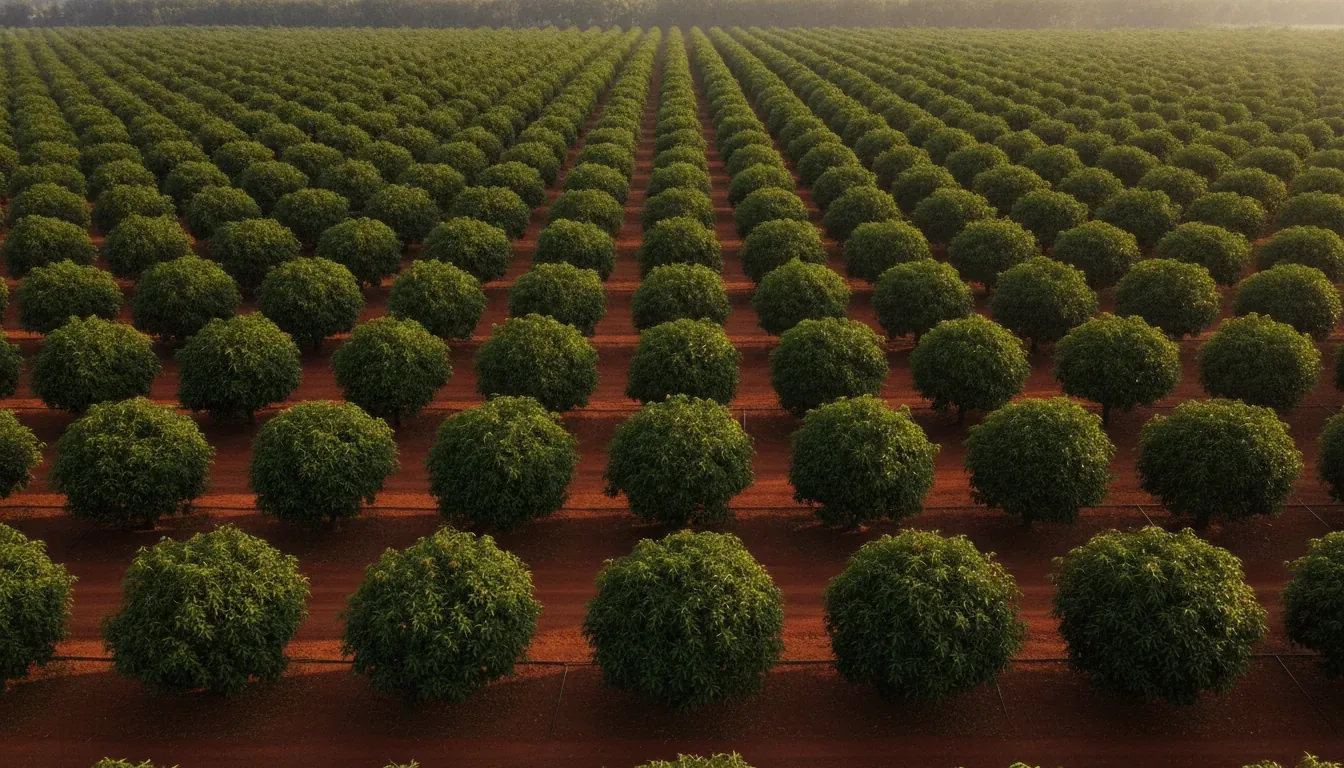
Spacing decides how many trees you plant per acre and how soon the orchard pays back. Traditional spacing gives roughly 40 to 50 trees per acre, high-density planting about 160, and ultra-high-density 670 to 1,100 trees per acre. Denser systems cost more upfront but reach commercial yield sooner.
| System | Spacing | Trees per acre | Year-1 capital per acre | Years to commercial yield |
|---|---|---|---|---|
| Traditional | 9m x 9m (10m x 10m gives about 40) | about 50 | Rs 66,000 to 93,000 | 6 to 8 |
| High-density (HDP) | 5m x 5m | about 160 | Rs 1,06,000 to 1,43,000 | 4 to 5 |
| Ultra-high-density (UHDP) | 3m x 2m | 670 to 1,100 | Rs 1,95,000 to 3,16,000 | 4 to 5 |
Traditional spacing keeps trees far apart, which is simple to manage but slow to fill an acre with fruiting canopy. High-density and ultra-high-density planting pack far more trees into the same acre, backed by drip irrigation and regular pruning to keep the canopy open and workable. These modern systems, refined internationally including through Israeli orchard technology, raise early output per acre but demand tighter management and more upfront capital. The technique detail, canopy management and pruning schedules sit in our guide to how high-density mango planting works.
How do you plant and raise young mango trees
Plant grafted saplings rather than seedlings, so the orchard fruits true to variety and years sooner. Prepare pits ahead of the monsoon, plant at the onset of the rains, stake and protect the young trees, and water by drip. Young trees need frequent light irrigation; mature trees need less.
Grafted saplings carry a known variety on a chosen rootstock, so they crop true and earlier than seedlings raised from stone. Dig and fill planting pits before the rains, plant as the monsoon sets in, and give each young tree a stake, a clear basin and protection from grazing. Drip irrigation suits mango at every stage: young trees want frequent, light watering to establish, while mature trees need far less and can be stressed slightly before flowering to encourage a good set.
This is the orientation. For the full sequence from land preparation to first pruning, follow how to start a mango orchard step by step.
How long until a mango orchard bears, and what yield can you expect
A grafted mango tree gives its first fruit in three to four years, but commercial yield takes longer: about six to eight years in traditional orchards and four to five years in high-density systems. Seedling trees take five to eight years. Mango is also prone to alternate bearing.
The gestation is the single most important fact a prospective grower should sit with. First fruiting on grafted trees comes in three to four years, but a full commercial crop is a longer wait: six to eight years in a traditional orchard, four to five in a high-density or ultra-high-density system, and five to eight years for seedling trees. Anyone selling mango farming on quick money is skipping this.
Mango also tends towards alternate, or biennial, bearing: a heavy crop one year is often followed by a light one the next. Good variety choice, balanced nutrition and pruning reduce the swing but rarely erase it. Yield is best read as a multi-year average rather than a fixed annual number, and it varies with variety, planting system, tree age and orchard management.
Is mango farming profitable in India
Mango farming can be profitable, but only across a multi-year horizon and never as a guaranteed return. One Tamil Nadu research figure puts average net returns near Rs 2.3 lakh per acre with a benefit-to-cost ratio around 2:1 and commercial bearing at four to six years. Real figures vary widely.
Profit in mango is real but slow and conditional. The Tamil Nadu research figure above is a reference point, not a promise: it assumes a mature, well-managed orchard, and it sits on the far side of a four to six year wait before commercial bearing. Every rupee of that return depends on variety, planting system, management standard and the season, and it must be read against the gestation period and the alternate-bearing swing described above.
This page does not project returns for any particular orchard, and no honest guide should. For the full cost sheets, break-even maths and per-acre modelling, see mango farming profit per acre, in detail. For the reasoning behind how we treat this, read why we don’t promise returns.
Which pests and diseases hit mango, and how do you manage them
The main threats are fruit fly, mango hopper, powdery mildew, anthracnose, stem borer, mealy bug and root-knot nematode. Manage them with low-residue methods: neem oil sprays, pheromone traps for fruit fly, and prompt removal of infested plant parts, backed by good orchard hygiene.
| Pest or disease | Scientific name | Low-residue management |
|---|---|---|
| Fruit fly | Bactrocera dorsalis | Pheromone traps, clear fallen fruit |
| Mango hopper | Idioscopus clypealis | Neem oil sprays, open canopy |
| Powdery mildew | Fungal | Timely sprays, avoid a dense damp canopy |
| Anthracnose | Fungal | Remove affected parts, orchard hygiene |
| Stem borer | Beetle larva | Remove and destroy affected wood |
| Mealy bug | Sap-sucking insect | Sticky bands, remove infested parts |
| Root-knot nematode | Meloidogyne incognita | Healthy planting material, soil care |
The pests that matter most are the fruit fly and the mango hopper, both of which attack the crop directly. Fruit fly is best countered with pheromone traps and by clearing fallen fruit that harbours larvae. Neem oil sprays and an open, well-pruned canopy keep hopper and mildew in check. Anthracnose, stem borer, mealy bug and root-knot nematode are managed through hygiene, prompt removal of infested plant parts, and healthy planting material. The aim throughout is low-residue control that keeps the fruit clean and the soil alive.
For fully organic methods, inputs and certification, see growing mango organically in India.
When and how is mango harvested
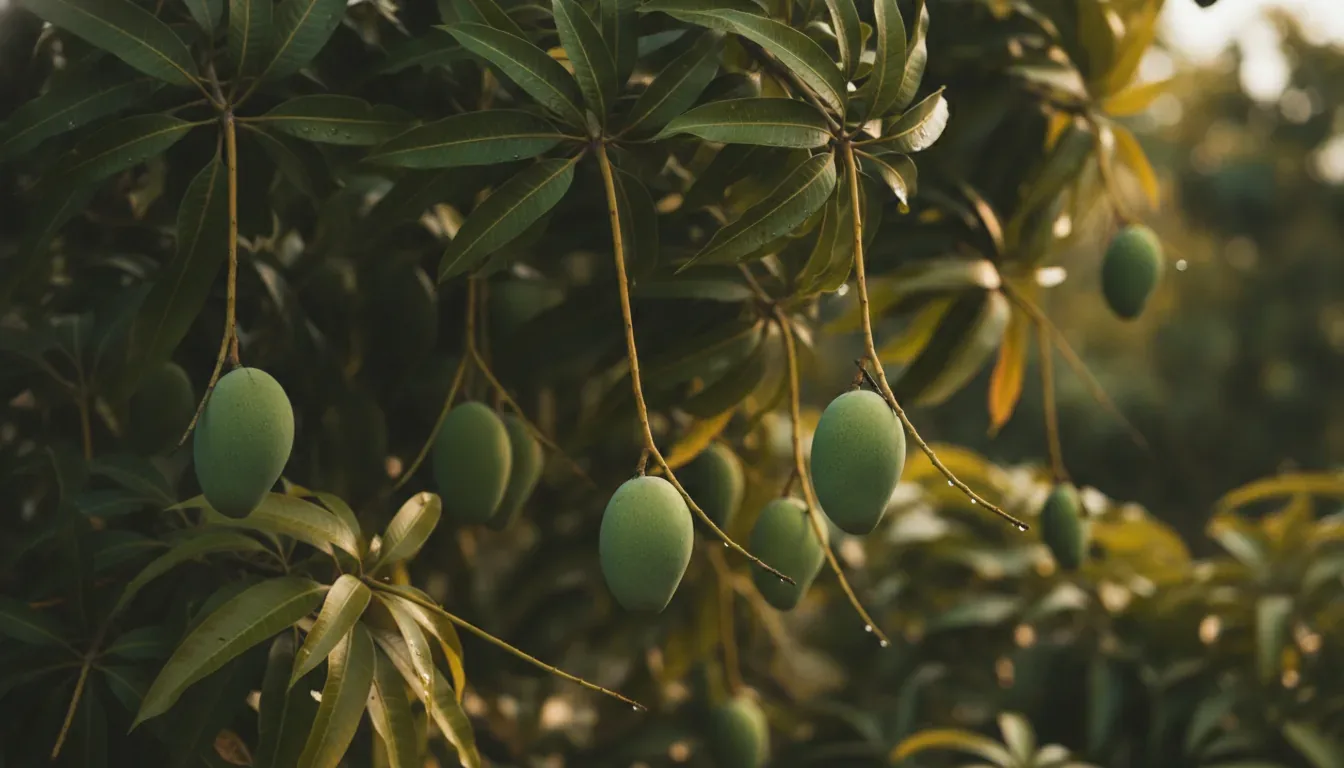
Mango is harvested when mature but still firm, judged by maturity indices such as shoulder development, colour break and specific gravity rather than full ripeness on the tree. The main harvest window runs April to July across India, with South India, including Karnataka, ripening earlier.
Mango is picked mature but unripe, then ripened off the tree, because fruit left to soften on the branch bruises and spoils. Growers judge maturity by the filling of the shoulders above the stalk, a change in skin colour, and the fruit sinking as its specific gravity rises. The national harvest runs roughly April to July, with the southern belt, Karnataka included, coming in earlier than the north. Handle picked fruit gently, keep it out of direct sun, and avoid the sap burn that marks skins when the stalk is snapped rather than cut. Careful harvest and handling protect both the eating quality and the market price.
What government support exists for mango growers
Mango orchard development is supported under the Mission for Integrated Development of Horticulture (MIDH) and the National Horticulture Board (NHB). Drip irrigation, which most modern orchards use, attracts a subsidy of up to 70 per cent under the Pradhan Mantri Krishi Sinchayee Yojana (PMKSY).
Public schemes lower the entry cost of an orchard. MIDH and the NHB support horticulture planting, mango included, while PMKSY offers a drip-irrigation subsidy of up to 70 per cent, which matters because drip is now standard for high-density mango. The exact rates, ceilings and eligibility vary by state and by year, and growers apply through their state horticulture department, so confirm the current terms locally before you budget on them.
Should you grow mango yourself, or own a managed mango orchard
That depends on how much of the next decade you want to spend running an orchard. Growing it yourself means buying land and managing planting, water, pests and harvest for years before commercial yield. A managed model lets you own the orchard while a professional team runs it.
Both routes are legitimate. Doing it yourself gives full control and the lowest per-acre cost, but it asks for land, capital, and years of hands-on involvement through the long gestation and the alternate-bearing swing, plus the weather and market risk that every grower carries. It suits people who want to farm, not only to own farmland.
The managed route answers a different reader: someone who wants to own a real, productive mango orchard without spending the next decade operating it. At Hasiru Farms this takes the form of theme-based managed farmland. Every project is built around a distinct lived theme rather than a generic plot with a clubhouse, and the theme shapes the architecture, the planting and the shared spaces. The land is then managed for life after the sale by Hasiru Care, our in-house team.
Ownership here is precise, not a promise. Every buyer receives individual ownership through a registered Sale Deed executed in their own name, conveying exclusive title to their specific parcel. Because that title is registered in your name, the land remains yours regardless of what happens to the company. The agricultural character of the land is retained. Hasiru has operated since 2021, with more than 100 acres delivered and over 250 families as owners.
One point is worth stating plainly, because it is the thing buyers most often get wrong: managed farmland is not a quick-return product. The theme is the investment, and ownership means belonging to a real, managed place, not buying a speculative yield. For the mango version of this model, see Mango Dew, our managed mango farmland on the managed mango farmland on the Ramanagara corridor, or start with Hasiru managed farmland near Bangalore.
Frequently asked questions
How much can I earn from one acre of mango trees?
Earnings from one acre depend on variety, planting system, tree age and management, and they arrive only after commercial bearing. One Tamil Nadu research figure references average net returns near Rs 2.3 lakh per acre at a benefit-to-cost ratio around 2:1. Treat it as a reference, not a promise.
Which state is the largest producer of mangoes in India?
Uttar Pradesh is the largest mango-producing state in India, accounting for about 26.56 per cent of national production in 2024-25. Andhra Pradesh, Bihar, Karnataka, Gujarat, West Bengal and Telangana are the other major producing states.
Which is the costliest mango in India?
The costliest mango in India is generally the imported Japanese Miyazaki variety, the type behind the widely quoted very high per-kilogram prices. It is now being trialled by a small number of Indian growers, which is why it draws so much attention at the top of the market.
What is the price of a 20-year-old mango tree?
There is no standard market price for a mango tree by age. What a mature tree is worth depends on its variety, its yield history, its health and its location, so any single figure quoted out of context is unreliable. A tree is valued through the orchard and land it sits in, not on its own.
Who decides which crop is grown on a managed orchard?
On a managed orchard, planting is planned by the operating team in line with the project theme and the agronomy of the site, so the land is developed coherently rather than piecemeal. Under the Hasiru model, that ongoing management is handled in-house by Hasiru Care.
What happens to my mango farmland if the company shuts down?
Because you hold individual registered title through a Sale Deed in your own name, the land remains yours regardless of what happens to the company. Ownership sits with you as the registered owner of a specific parcel, not with the management provider.
Can I sell or transfer my mango farmland later?
Yes. You hold the parcel through a registered Sale Deed in your own name, so it is your asset to sell or transfer as registered agricultural land, following the usual legal process for such land. Ownership and its transfer rest with you as the titleholder.
Where to go next
Mango farming in India rewards planning over haste: the right land, the right system, the right variety, and a clear-eyed view of the years before the orchard pays. Whether you intend to grow it yourself or to own a managed orchard, the deeper you plan, the better the outcome.
Go deeper on the parts that matter to you
- the beginner’s getting-started guide to mango farming
- organic mango cultivation and certification
- the full profit-per-acre breakdown
- high-density and ultra-high-density planting
- the Alphonso grower’s guide
- Kesar mango farming
- the Miyazaki mango guide
- our stance on not promising returns
If you would rather own a mango orchard than operate one, see Mango Dew on our Ramanagara corridor farmland, or arrange a visit to walk the land near Bangalore.