Growers across India are planting far more mango trees per acre than the old wide-spaced orchard ever allowed, and pulling fruit years sooner for it.
This is high-density mango farming, and its closer-packed cousin ultra-high-density planting, a technique built on tight spacing and constant canopy control.
The page below sets out how it works, how much it yields, and the ongoing discipline that decides whether the technique delivers.
High-density mango farming plants trees far closer than the traditional 10×10 metre layout, roughly 160 trees an acre for high-density planting and anywhere from about 450 to over 1,100 for ultra-high-density. An acre therefore carries more fruit, years earlier, in exchange for disciplined canopy management every season. Yield figures vary with variety, soil and how well the orchard is run, so the numbers on this page are attributed ranges, not fixed outcomes.
TL;DR: High-density and ultra-high-density mango planting swap wide spacing for many more trees per acre, drawing fruit from year two to three and lifting yield well above a traditional orchard. The uplift is real but conditional. It holds only where the canopy is pruned and the trees are fertigated on schedule, for the life of the orchard. Choose dwarf, regular-bearing varieties, and plan for the management before the planting.
On this page
What is high-density mango farming, and how is it different from the traditional orchard
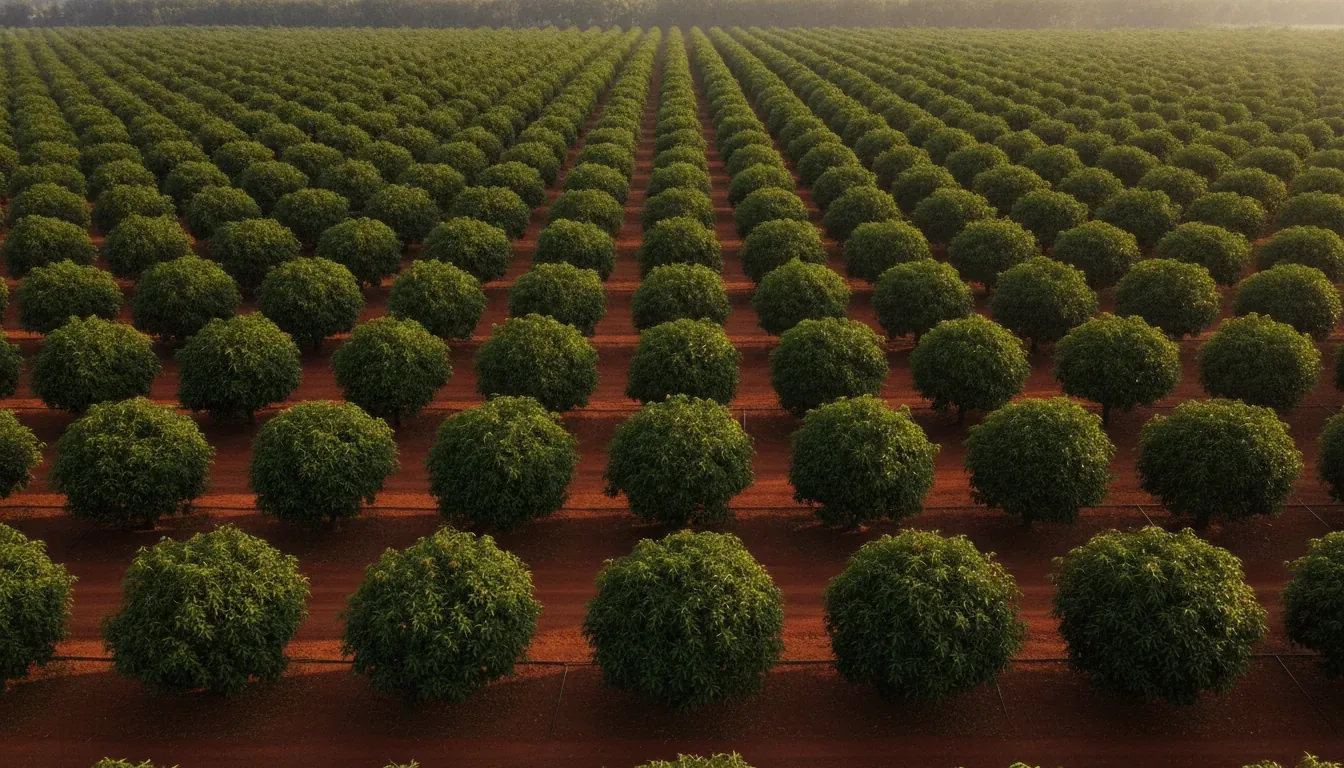
High-density mango farming plants trees much closer together than a traditional orchard, so an acre holds many more trees. A traditional layout spaces trees 10 to 12 metres apart at 40 to 100 trees an acre. High-density planting tightens that to around 160, and ultra-high-density pushes past 450 and can reach beyond 1,100.
The logic is simple. More trees sharing the same acre means more fruiting wood, and small, managed canopies let sunlight reach every tree instead of a few large ones hogging the light. The trade is that close-planted trees have to be held small on purpose, which is where the management comes in.
| System | Spacing | Trees per acre | First fruiting | Mature yield range |
|---|---|---|---|---|
| Traditional | 10×10 m to 12×12 m | ~40 to 100 | Year 5 onward | ~2.5 to 3 t/acre |
| High-density (HDP) | ~5×5 m (down to 3×3 m) | ~160 to 200 | Year 3 to 4 | ~5 to 10 t/acre |
| Ultra-high-density (UHDP) | ~3×2 m (to 4×2 m) | ~450 to 1,100 | Year 2 to 3 | ~9 to 18 t/acre |
Figures are attributed ranges from ICAR density-planting trials and published Indian grower guides (Agriplast, Agrifarming). Actual spacing, tree counts and yield vary with variety, soil and management, so treat these as planning ranges rather than fixed results.
For the wider context of how mango is grown in India, from site selection to harvest, see the complete guide to mango farming in India.
How close are the trees planted, and how many fit in one acre
Trees are planted from about 5×5 metres in high-density planting down to 3×2 metres, or even 3×1 metres, in ultra-high-density. That puts roughly 160 trees an acre under high-density planting and anywhere from about 450 to over 1,100 under ultra-high-density, against 40 to 100 in a traditional orchard.
The exact spacing is a decision, not a formula. A tighter grid gives more trees and a faster return of fruit, but it also raises the management load, because every tree has to be pruned and fed precisely to keep it in its allotted space. Grower guides commonly cite 5×5 metres for high-density and 3×2 or 4×2 metres for ultra-high-density, with the denser layouts leaning on dwarf varieties and drip fertigation to work at all.
Reframed from the common “how many trees for a large plot” question, the useful figure is always per acre, because that is the unit spacing and yield are measured in.
Which mango varieties suit high-density planting, and why only some
High-density and ultra-high-density planting suit dwarf, regular-bearing mango varieties, because close spacing only works with trees that stay compact and crop predictably. Amrapali and Mallika dominate ultra-high-density for this reason. Arunika, Ambika and Alphonso appear in high-density trials, though a vigorous variety behaves differently when packed close.
The constraint is structural. A variety that naturally grows large and spreading fights the whole idea of close planting, so it needs heavier pruning to hold its shape and can shade its neighbours if the schedule slips. Compact, regular-bearing types like Amrapali carry fruit reliably on small frames, which is why ICAR high-density trials leaned on Amrapali, Arunika, Ambika and Mallika, and why published guides describe ultra-high-density as suited almost exclusively to Amrapali and Mallika.
Alphonso can be grown at high density, but its vigour means it demands more disciplined training than a naturally dwarf variety of the same age.
How is the canopy managed and pruned to keep the trees small
The canopy is kept small by training each tree to a single stem with four to five main branches, then hedging and pruning it to a fixed height, roughly 1.5 to 3 metres, at least twice a year. Overgrown trees are cut back hard, a practice called dehorning, to restore light and shape.
Training starts young. Growers develop a single central stem, allow four or five well-placed primary branches, and then hold the tree to a planned height and width through repeated pruning. Published grower guidance ranges from twice-yearly canopy pruning with trees held at 1.5 to 2 metres, to pruning three to four times a year with trees kept under about seven feet. The mango factory approach documents holding a fixed height near three metres by dehorning and pruning rather than letting the tree find its own size.
Two things make this work. The first is light. A small, open canopy lets sunlight penetrate every tree, which drives flowering and fruiting across the whole orchard rather than only the outer trees. The second is water and nutrition delivered through drip fertigation, so each tree gets a precise, scheduled feed instead of competing for a broadcast application. When an old orchard loses shape, rejuvenation pruning, cutting the canopy back hard, resets it, after which the trees rebuild productive wood.
How much more does high-density mango yield, and how soon
High-density mango bears sooner than a traditional orchard and carries a heavier crop per acre once mature. Ultra-high-density can fruit from year two to three, and high-density from year three to four. Published mature yields run from about 5 to 18 tonnes an acre, depending entirely on variety, soil and management.
A year-by-year picture from ICAR high-density trials shows the build-up rather than a single number. In year two, trees carried roughly 10 to 15 fruits each, about 1.5 to 2.5 kg per tree. By year three, that rose to 20 to 35 fruits, around 6 to 8 kg per tree, near 7.5 tonnes per hectare. By years six to seven, mature trees carried 13 to 15 kg each, in the region of 14 to 16 tonnes per hectare. Published guides place first fruiting for high-density at year three to four with a commercial crop by year six to seven, and ultra-high-density fruiting from year two to three.
These are agronomic trial figures for the crop, not a projected financial return, and every one of them is conditional on the orchard being pruned and fertigated on schedule. This page deliberately stays on what the technique yields as a crop. For what mango growing actually earns per acre as an economic question, see the sibling analysis on what mango farming actually earns per acre.
What does high-density mango farming demand that traditional farming does not
High-density mango demands far more ongoing input than a traditional orchard: precise drip fertigation, canopy pruning several times a year, and constant attention to spacing and light. Skip the schedule and the close-planted trees shade each other out, congestion sets in, and the yield advantage collapses.
This is the part most articles leave out. The yield uplift is not a property of the planting layout on its own, it is a property of the layout plus the management. A wide-spaced traditional tree can be left largely to itself and still crop. A close-planted high-density tree cannot, because its whole economic case rests on being held small and productive, which only happens if someone prunes, feeds and monitors it, season after season, for the life of the orchard.
The real risk to a high-density orchard is neglect. A missed pruning cycle or an inconsistent fertigation schedule does not just cost a season, it lets the canopy close over, cuts the light, and pulls yield down across the block. The technique rewards discipline and punishes drift, which raises an obvious question for anyone who wants the fruit without doing the fieldwork themselves.
Who prunes and fertigates a high-density orchard if you do not farm it yourself
If you own a high-density mango farm but do not want to prune and fertigate it yourself, the schedule has to be run by someone who does. A managed-farmland operator takes on exactly that, running the pruning, fertigation and upkeep the technique depends on under a formal agreement, so the orchard stays productive without the owner in the field.
This is where a managed model earns its place. At Hasiru, there is a formal agreement between the company and the owner that covers the maintenance and management of the farmland. Under that maintenance agreement, Hasiru undertakes the management and maintenance of the land, which for a mango orchard means the disciplined pruning and fertigation schedule high-density needs is handled on the owner’s behalf. On-ground presence backs it up: Hasiru Care manages sites at the corridor locations, with staff physically present at the farmland rather than an arrangement that exists only on paper.
It also reframes what the ownership actually is. A theme and a real, cared-for place is the investment here, not a speculative yield play. For a worked example of managed mango farmland, see Mango Dew, our managed mango project near Ramanagara, where the day-to-day upkeep of the orchard is run for owners rather than by them.
Frequently asked questions
Who maintains a high-density mango farm, and what if I rarely visit?
Under a managed model, the operator maintains it. At Hasiru, a formal maintenance agreement means the company runs the pruning, fertigation and upkeep on a schedule, so the orchard is looked after whether or not the owner visits.
Do I receive the produce from a managed mango farm, and who decides the crop?
The managed model handles the crop as part of the farmland’s upkeep. What an owner receives, and how, is set by the specific project rather than by the technique. See the Mango Dew project page for how the managed model handles the crop on that project.
Is ultra-high-density mango more profitable than high-density?
That is an economics question, not a technique one, and it turns on costs, variety and market, not spacing alone. This page covers the technique and its yield uplift. For the earnings side, see what mango farming actually earns per acre.
Does high-density mango farming need more water than a traditional orchard?
It needs water delivered more precisely, not simply more of it. High-density and ultra-high-density orchards rely on drip fertigation, so each tree gets a scheduled feed of water and nutrients rather than a broadcast application, which is part of what keeps close-planted trees productive.
Can a high-density mango orchard be neglected and still yield well?
No. The yield uplift depends on the pruning and fertigation schedule being kept. Miss it and the close-planted canopies shade each other, congestion sets in, and yield falls, which is why disciplined ongoing management is central to the technique.
High-density mango rewards planning more than luck. If you want the full picture of growing mango in India, read how mango farming works end to end. If you would rather own a producing mango farm without running the pruning schedule yourself, see a managed mango farm at Mango Dew, backed by Hasiru’s record since 2021 of over 100 acres delivered for more than 250 families.