Buying a farm plot is not just buying “a piece of land in a beautiful location.” In Karnataka, a big share of buyer regret comes from one issue: the boundary is clear in someone’s head, but not clear in records or on the ground. If you are buying a portion out of a larger survey number, three terms decide whether you truly own a definable, defensible piece of land: 11E sketch, phodi sketch, and mutation. The right combination prevents future boundary fights, resale pain, and that sinking feeling of “I own it, but it feels blurry.”
If you want the full end-to-end due diligence stack, use this broader guide and come back here for the boundary deep dive: “Karnataka legal checklist for farm plot buyers.”
Table of Contents
TLDR (save this before you visit a site)
- If you are buying a part of a survey number, treat an 11E (pre-mutation) sketch as a boundary safety belt.
- If the RTC shows multiple holders in the same survey number and boundaries are not clearly demarcated, phodi becomes the clean-up step that maps separate holdings.
- Mutation is the revenue update that makes RTC reflect the new ownership and extent. Registration day is not the finish line.
- Boundary clarity is a two-part test: records plus on-ground demarcation. Your checklist should include a boundary walk, not just a site visit.
- For official sketches and survey document requests, Mojini is the state portal where citizens can apply for services like 11E and phodi online.
A quick glossary (plain English, buyer-focused)
Survey number (Sy.No.)
The government’s identity number for a parcel in a village. A single Sy.No. can be large and can later be divided or held by multiple parties.
Hissa
A sub-portion of a survey number, often used when a survey number is subdivided into parts.
RTC (Pahani)
The Record of Rights for land, often used by buyers to see owner names, extent, and other key entries. The official portal provides RTC services online.
11E (pre-mutation) sketch
A sketch issued for mutation involving part extents of a survey number. It helps identify the exact portion to be mutated.
Phodi sketch
A sketch used when specific extents are held by different parties within the same survey number but boundaries are not demarcated. It maps separate holdings.
Mutation (MR)
A revenue record update that changes RTC to reflect ownership and extent after a transfer.
Tippani, pakka book, atlas
Survey records that can support measurement history and mapping. Mojini explicitly offers online requests for survey records such as tippani and pakka book.
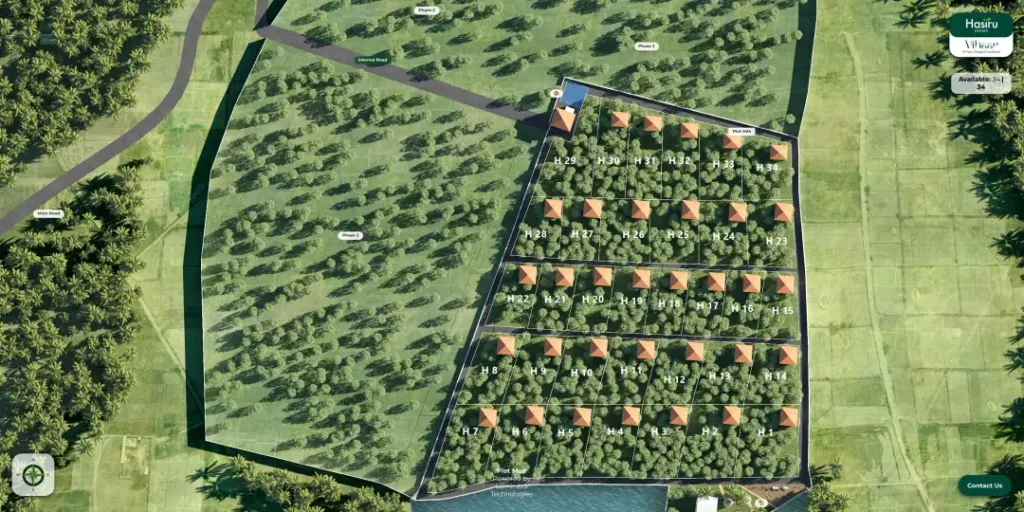
The buyer’s mental model: legal boundary vs physical boundary
Most first-time buyers accidentally assume the boundary is “whatever the seller points to.” That is a physical boundary claim. A buyer-safe purchase needs a legal boundary story too.
Think of it like this:
- Legal boundary is what can be defended in records, supported by sketches and entries.
- Physical boundary is what is visible on site: markers, fencing, natural edges, and what neighbors informally accept.
When legal boundary and physical boundary match, life is simple. When they do not, the person with stronger paperwork and stronger possession history often wins. That is why your boundary checks should happen before you get emotionally attached to the view.
If you want to anchor your basics first, read “Farm plot vs farmland vs agricultural land in Karnataka” and then come back to the boundary mechanics.
What is an 11E sketch, and when do you need it?
11E in one sentence
An 11E (pre-mutation) sketch is used to effect mutation when a transaction involves part extents of a survey number, marking the exact portion to be conveyed.
The buyer scenario where 11E matters most
You are shown land that is “1 acre out of 5 acres in Sy.No. X.” If that 1 acre is not clearly identified as a specific portion in a sketch tied to records, you are buying a number on paper, not a defined piece on the ground.
Karnataka has long pushed the idea that pre-mutation sketches should reduce disputes and ensure correct identification of land being transferred. A state administrative reforms report explicitly discusses making 11E sketch compulsory for transactions within the same survey number to avoid wrong possession being delivered against the registered survey number.
What a buyer should look for in an 11E sketch
You do not need to be a survey expert to do first-level screening. Ask for the sketch and check:
- Does it clearly show the parent survey number boundary?
- Does it mark the portion being transferred in a distinct way?
- Do measurements and reference points exist, not just a rough outline?
- Does the extent in the sketch align with the extent being sold?
- Does the narrative in the sale paperwork match the portion shown?
A blunt rule that protects buyers
If you are buying a part extent and the answer is “we will sort 11E later,” treat it as a risk that must be priced and contractually pinned on someone. Hasiru’s buyer checklist calls out 11E as a safety belt when a farm plot is carved out of a bigger survey number.
What is phodi, and why plot buyers should care even if they are not subdividing
Phodi in one sentence
Phodi is a process where survey authorities measure and issue sketches to demarcate boundaries of specific extents held by different parties within the same survey number when boundaries are not clearly demarcated.
The problem phodi solves
A survey number can show multiple owners or holders. On paper, it looks like everyone has an extent. On the ground, nobody is fully sure where one holding ends and another begins.
This is where buyers get trapped. You might buy from someone who has “the right extent,” but the boundaries are not separated cleanly, so practical possession becomes messy, especially when neighbors disagree.
Buyer signals that phodi might be needed
- RTC shows multiple parties, but no clean subdivision story is provided.
- Seller cannot explain the boundary history beyond “everyone knows this side is ours.”
- The site has informal markers that look recent or inconsistent.
What phodi changes for a buyer
- It creates a clearer mapping of holdings, making it easier for the record system to reflect distinct portions.
- It reduces the “shared survey number confusion” that often shows up at resale.
What is mutation, and why it is not optional in real life
Mutation in one sentence
Mutation is the revenue record update process that reflects ownership and extent changes in the RTC after a transfer.
The buyer trap: treating registration day as completion
Many buyers think: sale deed done, money paid, keys in hand, done. But revenue records still need to align. Hasiru’s “Stamp Duty, Registration and RTC” guide frames buying farmland as a chain of steps, where missing the post-registration updates creates problems later.
Why mutation matters for boundaries, not just ownership
Mutation is one of the bridges between transaction and land record reality. If the ownership trail in RTC does not match what you are shown, you might face:
- trouble during resale
- delays in financing
- conflict resolution headaches
If you want the full buying sequence, read Hasiru’s step-by-step legal process guide, and keep this article as your boundary module.
The simple decision tree: 11E vs phodi vs mutation
Use this as a pre-token checklist.
Step 1: Are you buying the full extent of a survey number?
- If yes, you still need mutation continuity, but 11E logic is usually not the core issue.
Step 2: Are you buying a portion of a survey number?
- If yes, treat 11E as critical for defining “which portion” is being transferred.
Step 3: Does the survey number appear to be shared among multiple holders without demarcated boundaries?
- If yes, phodi becomes the pathway to clean demarcation.
Step 4: After transfer, does RTC reflect the new reality?
- If not, follow up on mutation until the record aligns.
Where to verify and request records (official portals)
RTC and MR (for basic ownership and mutation trail)
The state’s official land records portal provides RTC services online.
Sketches and survey document requests
Mojini is the Karnataka government portal where citizens can apply online for services including 11E (pre-mutation sketch) and tatkal phodi, and can request survey records like tippani and pakka book.
Practical note: portals tell you what exists in the system. They do not replace on-ground verification.
How to match paperwork to the ground (the boundary walk that most buyers skip)
Hasiru’s legal checklist explicitly warns buyers to walk boundaries with intent, not just “see the view.”
Here is a buyer-friendly field method:
1) Do a first walk without anyone leading you
Start by walking the perimeter in your head based on the sketch. If you cannot even approximate it, your boundary story is too weak.
2) Identify boundary markers and ask “since when?”
Markers that look fresh, inconsistent, or newly painted are not proof, they are clues. Ask neighbors what they recognize as the boundary. You are not seeking gossip, you are checking if the boundary is socially stable.
3) Take photos and pin them to notes
Your future self will forget. Take photos of corners, markers, and any disputes like a neighboring fence line creeping inward.
4) Look for conflict magnets
- a tree line that cuts across what the seller claims
- a road edge used by multiple people
- water channels or drainage lines that neighbors assume are shared
5) If the deal is meaningful, consider a surveyor visit
The audit report describing the sketch system notes measurements being undertaken through government or licensed surveyors when issuing sketches.
You are not trying to “overcomplicate.” You are trying to buy peace.
Red flags that should pause the deal
- Part-extent sale with no 11E story, or “we will do it later” without written responsibility.
- Multi-owner survey number situation, but no phodi plan and no clarity on demarcation.
- Ownership continuity in RTC does not match the chain you are shown, and mutation status is unclear.
- Approach road exists only in marketing material, not defensible in reality. Hasiru has a full guide on right-of-way verification.
Buyer checklist (copy-paste)
Use this as a message template when you ask a seller, broker, or project operator for documents.
Records
- Latest RTC for the relevant survey number and hissa (if applicable).
- Mutation trail or MR references that show ownership continuity.
Boundary and sketches
- If buying a part extent: 11E (pre-mutation) sketch.
- If shared survey number without demarcation: phodi sketch or proof of phodi process underway.
- Site demarcation method description, and evidence of boundary maintenance.
On-ground verification
- Boundary walk notes and photos.
- Access route verification, including right-of-way if needed.
For broader context and additional checks beyond boundaries, use Hasiru’s legal checklist.
FAQs
1) What is an 11E sketch in Karnataka?
An 11E (pre-mutation) sketch is used to effect mutation when a transaction involves part extents of a survey number, marking the specific portion for mutation and record updating.
2) Is 11E needed if I am buying only a portion of a survey number?
If you are buying a part extent, 11E is one of the strongest ways to reduce “which portion is mine” ambiguity, and Karnataka governance discussions have emphasized it as a dispute-reduction mechanism.
3) What is the difference between 11E and phodi?
11E is tied to mutation involving part extents, while phodi addresses demarcation of separate holdings within the same survey number when boundaries are not already demarcated.
4) What does mutation change for a buyer?
Mutation updates revenue records so RTC reflects ownership and extent after transfer. It is part of the post-registration chain that buyers should not ignore.
5) Can a sale deed exist while RTC still shows the old name?
Yes, that mismatch can happen if post-registration updates are pending. Hasiru’s step-by-step process emphasizes that registration is not the finish line.