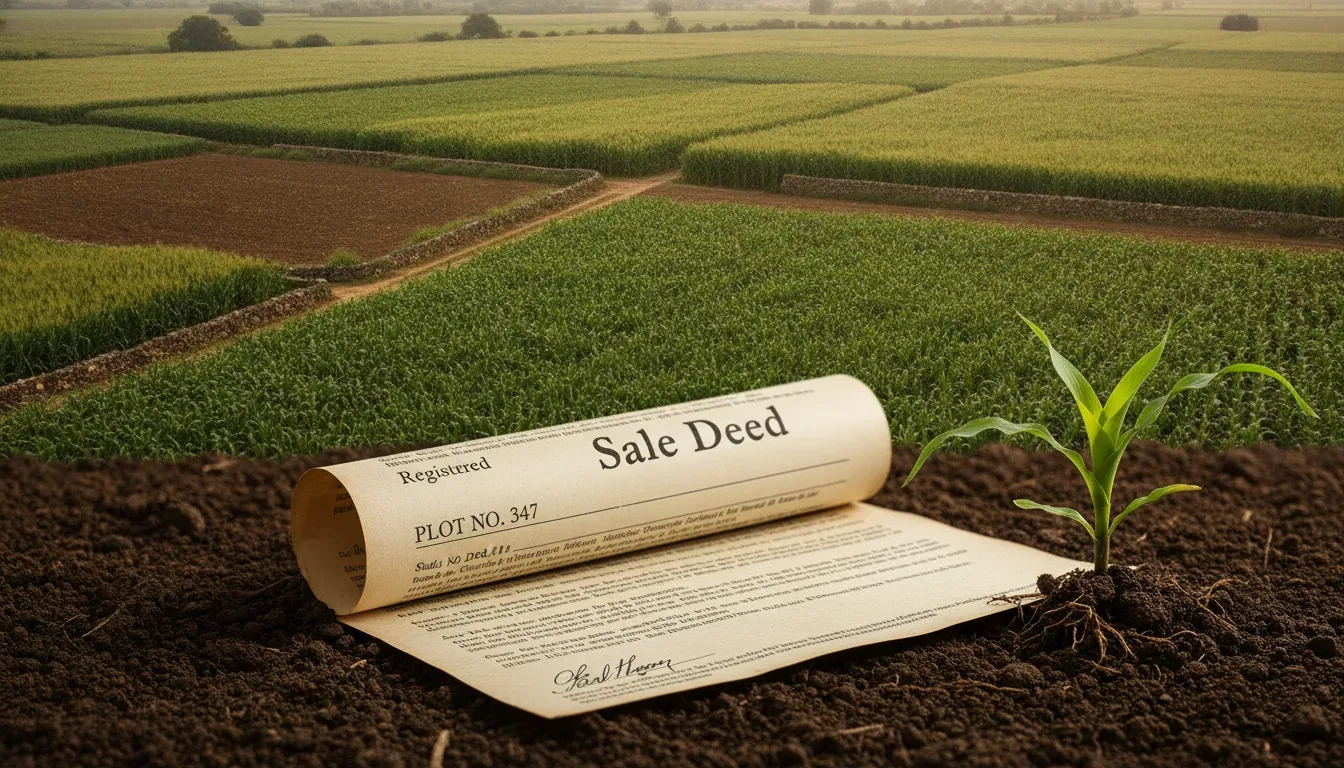
Buying “land” in and around Bengaluru can feel deceptively simple: you see a listing that says farm plot, another that says farmland, and a third that says agricultural land—and all three look like the same patch of green on a map.
But in Karnataka, these words can mean very different things depending on how the land is recorded, what approvals exist, and what you’re legally allowed to do with it. Many buyers discover the difference only after paying a token—when a bank refuses a loan, a building plan gets rejected, or resale becomes difficult.
This guide breaks it down in plain English so you can understand what you’re actually buying—and how to avoid common traps.
Table of Contents
Why this confusion happens (and why it matters)
The biggest reason people get misled is that “plot” is a familiar word, and marketers know it. In cities, a “plot” usually means a clearly defined site with access roads and predictable permissions. So when you hear “farm plot,” your brain automatically imagines: a neat little site where I can fence, build a small farmhouse, plant a few trees, and chill on weekends.
But in many cases, “farm plot” is not a legal land category. It’s often a packaging of something else—usually agricultural land that has been subdivided or “formed” informally into smaller parcels.
Why it matters:
- Usage limits: Agricultural land comes with restrictions. The ability to build, convert use, or create sites depends on approvals—not on what the brochure says.
- Loan & resale: Banks and informed buyers will check records and approvals. If the land is “site-like” but not legally compliant, resale can be painful.
- Long-term safety: Unauthorized layouts and unclear titles create disputes, notices, penalties, and sometimes demolition risk (depending on where and how the land was developed).
So the core rule is this:
Ignore the listing label. Trust the land records, approvals, and legal use permissions.

Quick definitions you can rely on
Think of these three terms as living on different layers:
- “Farm plot” is usually marketing language
- “Farmland” is usually functional language
- “Agricultural land” is usually revenue/legal classification language
Farm plot (usually a market term)
A “farm plot” is commonly used to describe a small parcel sold for leisure farming, weekend use, orchards, or “farmhouse” dreams.
What it often implies in marketing:
- smaller size (e.g., 1 gunte to 1 acre segments)
- internal roads, fencing, a gate, “layout feel”
- clubhouse/amenities talk (sometimes)
What it may actually be underneath:
- agricultural land divided into smaller parts (sometimes cleanly, sometimes not)
- land with partial development work but unclear approvals
- land that looks like a plotted layout but isn’t legally treated like one
In short: a farm plot may be agricultural land with a sales pitch. Sometimes it’s done responsibly; sometimes it’s not.
Farmland (a functional term)
“Farmland” usually refers to land being used—or suitable to be used—for agriculture:
- crops, orchards, timber, plantations
- drip irrigation setups, borewell, farm operations
- long-term cultivation plans
Farmland can be:
- a large parcel (traditional farmland)
- a managed orchard project
- a professionally maintained farm where the buyer doesn’t personally cultivate daily
Importantly, “farmland” is still usually agricultural land in official records unless conversion has happened. The difference is that the buyer’s intention is farming first, not construction first.
Agricultural land (the legal/revenue category)
This is the clearest term because it is tied to how the land is recorded in revenue documents. Agricultural land typically:
- appears as agricultural in RTC/pahani records (and related revenue documents)
- has land use designated for cultivation/agri activities
- may have restrictions on non-agricultural use unless permissions are obtained
This is the category that determines:
- what use is permitted
- what approvals are needed to change use
- how authorities treat the land if development violates rules
If you want certainty, always anchor your understanding to how it is recorded and what approvals exist.

What you can legally do on each type (without assumptions)
Here’s a practical way to think about it:
Your rights depend on (1) land classification + (2) approvals + (3) local jurisdiction rules (panchayat/TPA/urban authority zone).
On agricultural land (typical baseline)
Generally safe, usually permissible (subject to local rules):
- cultivation, orchards, agroforestry
- fencing (within limits and local rules)
- farm operations infrastructure (like pump house, storage, etc.) depending on rules and permits
What becomes tricky:
- residential-style construction
- site formation, selling it like a residential layout
- commercial buildings
Many buyers assume “I own it, so I can build.” In land matters, ownership alone isn’t the whole story.
On “farm plots” (depends entirely on how it was created)
If the “farm plot” is simply a smaller piece of agricultural land:
- you can typically do what agricultural land allows
- you may face additional issues if the subdivision/layout formation isn’t compliant
If the “farm plot” is part of a properly planned, approved development (rare, but possible):
- there may be clearer road plans, common area definitions, and better documentation
- but even then, building permissions depend on land use status and zoning
Bottom line: A farm plot is not automatically build-ready. It’s “build-ready” only if the approvals say so.
On converted land (non-agricultural use)
If the land has been legally converted (where applicable) for non-agricultural use:
- you may have broader options—but it still doesn’t automatically mean “you can build anything”
- planning approvals, zoning, and local authority permissions still apply
Conversion is a big milestone, but it’s not the finish line. It’s more like permission to enter the next stage of compliance.
The real make-or-break topic: conversion & approvals
If you remember one thing from this blog, remember this:
The “farm plot” story is won or lost on conversion, planning approvals, and documentation continuity.
In Karnataka, land use and development are shaped by multiple layers:
- revenue classification (agricultural vs converted)
- permission to divert land use (conversion/diversion)
- planning and layout approval processes (if sites/roads are involved)
- local governance rules (panchayat / planning authority / urban bodies)
- khata and property tax treatment
Conversion (what it is and what it isn’t)
Conversion (often discussed as “DC conversion”) generally refers to permission to use agricultural land for non-agricultural purposes (like residential, commercial, etc.), subject to conditions and payment of fees.
What conversion is:
- an official permission to change land use category (depending on purpose and process)
- a documented order you can verify (not just a verbal claim)
What conversion is not:
- a magic stamp that makes a plotted layout automatically legal
- a guarantee that you can build immediately without further planning approvals
- something you should accept based on “we have applied” or “it’s in process”
In buyer reality, there are three risk tiers:
- No conversion + selling as if it’s a residential plot → highest risk
- Conversion exists, but layout approvals and documentation are weak → medium risk
- Conversion + clear plan approvals + clean records → lower risk
Layout formation and “site-like selling”
A frequent issue: agricultural land is divided into many smaller “sites,” internal roads are formed, and it’s marketed as “farm plots.”
This can create problems if:
- approvals for forming a layout or internal roads are missing or unclear
- the development violates local planning norms
- the buyer is told “you can build a farmhouse easily” without proof
If a seller uses these phrases, pause:
- “No need conversion for farmhouse”
- “All approvals are there” (but no documents are shown)
- “It’s like a layout but it’s farmland, so no problem”
Your response should always be: Show the documents that prove what you’re claiming.
Khata confusion (A Khata, B Khata, panchayat khata)
Buyers often hear “Khata” as if it’s a single universal certificate that equals legality. In reality, khata is often about property tax registration and administrative tracking.
- A “khata exists” does not automatically prove land-use compliance.
- A “panchayat khata” might exist even when planning compliance is unclear.
- “B khata” discussions often create false comfort.
Treat khata as one piece of the puzzle—helpful, but not your foundation.
The practical takeaway
If your goal is farming + long-term asset, you can buy agricultural land if the title and records are clean.
If your goal is weekend home + construction, you must think beyond the word “farm plot” and ask:
- Is the land use legally compatible with what I want to build?
- Are approvals documented and verifiable?
- Will my plan survive scrutiny during resale?
Document checklist (what to verify before you pay)
You don’t need to become a lawyer. But you do need to become disciplined.
A good rule: Never pay a token based on photos, promises, or WhatsApp PDFs alone. Verify.
Core records you should insist on seeing
- RTC/Pahani: Confirms survey number, extent, owner name (as per revenue), land type, and cultivation-related info.
- Mutation extract (MR): Shows how ownership moved from one person to another over time.
- Encumbrance Certificate (EC): Shows registered transactions, mortgages, and certain legal burdens (but note: EC has limits).
- Survey sketch / Tippani / village map references: Helps confirm boundaries and prevents “wrong land shown” issues.
- Tax paid receipts: Not proof of legality, but useful as supporting consistency.
If someone claims “conversion is done”
Ask for:
- Conversion order (official order copy, with details matching the land)
- Proof that the conversion applies to your specific survey number and extent
- Any conditions in the order (sometimes there are conditions that affect what you can do)
If someone claims “it’s an approved layout / plotted development”
Ask for:
- Approved plan copy (with authority stamp and reference)
- Road width details and demarcation
- Common area definition (if any)
- Documentation that the site you’re buying is part of the approved plan
Where buyers typically go wrong
- They check only the EC and assume “clear title.”
- They don’t verify the mutation chain.
- They accept “conversion applied” as if it’s equivalent to “conversion approved.”
- They don’t confirm whether the parcel shown on-site matches the survey records.
Practical tip: match these 4 items every time
- Survey number
- Extent (exact size)
- Owner name (current)
- Boundaries (physical vs record)
If any of these don’t match cleanly, slow down.
Red flags that should make you walk away
Land buying rewards patience and punishes urgency. Here are strong “walk away” signals:
- Pressure tactics: “Two buyers are coming today, pay token now.”
- Document avoidance: “We’ll show papers after advance.”
- Vague approvals: “All approvals are there” but nothing is shareable.
- Boundary confusion: The land shown doesn’t match survey boundaries clearly.
- Too-good-to-be-true pricing near major corridors with big promises.
- Promises of easy construction without conversion/planning clarity.
- Fragmented ownership without clean mutation consolidation.
Also watch for a softer red flag:
If the seller gets irritated when you ask basic verification questions, that’s your answer.
Practical buying paths based on your goal
Different goals need different land choices. Pick your path first, then select the land type that fits it.
Goal A: You want farming, orchard income, or long-term landholding
What to prioritize:
- clean title and mutation chain
- water potential and soil suitability
- access road clarity (legal access matters)
- realistic expectations on returns (farming is a process, not a quick flip)
In this path, agricultural land can be a valid choice if verified well.
Goal B: You want a weekend farm experience (without daily management stress)
Here the real challenge is not just buying land—it’s maintaining it.
Consider what usually breaks the dream:
- lack of time to manage workers/vendors
- inconsistent maintenance (weeds, pests, irrigation breakdown)
- security and supervision issues
- “we’ll do it ourselves” plans collapsing after 3 months
This is where managed farmland models often make sense (more on that in “Why Hasiru”).
Goal C: You want to build a farmhouse-style structure and use it often
This is the most compliance-sensitive goal.
Your priorities:
- clear legality of land use for your intended structure
- documentation that supports building permission pathways
- clarity on local jurisdiction expectations (not assumptions)
If someone says “everyone is building here,” remember:
Other people building is not a legal approval.
Goal D: You want investment and easy resale
Resale-friendly land tends to be land with:
- clean documentation
- clear access
- fewer “explain it later” risks
- compliant development (or at least defensible legal position)
Even if you personally don’t plan to build, your future buyer might ask those questions—and your price will reflect how confident the answers are.
The buyer mindset that protects you (and saves money)
Most bad land decisions happen due to one of these:
- Buying with emotion (“I can see my farmhouse here!”)
- Buying based on scarcity pressure
- Treating land like an apartment purchase (it isn’t)
- Underestimating documentation complexity
A safer approach looks like this:
- Define your use goal (farming, weekend use, build, investment)
- Shortlist locations based on access, water, and long-term value
- Verify records first, then visit
- Confirm boundaries on-site with survey references
- Only then negotiate
If you flip that order, you increase the chance of paying for a problem.
Why Hasiru (and why it matters for this exact topic)
If you’ve read this far, you already know the real pain isn’t just “choosing land”—it’s reducing legal ambiguity and ensuring you can actually enjoy ownership.
That’s where Hasiru’s approach can be valuable, especially for buyers who want farmland as a lifestyle and long-term asset—not as a paperwork project.
Here’s the “Why Hasiru” in the context of farm plot vs farmland vs agricultural land:
- Clarity-first approach: Instead of selling a dreamy label, the focus is on what the land is, how it’s managed, and what ownership practically looks like.
- Managed farmland model: Many buyers want the outcome (green space, orchard growth, weekend calm) without becoming full-time operators. A managed model bridges that gap.
- On-ground execution support: Farming success is operational—watering schedules, maintenance cycles, soil care, and consistent supervision matter as much as the purchase.
- Lifestyle + sustainability orientation: If your goal is to own land responsibly—planting trees, building biodiversity, and maintaining the farm health—managed stewardship helps you stay consistent over time.
In short: if your worry is “I don’t want to buy the wrong type of land” and “I don’t want ownership to become a burden,” a managed farmland framework can reduce both risks—compliance anxiety and maintenance failure.
FAQs
Is a “farm plot” the same as agricultural land?
Not necessarily. “Farm plot” is often a marketing term. The land might still be agricultural in official records, or it might be part of a larger development with additional claims. Always verify the revenue classification and approvals.
Can I build a farmhouse on agricultural land in Karnataka?
This depends on land classification, local rules, and what exactly you mean by “farmhouse.” Some farm-related structures may be permissible under certain conditions, but residential-style construction can require permissions or conversion. Get professional advice before you assume.
What is DC conversion and when do I need it?
Conversion is typically needed when you want to use agricultural land for a non-agricultural purpose (like residential or commercial). It’s not a casual checkbox—you need the official order and must follow the conditions and related planning requirements.
Is checking the EC enough to confirm “clear title”?
EC is important, but it’s not the whole story. Title clarity also depends on RTC, mutation history, boundary verification, and whether claims match official records.
Why do some “farm plot” projects feel risky?
Because they can be sold like sites without the approvals and documentation that a true plotted development requires. The more “layout-like” the marketing is, the more carefully you should verify planning and legal compliance.
What’s the safest way to approach farmland ownership if I’m busy?
Choose a structure where (a) documentation is clean and verifiable and (b) ongoing maintenance is handled consistently. Managed farmland models exist specifically because most professionals don’t have the time to run farm operations day to day.