Access Road Reality: How to Verify Right-of-Way Before You Buy a Farm Plot
A “beautiful farm plot” is useless if you can’t reliably reach it.
Access is the #1 hidden risk in farm-plot buying because it’s easy to fake during a visit (“we came in smoothly, so it’s fine”), and painfully hard to fix later when a neighbour blocks the path, a gate appears, or you discover the “road” is actually someone else’s private land.
This guide helps you verify right-of-way (ROW) properly—before you pay a token—so your land doesn’t become “landlocked with a view.”
Why access road issues happen so often
Access problems are common in and around Bengaluru because land is frequently:
- subdivided informally,
- shown with “temporary approach paths,” or
- accessed through someone else’s land based on informal understanding.
During your first visit, access may look perfectly fine because:
- the neighbour hasn’t objected yet,
- the current owner has a friendly arrangement,
- the “road” is open only because no one has fenced it,
- the approach is via a bund/path used for farming—not a legally protected ROW.
After purchase, you become the new person in the equation. Informal permissions often vanish.
The harsh truth: Owning the land doesn’t automatically give you a legal right to cross someone else’s land to reach it.

Types of access roads and which ones are safest
Not all “roads” are equal. What you want is legally defensible access.
1) Public road access (best-case)
This is when your land touches a public road (maintained or recognized by the government/local body). It’s usually the most secure form of access because it doesn’t depend on a private person’s goodwill.
2) Village / panchayat road access (usually strong, but verify)
Many rural access roads are village-level roads—widely used and locally maintained. They can be reliable, but you still need to verify the road’s status and continuity (some “roads” are just customary paths).
3) Layout internal road access (only as good as the approvals)
If your plot is part of a plotted development, the internal roads may be shown on a plan. But if the “layout” is only informal plotting, internal roads can be disputed later.
4) Private road access (riskier than it sounds)
Sometimes the “road” is actually a strip of land owned by a private person or a group. If your access depends on this, you need written, registered rights—not verbal promises.
5) Access via farm bund/path (highest risk)
This is where you enter through a field edge, bund, or tractor path. It may work today, but it’s the easiest to block tomorrow.
What “right-of-way” actually means for buyers
Right-of-way is your legal right to pass through a defined route to reach your property.
There are two broad realities:
- Land has direct road frontage
You generally don’t need ROW from others because you touch a road. - Land does not have road frontage (landlocked or semi-landlocked)
You must rely on:
- an existing legally recognized access strip, or
- an easement/right-of-way granted through another property.
Here’s the mistake many buyers make: they assume “because everyone uses that path,” it’s theirs.
Usage is not always ownership, and habit is not always a legal right.
Limited but important concept
A right-of-way needs to be:
- specific (exact route),
- permanent (not “until owner changes mind”),
- transferable (valid for future owners),
- documented (preferably registered).
If the seller can’t explain ROW clearly, assume it’s not secure until proven otherwise.
Step-by-step verification process
This is the practical workflow you can use for almost any farm plot. Do it in order.
1) Start with the blunt question
Ask the seller:
“Does this land have direct road access, or does it require right-of-way through someone else’s land?”
Don’t accept vague answers like:
- “Road is there… everyone comes.”
- “No problem, we have access.”
- “It’s a common road.”
Your aim is to classify it into one of these:
- Direct frontage (best)
- Common/public/village road (verify)
- Private ROW (needs documentation)
- Informal path (avoid or legalize first)
2) Walk the entire access route—slowly
Don’t just drive in and leave. Walk from the nearest main road to the plot.
While walking, note these realities:
- Does the route pass through someone’s farm gate?
- Are there “private property” signs?
- Is there a narrow pinch point (1–2 meters) where someone could block it?
- Is the route dependent on passing between two fields where boundaries could shift?
Simple test: If one person put up a fence tomorrow, could you still enter?
If the answer is “maybe not,” you need stronger proof.
Limited H3: The “gate test”
If there is any gate—even a small one—ask:
- Who owns it?
- Who has the key?
- Is there any written agreement?
A gate is often the earliest sign that access is not truly public.
3) Check whether the “road” is actually part of your land
Sometimes the access strip is inside the same survey number or attached to the plot extent. That can be good—if it is clearly reflected in documents and matches the ground reality.
You want clarity on:
- Does your plot boundary include a road strip?
- Is it a separate strip promised “later”?
- Is it someone else’s land being used informally?
If the seller says “we’ll leave road later,” treat it as not guaranteed unless it’s already documented and enforceable.
4) Verify access in land records and maps (not just in chat)
At minimum, verify:
- survey number boundaries,
- adjacency (which properties touch your plot),
- whether a “road/raste” is recorded or indicated in the area maps/sketches.
You don’t need to decode everything yourself—but you must insist on documentation that shows the access logic clearly.
Limited H3: Why Google Maps is not proof
Maps are useful for direction, not legality.
A visible track on a satellite image doesn’t prove:
- ownership,
- right-of-way,
- permanence.
Treat maps as a clue, not a certificate.
5) Confirm continuity: the road must connect to a recognized road network
Some plots have a road that exists within a project but doesn’t properly connect to a public road without crossing private parcels.
So verify:
- where the access begins (main road point),
- whether the “last 200 meters” crosses someone’s land,
- whether the access changes in rainy season (a common rural reality).
Continuity issues often show up in monsoons:
- path becomes slushy and unusable,
- tractors cut a new route through a field edge,
- owners redirect traffic.
If access shifts seasonally, legal certainty is usually weak.
6) Talk to adjacent landowners (this is underrated)
A five-minute conversation can save you years of stress.
Ask the neighbour (politely, without drama):
- “Is this approach road public/common?”
- “Has anyone ever blocked it?”
- “Any disputes about boundaries or road width?”
- “Who maintains it?”
You’re listening for phrases like:
- “It’s okay for now…”
- “Earlier owner was our friend…”
- “People fight about this road…”
If neighbours look uncomfortable discussing access, treat that as a signal.
7) If right-of-way is needed, demand a proper legal structure
If your land doesn’t touch a road directly, do not rely on “verbal understanding.”
A safer approach is:
- a clearly defined route (with measurements and description),
- a written right-of-way/easement arrangement,
- registration wherever applicable,
- alignment between what’s written and what exists on the ground.
Also confirm whether the right is:
- exclusive or shared,
- limited to farming use or includes vehicle access,
- wide enough for your needs (car access vs tractor-only path).
Red flags that should make you pause or walk away
Here are common red flags (kept short on purpose):
- “Everyone uses it, so it’s common.”
Common usage is not legal protection. - The last stretch is through someone else’s land.
That “last 100 meters” is where most disputes start. - A road exists only in the brochure, not on the ground.
And the seller promises “it will come.” - Access depends on removing crops/adjusting bunds.
That means access is not stable. - There is a gate controlled by someone else.
Unless documented, it’s a future lockout risk. - The seller refuses to put access commitments in writing.
If it’s real, it can be written.
What to put in your agreement and sale deed
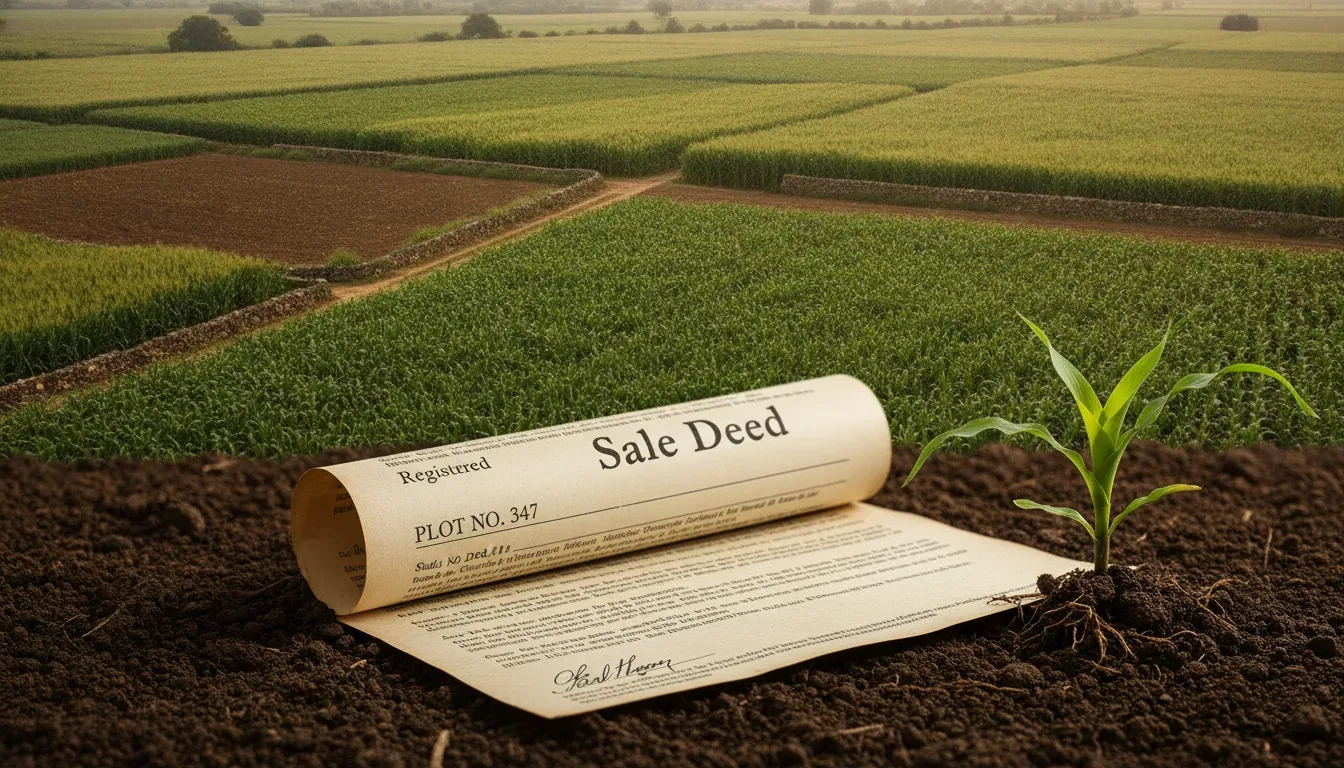
This is where buyers lose leverage. Everyone checks access before paying, but forgets to lock it in writing.
Your agreement should clearly state:
- the nature of access (direct road frontage vs right-of-way),
- the exact access route description,
- the responsibility for keeping access open,
- consequences if access is blocked or found false.
Why Hasiru
When people buy farm plots, most assume the main risk is price or paperwork. In reality, the main risk is ownership becoming stressful—especially when basics like access, maintenance, and on-ground execution aren’t professionally handled.
How Hasiru Farms fits into access road reality:
- Project-led planning: In organized farmland projects, access planning is treated as a core requirement, not an afterthought.
- On-ground oversight: If you’re not visiting every week, access issues can quietly build up (blocked paths, boundary creep, informal route changes). A managed model reduces that risk.
- Operational practicality: Farming needs reliable entry for people, tools, and maintenance—so access isn’t just a “buyer concern,” it’s an operational necessity.
If your goal is to enjoy land ownership without constant firefighting, a managed farmland approach can make the experience more predictable—especially for busy professionals and NRIs.
Conclusion
Access is not a “small detail.” It’s the backbone of your land’s usability and resale value.
Before you buy any farm plot, make sure you can answer these clearly:
- Does the land have direct road frontage—or does it need right-of-way?
- Can you trace the full route from the main road without crossing private land informally?
- Do the documents and ground reality match?
- If ROW is needed, is it defined, permanent, and transferable in writing?
If any part of the access story depends on “trust,” “common understanding,” or “it will be done later,” slow down. The best farm plot is the one you can reach legally, reliably, and confidently—today and ten years from now.
FAQs
1) If I can reach the plot today, isn’t that enough?
Not necessarily. You might be using an informal path that can be blocked later. You need access that is legally defensible and documented when required.
2) What’s the biggest mistake buyers make about access?
Assuming “common usage” equals “legal right.” The second biggest mistake is not writing access commitments into the agreement and sale deed.
3) Is a narrow path okay if I only visit occasionally?
Even occasional use needs legal certainty. Also, future buyers may want vehicle access, and your resale value can drop if access is weak.
4) What if the seller says “we’ll provide the road after you buy”?
Treat it as a risk. Access should be established and verifiable before purchase, not promised later.
5) Can right-of-way be shared with other plot owners?
Yes, but shared ROW should still be clearly defined—route, width, rights, maintenance responsibility, and enforceability should be documented.A “beautiful farm plot” is useless if you can’t reliably reach it.