Introduction
If you are searching “farm plot price near Bangalore” or “buy farm plots near Bangalore,” you will notice a pattern fast.
Most pricing conversations are not really about price.
They are about tradeoffs.
- Do you want to visit monthly or only a few times a year?
- Do you want a managed model or standalone land?
- Do you want a smaller plot closer, or a larger plot farther?
- Do you want basic land, or a community-like experience with shared planning?
This guide helps you answer the most practical question a buyer can ask:
Table of Contents
TLDR: The fastest way to choose the right budget
If you want to buy and actually use your farm plot
- ₹15L usually works when you accept tighter compromises on plot size, distance, or readiness, and you keep your “first-year setup” simple.
- ₹25L is often a practical “balance budget” because you can allocate money not just to the land, but to making it usable.
- ₹50L gives you stronger flexibility on distance, plot readiness, and experience, but it also increases the risk of overpaying for branding or convenience if you skip verification.
The one rule that saves the most regret
Do not plan your budget as “plot price only.” Plan as:
Land cost + registration and stamp costs + due diligence + first-year readiness.
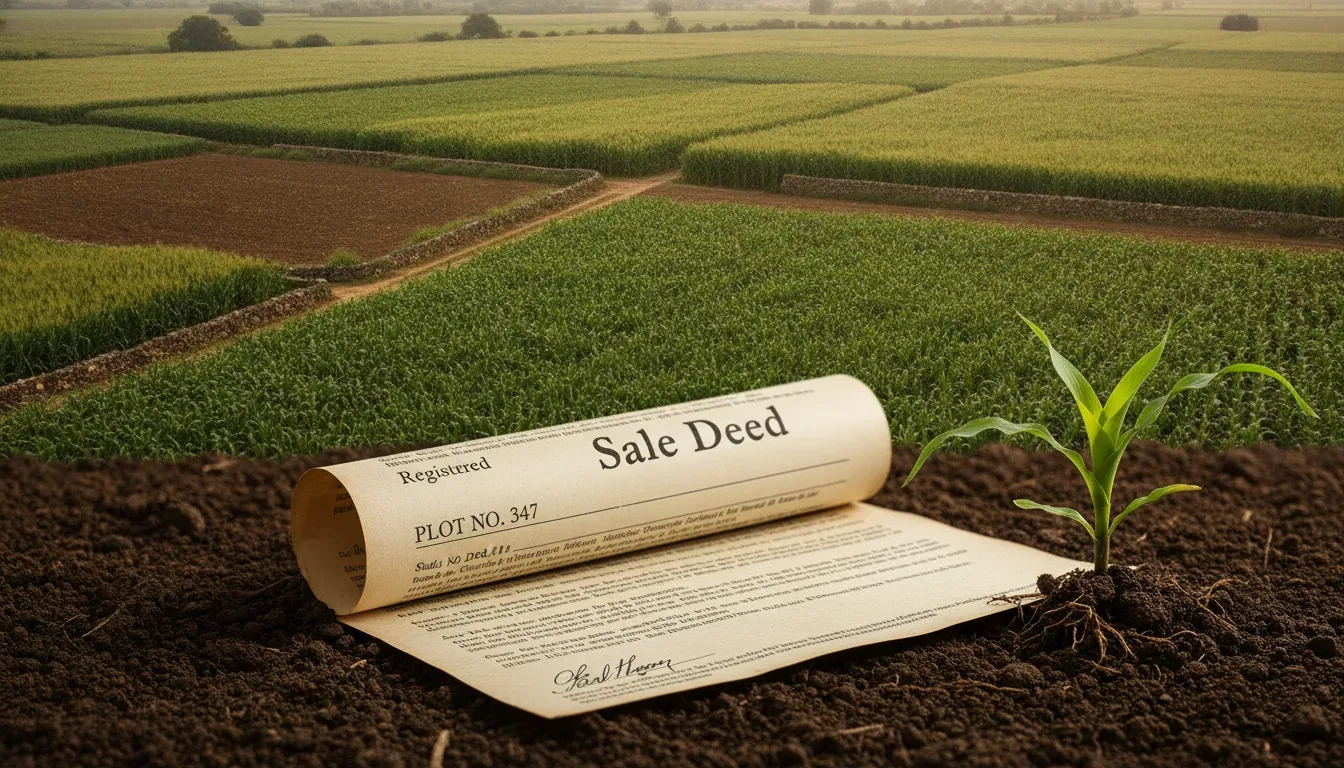
In Karnataka, a conveyance (sale deed) typically involves stamp duty and registration fee components. The Department of Stamps and Registration lists conveyance stamp duty as 5% on market value plus surcharge and additional duty, and registration fee as 2%.
That single detail changes how you should think about every budget tier.
Why “farm plot price” is a misleading phrase
When buyers say “farm plot price,” they often mean one of these three things:
- The price of raw land itself
- The total cash needed to complete the purchase (including registration)
- The total cost to make the plot usable (fence, water planning, basic plantation, upkeep)
Sellers often quote (1). Buyers actually experience (2) and (3).
A price guide that ignores total cost is not a guide. It is a brochure.
So let us fix that first.

Step 1: Plot price vs total ownership cost
A practical breakdown of the full cost stack
A) Acquisition costs
- Land consideration (the negotiated price)
- Stamp duty, surcharge, additional duty (as applicable)
- Registration fee
- EC, copies, documentation expenses (varies)
- Lawyer verification fees (varies)
Karnataka’s Stamps and Registration department publishes the stamp duty and registration fee schedule, which you should treat as a primary reference for cost planning.
B) First-year readiness costs
This is where many budgets silently collapse:
- Fencing and gate basics
- Water planning (even if you do not drill immediately)
- A basic plantation plan that matches your usage model
- Periodic upkeep and security approach
C) Optional lifestyle upgrades
These are nice-to-haves, not must-haves:
- Cottage or stay features (where permitted and verified)
- Premium landscaping
- High-end amenities
If you allocate too much budget here before you have legal and water clarity, you increase regret risk.
Step 2: The 4 levers that decide what you get for ₹15L, ₹25L, ₹50L
Most buyers think budget directly buys plot size. In reality, budget is distributed across these levers:
Lever 1: Distance and drive-time reality
Closer belts usually command higher pricing because you can visit more. Farther belts often give you more land per rupee but reduce visit frequency.
Lever 2: Plot size and layout
A 4,000 to 6,000 sq ft plot behaves very differently from a half acre in terms of upkeep, fencing cost, and how quickly it feels “done.”
Lever 3: Readiness level
“Ready” can include things like internal access planning, clear demarcation, fencing standards, and consistent upkeep. Readiness is not free, and it often shows up as price premium.
Lever 4: Ownership model
Standalone land can be cheaper upfront but costlier in time and coordination.
Managed farmland can cost more upfront but reduce operational burden if the scope is strong and consistently executed.
Your budget tier is basically your choice of which lever you want to prioritize.
Budget Tier 1: ₹15 Lakhs (Entry budget)
Who ₹15L is best for
- First-time farmland buyers who want to start small
- Buyers who are okay with a simpler setup and fewer “done-for-you” elements
- Buyers who will keep the first-year plan minimal and realistic
- Buyers who prefer proof and clarity over aesthetics and hype
What you can realistically expect at ₹15L
At this budget, you are usually making at least one hard compromise:
Common tradeoff patterns
- Smaller plot size closer to Bangalore
- Larger plot size farther from Bangalore
- Raw land with more DIY planning
- Or an entry-level offering where the “extras” are limited
A smart ₹15L buyer focuses on what prevents loss:
- Access clarity
- Boundary clarity
- Documentation clarity
- Summer water plan basics
If any of these are weak, a low price is not a bargain.
What you should not expect at ₹15L (most of the time)
- A fully “resort-like” farm community experience
- High-cost amenities bundled into the ticket size
- A ready-to-enjoy feel without additional spending or effort
- Zero-maintenance ownership
You can still build a great ownership experience at ₹15L. You just need to accept that you are building it step by step.
The best way to win at ₹15L
1) Keep the first-year plan simple
- Fence and boundary clarity first
- A basic water plan that matches lifestyle use
- Minimal plantation that you can maintain consistently
2) Prioritize repeat visits over “more land”
A small plot you visit monthly beats a larger plot you visit once a year.
3) Avoid “cheap deal urgency”
If you feel pressure to pay token immediately, slow down.
Budget Tier 2: ₹25 Lakhs (Balance budget)
Who ₹25L is best for
- IT professionals who want land ownership plus weekend usability
- Families who want a repeatable monthly routine
- Buyers who want enough buffer to make the land feel “usable” after purchase
- Buyers choosing between standalone land and managed farmland models
What you can realistically expect at ₹25L
This is often where buyers can balance:
- plot experience
- readiness
- and a realistic first-year plan
What typically improves in this tier
- Better ability to choose a corridor you will actually revisit
- Better ability to invest in readiness without stress
- A more comfortable fence, gate, and basic plantation plan
- Reduced need to compromise on access and demarcation
How managed farmland can fit at ₹25L
In some managed farmland offerings, part of the readiness and ongoing upkeep model may be bundled, which can improve usability for busy owners. The key is not the label. The key is the scope.
For example, Hasiru Farms’ project pages list plot sizes that many Bangalore buyers consider as “weekend friendly,” such as:
- Raaga: 8,000 sq ft plots, with the project described as 17 acres total land area.
- Prakruthi: 6,000 sq ft plot sizes, 33 acres total land area, and it mentions 5 borewells on the project page.
- Brindavan: 6,000 sq ft plot size and 30 acres total land area.
These references are useful for understanding the kinds of plot sizes commonly positioned for managed weekend usage. Pricing and availability should always be confirmed directly and verified with documentation.
The best way to win at ₹25L
1) Allocate budget for usability, not just ownership
A big reason buyers stop visiting is friction. Reduce friction early:
- access comfort
- clear demarcation
- a simple water and plantation plan
- and upkeep rhythm
2) Test-drive your routine
Do the drive on a normal weekend at the time you would actually leave Bangalore.
3) Be strict about documentation and boundaries
A better plot with unclear boundaries is worse than a simpler plot with clean clarity.
Budget Tier 3: ₹50 Lakhs (Premium flexibility)
Who ₹50L is best for
- Buyers who want stronger flexibility on distance and readiness
- Buyers who want more space and more “finished feel” earlier
- Families planning longer stays and deeper usage
- Buyers considering premium managed farmland experiences or larger standalone parcels
What you can realistically expect at ₹50L
Your biggest advantage here is choice.
What typically improves in this tier
- You can be choosier about access comfort and drive fatigue
- You can prioritize readiness and community standards
- You can invest in a better first-year plan without feeling squeezed
- You can create a more complete “weekend retreat” feel sooner
The biggest ₹50L mistakes (very common)
Mistake 1: Paying for marketing without verifying execution
Premium pricing only makes sense if the on-ground reality matches the story.
Mistake 2: Skipping checks because it “feels reputable”
Legal diligence does not become optional at higher budgets.
Mistake 3: Overbuilding before you understand the land
Do not lock major spending until you have clarity on:
- land category and documentation
- boundaries and access
- water reality in peak summer
The best way to win at ₹50L
1) Price-check like an analyst
Compare comparable parcels on equal variables:
- distance band
- plot size
- access quality
- demarcation clarity
- and readiness
2) Use premium budget to reduce regret, not to increase complexity
A premium budget should buy simplicity and repeatability, not a complicated project to manage.
The non-negotiable cost you must plan for: stamp duty and registration
Most buyers underestimate this and then squeeze their first-year readiness.
For conveyance (sale deed), Karnataka’s Department of Stamps and Registration lists stamp duty as 5% on market value plus surcharge and additional duty, and registration fee as 2%. (Karnataka Government IGR)
A simple way to budget this
- Treat 5% plus 2% as your visible base components.
- Expect the total to be higher once surcharge and additional duty are included.
- Use the official calculator and the current fee schedule before finalizing your negotiation.
If you are comparing ₹15L vs ₹25L vs ₹50L, this matters because:
- At ₹15L, these costs eat a meaningful portion of your budget.
- At ₹25L and ₹50L, the absolute rupee amount becomes bigger and can affect how much you can spend on usability.
Guidance value vs market value: how to sanity-check a quoted price
In Karnataka, “guidelines value” (also called guidance value) is commonly discussed as the minimum benchmark used in registration contexts. The Stamps and Registration department provides resources around guidelines value revisions.
Kaveri online services, run by the Department of Stamps and Registration, is described as enabling citizens to know details of stamp duty and property guidelines value among other services.
What buyers should do with this
- Use guidance value as a baseline reference.
- Do not assume market value equals guidance value.
- Use it to detect obvious anomalies in pricing.
The “apples to apples” rule for comparables
A quoted price is only comparable when these match:
- same distance band and approach road quality
- similar plot size
- similar readiness level (fencing, demarcation, access)
- similar land category and documentation hygiene
- similar water reality in peak summer
If those variables differ, the price difference may be justified, or it may be a trap. Your job is to isolate why the number is different.
What makes a farm plot “expensive” even if the ticket price is low
A cheap ticket price can hide expensive problems.
1) Unclear access or last-mile discomfort
If you cannot bring family comfortably, visits drop.
2) Boundary ambiguity
Boundary disputes and re-demarcation costs are the opposite of peace.
3) Summer water uncertainty
If water is unreliable in April and May, you pay in maintenance stress and lost planting effort.
4) Token pressure without document access
Urgency is often used to bypass verification.
5) Vague land category explanations
If explanations feel foggy, slow down.
A good deal is not cheap. A good deal is clear.

Should you buy smaller and closer, or bigger and farther?
This is the most important lifestyle decision.
Smaller and closer usually wins when
- you want monthly usage
- you have kids or parents who will visit
- you want a low-friction weekend routine
- you do not want ownership to feel like planning
Bigger and farther can win when
- you want deeper nature payoff per visit
- you are okay visiting less often
- you prefer longer stays and fewer trips
- you have an on-ground maintenance plan you trust
Many IT buyers regret bigger-and-farther because they overestimate how often they will travel. If your goal is weekend usage, optimize for repeatability.
A practical buying flow for 2026 buyers (copy-paste checklist)
Step 1: Set your usage model
Weekend lifestyle, orchard establishment, or active farming.
Step 2: Choose your visit frequency
Monthly, quarterly, or occasional.
Step 3: Pick a distance band you will actually sustain
Do not pick based on maps. Pick based on real weekend behavior.
Step 4: Shortlist 3 to 5 options
Include at least one simpler option, not just “perfect” ones.
Step 5: Do a route test drive
At the time you would actually travel.
Step 6: On-site checks
- access and boundary clarity
- neighborhood reality
- basic water logic
Step 7: Document verification
Independent lawyer, independent checks.
Step 8: Budget finalization
Include acquisition plus first-year readiness.
Step 9: Purchase only when the story matches the evidence
If anything feels rushed, pause.
Why Hasiru Farms for budget-aligned, IT-friendly ownership
If your intent is “buy farm plots near Bangalore,” your biggest risk is not only price.
It is buying something you cannot sustain with your schedule.
Hasiru Farms positions itself around theme-based managed farmlands and highlights scale metrics on its site such as 150+ happy customers, 300+ acres completed, 50,000+ trees planted, and 9+ managed farmlands.
If you are comparing what “usable plot sizes” look like in managed communities, Hasiru’s project pages present examples like:
- Raaga with 8,000 sq ft plots and 17 acres total land area.
- Prakruthi with 6,000 sq ft plot sizes and 33 acres total land area.
- Brindavan with a 6,000 sq ft plot size and 30 acres total land area.
- Mango Dew with 6,000 sq ft plot sizes and a mango-orchard concept described on the project page.
The practical benefit for many IT buyers is that a managed model can reduce ongoing effort, which increases repeat visits and reduces neglect risk. As always, verify scope, terms, documents, and suitability for your budget before you decide.
FAQs
1) Can I buy a farm plot near Bangalore within ₹15 lakhs in 2026?
In many cases, yes, but you will usually make one major compromise, such as smaller size, farther distance, lower readiness, or more DIY planning. The smarter approach is to target clarity and usability over “maximum size.”
2) Is ₹25 lakhs enough for a weekend farm plot setup?
Often, ₹25L is where buyers can balance land purchase with first-year readiness like fencing, basic plantation planning, and water planning. The exact fit depends on corridor, plot size, and readiness level.
3) What does ₹50 lakhs change the most?
It increases choice. You can often prioritize better access comfort, stronger readiness, and a more complete weekend experience sooner. The risk is overpaying for branding without verifying execution.
4) What costs should I budget beyond the plot price?
At a minimum: stamp duty and registration, document verification, and basic readiness like fencing and water planning. Karnataka’s fee schedule for conveyance includes stamp duty and registration fee components that buyers should plan for.
5) How are stamp duty and registration charges calculated in Karnataka?
For conveyance, the Stamps and Registration department lists stamp duty as 5% on market value plus surcharge and additional duty, and registration fee as 2%. Always check the latest official calculator and fee schedule for your exact case.
6) What is guidance value and why does it matter for my budget?
Guidance value is used as a benchmark in registration contexts. The department provides guidelines value resources and Kaveri services are described as enabling citizens to know property guidelines value details.
7) Is managed farmland always more expensive than standalone land?
Not always, but managed models may include elements of planning and upkeep that standalone land does not. The right comparison is not “price per square foot.” It is “total cost plus time plus peace of mind,” after verifying scope and terms.