You have probably read that an NRI cannot simply buy agricultural land in India. That part is true. The harder question is whether you can still own or hold managed farmland with an operator like Hasiru while you live abroad, and what you would actually end up with.
TL – DR
An NRI cannot buy agricultural land in India by direct purchase under FEMA. Hasiru’s value is the managed model around whatever route applies: a named, registered document set, a formal maintenance agreement, and title that stays with its holder regardless of what happens to the company. The precise NRI ownership route is being confirmed with the client’s lawyer and is marked pending on this page.
Table of Contents
Can an NRI buy agricultural land in India at all
No. Under FEMA 1999 and the RBI Master Direction on the acquisition and transfer of immovable property, an NRI cannot acquire agricultural land, plantation property or a farmhouse by direct purchase. The routes that do exist are narrow and specific, and general permission is not available.
This page does not re-teach that law. For the full legal picture, read our full guide on NRI agricultural land ownership in India [link: /blogs/nri-buying-agricultural-land-india-2026].
What Hasiru can speak to plainly is the model that sits around whatever route applies to you, which is where the rest of this page focuses.
So how does the Hasiru managed model work for someone living abroad
The model separates two jobs that an NRI usually has to handle alone: acquiring the farmland and running it. Hasiru runs the second job end to end, which is the part that matters most when you are not in the country. The acquisition route for an NRI specifically is the piece still being confirmed, and it is marked below.
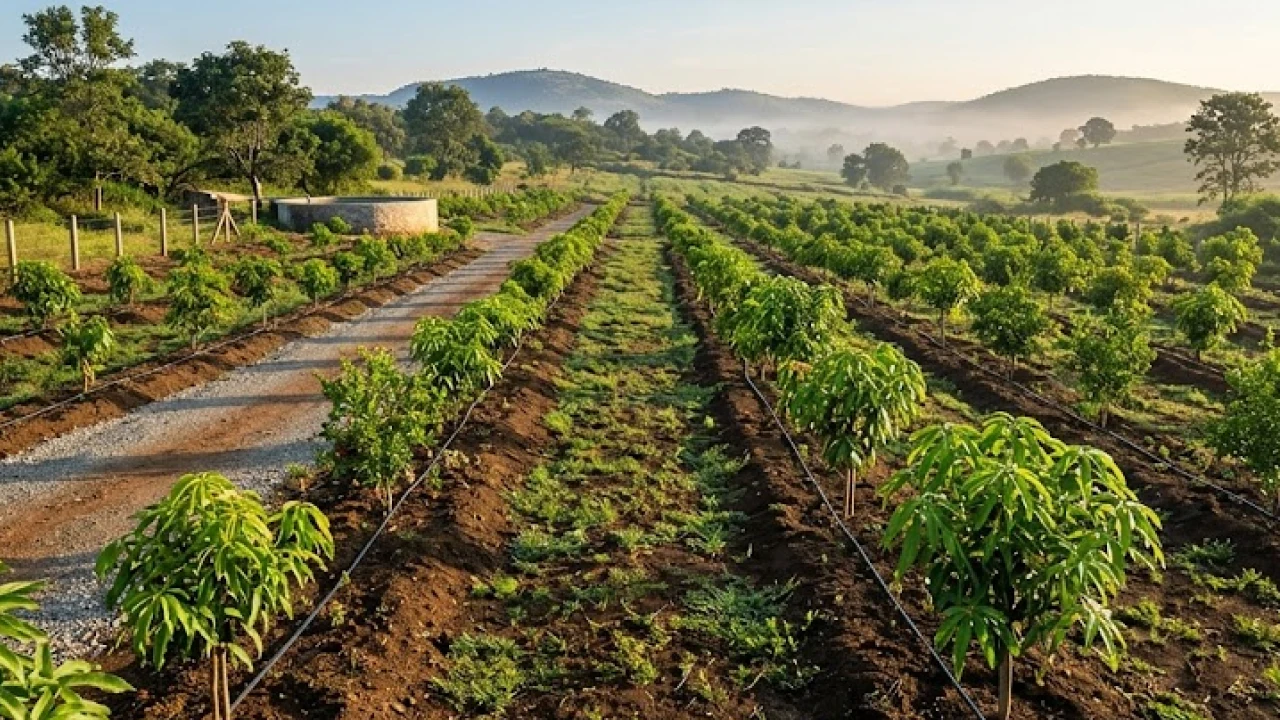
What is not in question is how Hasiru manages the land. Every Hasiru project is theme-based managed farmland: built around a distinct lived theme rather than a generic plot with a shared clubhouse, and managed for life after the sale. That managed-for-life commitment is the reason the model suits an owner who lives abroad.
Where a registration requires an owner who cannot attend in person, Hasiru supports it through a General Power of Attorney. The mechanics of GPA-based registration for NRIs are covered in our NRI GPA registration guide [link: /blogs/nri-gpa-for-registration-india].
Owners receive updates on their farmland, and a new owner dashboard is in progress.
If you want to see the managed model on the ground rather than on a page, book a site visit and meet existing owners [link: /visit-a-hasiru-project], or explore Hasiru’s live projects [link: /projects].
What would I actually hold, in whose name, and on what documents
You would hold individual, registered ownership evidenced by a specific set of Karnataka land documents, not a share in a pool and not a certificate. The document set is fixed and named. The name in which an NRI holds that title is the one part still being confirmed legally.
Most operators describe managed farmland in generalities. The document set above is the specific, checkable answer to what you actually hold, and naming it is the point.
For a document-by-document walkthrough, see exactly what you own when you buy Hasiru farmland [link: /what-you-own-when-you-buy-hasiru-farmland].
Holding the documents is one half of the answer. The other half is who keeps the land in good order once you are back overseas.
Who looks after the land while I am overseas, and what if Hasiru disappears
Hasiru looks after it under a formal management and maintenance agreement, and because ownership is by individual registered title rather than a claim on the company, the parcel stays with its title-holder regardless of what happens to Hasiru.
The management and maintenance agreement is a written agreement between Hasiru and the owner covering the management and upkeep of the farmland. It is the answer to the two questions that stop most overseas buyers signing: who does the work on my plot, and what are the ongoing costs. Both sit in the agreement rather than in an informal promise.
Continuity does not depend on Hasiru continuing to exist. Because the title is registered and independent of the company, the land is the owner’s whether or not the company is. That is the honest answer to the question overseas buyers ask most: what happens to my land if you disappear while I am not here.
For exit, owners are free to sell or transfer. Hasiru follows a Right of First Refusal: if an owner wishes to sell, Hasiru gets the first opportunity to buy; if Hasiru declines, the owner may sell to a third party, with the transfer carried out through Hasiru on agreed terms.
This is easiest to verify in person. Book a site visit and meet existing owners [link: /visit-a-hasiru-project] before you decide.
Can I see this before I commit
Yes. The site visit is Hasiru’s primary way of proving the model. You can walk a delivered project and meet people who already own there before you commit to anything.
Frequently asked questions
Is managed farmland worth it for an NRI?
It depends on what you want from it. If you want a real, managed, theme-based place that is looked after for you while you live abroad, the model fits. If you want a short-term financial play, it is not built for that, and Hasiru does not sell it as one.
Does Hasiru promise any return on managed farmland?
No. Hasiru does not lead with speculative returns, and does not promise yield, appreciation or passive income. The proposition is ownership of a real, managed place, described by what it is rather than by a projected number.
What if I can rarely visit my farmland?
The model is built for exactly that. Management and upkeep run under the maintenance agreement whether or not you visit, and updates come to you. Rare visits do not leave the land unattended.
Can an NRI inherit agricultural land in India?
Whether and how an NRI can inherit agricultural land, and how that differs from buying it, is a specific legal question. We cover the position in our NRI inheritance guide [link: /blogs/nri-inherit-agricultural-land-india].
Can an NRI sell agricultural land in India?
Whether an NRI can sell agricultural land, and on what conditions, is a legal question rather than a Hasiru policy. It is addressed in our full guide on NRI agricultural land ownership in India [link: /blogs/nri-buying-agricultural-land-india-2026].
Managed farmland for an NRI, in short
An NRI cannot buy agricultural land in India by direct purchase under FEMA, and that part is settled. What Hasiru’s managed farmland model offers is everything that sits around whatever route applies to you: individual, registered title in a named Karnataka document set, a formal management and maintenance agreement, and land that stays with its title-holder regardless of what happens to the company. The one piece still being confirmed is the exact ownership route for an NRI, which is marked pending on this page and is being settled with the client’s lawyer.
If you want a real, theme-based place that is looked after for you while you live abroad, rather than a short-term financial play, the model is built for that, and Hasiru does not sell it as anything else. The surest way to judge it is on the ground. Book a site visit, walk a delivered project, and meet people who already own there before you commit to anything.